


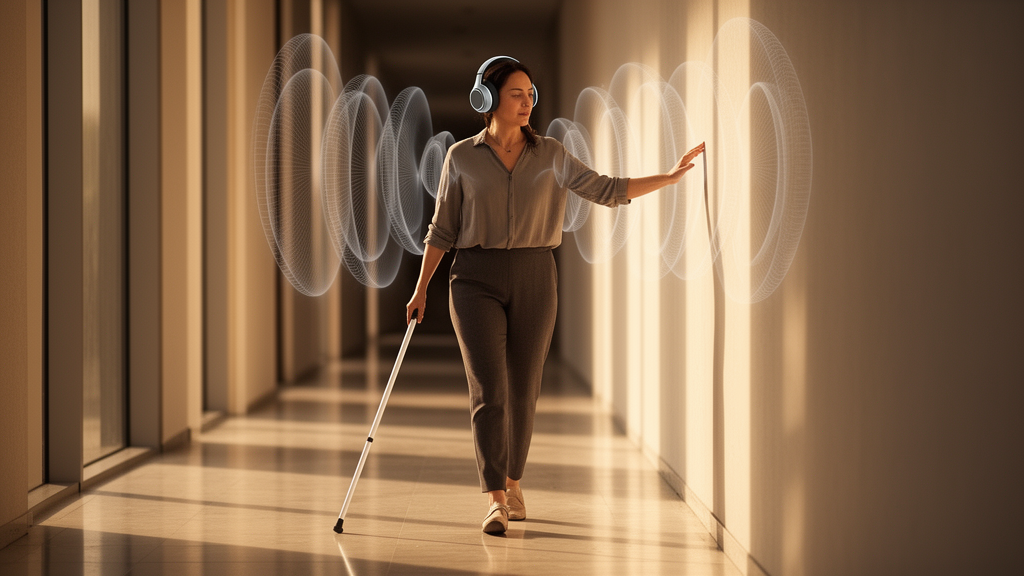
For millions of people living with blindness or low vision, the world of space and distance must be built from sound, touch, and movement rather than sight. The review, published in Frontiers in Psychology, pulled together every peer-reviewed intervention study it could find on audio-motor and related audio-spatial training, and what emerged was a field brimming with creative technology but running on surprisingly thin evidence. The numbers tell the story of a research area that is vibrant in imagination but tiny in scale.
Of those, 126 had visual impairment, ranging from congenital blindness to retinal disease with central scotoma, while 25 were sighted people serving only as comparison groups. Six studies came from Italy, with the rest from the United States, China, and Romania. Participants spanned ages three to 85, from toddlers just learning to map their bodies to older adults navigating life after vision loss.
What makes this review genuinely useful is the way it dissects a field that has often blurred its own categories. The authors drew a sharp line between four fundamentally different kinds of intervention. Movement-contingent audio-motor training, exemplified by the Audio Bracelet for Blind Interaction, or ABBI, ties sounds directly to the wearer's own movements, so every arm swing or step produces an audible consequence.
Active audio-spatial and game-based training, typified by the Audio-based Environment Simulator, or AbES, lets users explore virtual buildings through sound alone. Audiovisual motor training couples action with both sound and sight, while camera-based sensory-substitution systems translate visual information from the environment into auditory cues. Each mechanism is distinct, and the review insists they should be evaluated as such rather than lumped together under vague claims of "spatial improvement."
The most striking findings came from the ABBI trials with children. In one Italian study, seven visually impaired children aged roughly three to five wore the bracelet for one hour a week over three months. The two blind children showed significantly reduced errors in both static and dynamic auditory localization, with p-values below 0.01, while the five children with low vision showed no clear improvement at all.
A larger non-randomized controlled study followed 44 visually impaired children aged six to seventeen over twelve weeks, combining 45 minutes of weekly supervised practice with about five hours of home practice, totaling roughly 69 hours. The ABBI group outperformed children receiving classical rehabilitation on auditory localization, with an effect size of d = 1.45, as well as on auditory bisection, auditory reaching, proprioceptive reaching, and mobility. Notably, auditory distance judgment did not improve, and the one-year follow-up covered only ten of the trained children.
Navigation studies painted an equally nuanced picture. In a randomized comparison of seventeen early-blind adults learning a virtual building through AbES, participants who explored freely as gamers and those who followed directed navigation lessons ended up nearly identical on direct-route success, at 87.5 percent versus 88.57 percent. But the gamers were markedly better at choosing the shortest exit in a drop-off task, scoring 2.50 versus 1.25 points, a difference the authors reported as highly significant.
A separate pilot study of seven early-blind adolescents found that after an hour of AbES game play, participants succeeded on 97.14 percent of exit-route trials in a real building, and game scores correlated strongly with real-world route performance. Perhaps the most intriguing physiological finding concerns how training reshapes auditory space itself. In a study of sixteen adults, nine of them early-blind, just ten minutes of audio-motor training delivered in four short blocks significantly reduced errors in auditory reaching and in matching the position of joints, with the blind subgroup showing particularly strong gains.
Yet in a small study of six adults with long-term late blindness, three trained and three untrained, four weeks of practice improved vertical sound localization and proprioceptive matching but left horizontal localization completely unchanged. The review reads this pattern as evidence of domain-specific recalibration: the auditory spatial system may be retuned along particular dimensions rather than uniformly upgraded, a subtlety that broad claims of "better spatial skills" would completely miss. At the technological frontier, a Chinese usability study compared four feedback strategies in a desktop targeting task using a system called StereoPilot.
For the three visually impaired participants, spatial-audio rendering produced an information-transfer rate nearly three times higher than voice or vibrotactile feedback, with positioning errors 28 percent lower than voice, 39 percent lower than vibration, and 46 percent lower than non-speech audio. The Romanian contribution tested a two-day audio-game protocol in ten adults with residual vision between zero and fifteen percent, finding that correct travel decisions rose from 74.3 to 82.1 percent, though completion time improvements fell short of statistical significance. A single-case feasibility study even documented a child with hemianopia, nystagmus, and hemiplegia improving on visual-search and hand-function measures after two weeks of ABBI training, with gains largely maintained at one year, though one child can never establish generalizability.
Here is where the viral promise collides with scientific reality. The review's risk-of-bias assessment is blunt: of the eight non-randomized studies, seven were judged to carry serious risk of bias and one, the single-case study, critical risk, driven by absent or non-equivalent control groups, tiny samples, confounding, practice effects, and selective reporting. Even the two randomized trials earned only "some concerns" judgments rather than clean bills of health, because allocation concealment, assessor blinding, and analysis plans were incompletely described.
The authors also deliberately removed a previously common shortcut, counting statistically significant trials as an "effectiveness rate," noting that vote counting by significance can be badly misleading. Instead, they followed the Synthesis Without Meta-analysis framework, presenting controlled between-group evidence before uncontrolled pre-post changes and refusing to infer effect sizes where the underlying data did not support them. The certainty of evidence was rated low or very low across every outcome domain, and the review is explicit about what that means.
Preliminary findings suggest that selected interventions may improve specific tasks, auditory localization, reaching, proprioceptive matching, and virtual or real-world navigation, in some visually impaired populations. But nothing in the evidence establishes clinical effectiveness, an optimal training dose, long-term benefit, or any protective effect against developmental delay. The authors also stress a distinction the field often ignores: a statistically significant change within a trained group paired with no change in a control group is not the same as a significant difference between groups.
Early intervention remains a theoretically motivated priority, not a confirmed recommendation, because no included study directly compared early with later training. The supplementary search through mid-2026 revealed a field accelerating rapidly, with new peer-reviewed systems combining spatial audio with wearable computer vision and haptic feedback, and emerging preprints describing mixed-reality navigation and geometry-aware generative spatial audio. The review's real contribution is conceptual: it gives researchers a clean taxonomy of mechanisms and outcomes, and a clear roadmap.
Future trials need adequate power, active comparators, prospectively registered protocols, standardized patient-relevant measures, complete effect-size reporting, and follow-up long enough to test whether laboratory gains survive in daily life.
Subject of Research: Audio-motor and audio-spatial interventions for spatial function in visually impaired people
Article Title: Audio-motor and related audio-spatial interventions for spatial function in people with visual impairment: a systematic review
Article References: Hu, J., Yu, Q., Zou, M., Ma, S., & Zhu, D. (2026). Audio-motor and related audio-spatial interventions for spatial function in people with visual impairment: a systematic review. Frontiers in Psychology, 17, Article 1927485. https://doi.org/10.3389/fpsyg.2026.1927485
Image Credits: AI Generated
DOI: 10.3389/fpsyg.2026.1927485
Keywords: systematic review, visual impairment, audio-motor training, auditory localization, sensory substitution, ABBI, navigation, spatial cognition, proprioception, rehabilitation, spatial audio, evidence certainty
Cite Scienmag News
Glenn Wilkins. (October 27, 2026). Sound That Moves You: What a Decade of Audio Training Studies Really Shows for Blind and Low-Vision Spatial Skills. Scienmag. https://scienmag.com/sound-that-moves-you-what-a-decade-of-audio-training-studies-really-shows-for-blind-and-low-vision-spatial-skills/
Glenn Wilkins. "Sound That Moves You: What a Decade of Audio Training Studies Really Shows for Blind and Low-Vision Spatial Skills." Scienmag, 27 October 2026, https://scienmag.com/sound-that-moves-you-what-a-decade-of-audio-training-studies-really-shows-for-blind-and-low-vision-spatial-skills/. Accessed 27 October 2026.
Glenn Wilkins. "Sound That Moves You: What a Decade of Audio Training Studies Really Shows for Blind and Low-Vision Spatial Skills." Scienmag. October 27, 2026. https://scienmag.com/sound-that-moves-you-what-a-decade-of-audio-training-studies-really-shows-for-blind-and-low-vision-spatial-skills/


