


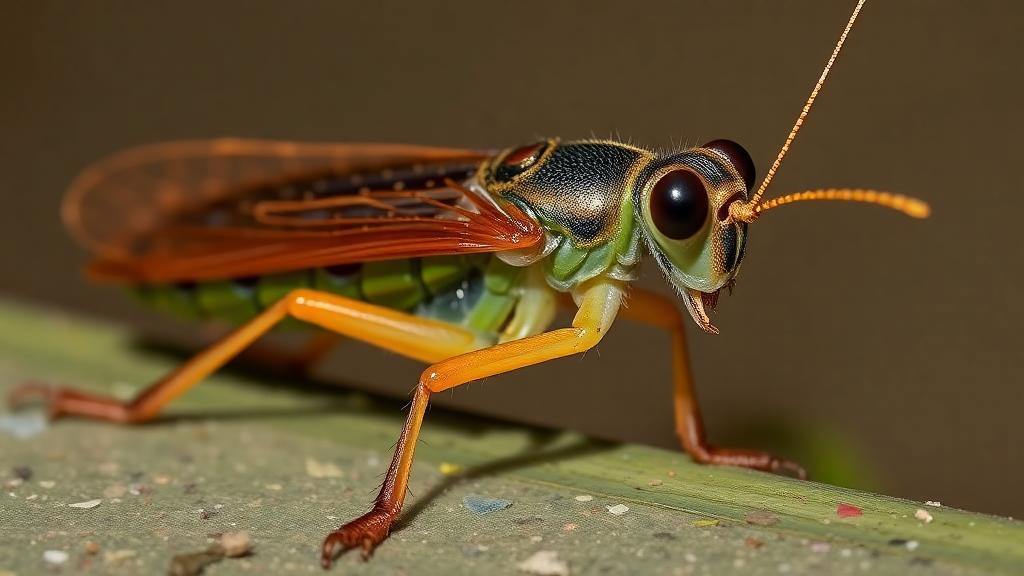
Populations of flightless round-winged katydids once classified as Amblycorypha bartrami have been recognized as three new species after a study compared their calling songs, body structures and DNA across the southeastern United States. Researchers formally described Amblycorypha carolina, A. peedee and A. tallapoosa, finding that populations differing in song structure and morphology also showed genetic divergence in a multi-locus analysis. The study sampled purported A. bartrami in Alabama, Florida, Georgia, North Carolina and South Carolina, alongside A. parvipennis populations from Arkansas and Missouri for comparison.
The round-winged katydids belong to the rotundifolia species group of Amblycorypha, whose members are flightless, medium-sized and difficult to distinguish by external appearance alone. They live in longleaf pine and turkey oak sandhills across the Southeast and typically move only about 10–15 metres per day. Earlier research had identified song differences among populations assigned to A. bartrami, including anomalous calls in South Carolina and North Carolina, but the broader investigation combined recordings, standardized measurements of preserved specimens and DNA sequences to assess whether those differences corresponded to separate evolutionary lineages.
Most fieldwork was conducted at night. Researchers located males by listening for their calls and searching vegetation with headlights, while some females and males were collected during the day with sweep nets. Calling songs of free-ranging or caged males were recorded using shotgun microphones and digital recorders at sampling rates of 44 or 48 kilohertz.
For laboratory recordings, microphones were placed 0.5 metres from the males, with foam placed between the animals and the microphones to reduce echoes and background noise. Because katydid syllable rates vary with temperature, researchers measured rates during the sustained portion of each call and related those measurements to temperature. The temperature relationships distinguished at least four song types among the sampled populations.
Males from northern Georgia and northern Alabama had the fastest rates, approximately 13.1 syllables per second at 25°C, corresponding to the newly described A. tallapoosa. Florida populations produced intermediate rates of about 10.0 syllables per second at the same temperature and retained the name A. bartrami. Males from western Alabama also sang at rates similar to those in Florida.
South Carolina populations had the slowest rates, approximately 5.8 syllables per second at 25°C, and were assigned to A. carolina. North Carolina males produced a distinctive paired pattern: the rate within syllable doublets was about 11.6 syllables per second at 25°C, while the rate between doublets was approximately 4.0 syllables per second. Call structure provided additional distinctions.
Florida A. bartrami males generally began a song with several shorter series of roughly five or six syllables before producing a sustained main section that averaged 107±22 syllables. The main series of A. carolina contained about 25 syllables, while A. peedee usually had about 17 and A. tallapoosa about 8. North Carolina males almost always arranged their syllables in doublets: of 517 syllables recorded in 30 main series from eight males, 482 belonged to doublets, eight were single syllables and nine occurred as triplets.
Spectrally, the calls were broadband, with most energy between 10 and 15 kilohertz, but cluster and principal-coordinate analyses detected significant population-level differences over both 30-second calls and individual syllables. Morphological measurements supported some of the divisions, although samples were uneven and several female characters did not differ significantly. Males assigned to A. tallapoosa were generally the smallest: their mean pronotal length was 5.08±0.14 millimetres, tegminal length 25.4±0.70 millimetres, hind-femur length 23.3±0.11 millimetres and hind-tibia length 25.1±0.20 millimetres.
A. carolina females had a mean pronotal length of 6.60±0.07 millimetres, compared with 5.99±0.23 millimetres for the Georgia and northern Alabama group. South Carolina A. carolina males had longer tegmina and greater hindwing exposure than A. parvipennis males, with respective means of 26.2±0.44 versus 23.8±0.47 millimetres for tegminal length and 2.74±0.17 versus 0.89±0.34 millimetres for hindwing exposure. The genetic analysis used mitochondrial cytochrome c oxidase subunit I, a roughly 3,700-base-pair ribosomal region containing ITS1, ITS2 and 5.8S, and the nuclear genes wingless and tubulin-alpha I.
Histone 3 showed no variation among the samples and was excluded from subsequent analyses. Bayesian multi-locus coalescent analyses indicated divergence among the sampled populations. The mitochondrial and ribosomal gene trees generally resembled the population tree, whereas the tubulin-alpha I tree differed substantially; the species-tree topology was unchanged when tubulin sequences were omitted.
Genetic relationships did not always coincide perfectly with broad song identity. Within South Carolina, the Georgetown County population grouped more closely with the North Carolina population in the geographic analysis, while the Aiken and Edgefield populations were genetically distinct from one another despite having the same general South Carolina song type. The authors say that additional sampling is needed to explain this variation.
More broadly, they propose that the flightless katydids’ limited movement, major river drainages and the fragmentation of longleaf pine habitat have reduced gene flow, allowing genetic divergence and song differentiation among populations. That explanation remains a hypothesis to be tested with broader geographic sampling rather than a directly measured effect of any particular river or habitat change. The three names also reflect the geographic structure recognized in the study.
A. carolina was named for South Carolina populations between the Savannah and Pee Dee rivers, A. peedee for populations north of the Pee Dee River in North Carolina, and A. tallapoosa for the area bounded by the Coosa and Tallapoosa rivers in Alabama. The researchers identified specific questions for future work: sampling both sides of the Pee Dee, Savannah, Coosa and Tallapoosa rivers could clarify the degree of isolation, while additional South Carolina populations could test why A. carolina displays marked genetic differentiation among sites. Their results nevertheless show that calling-song differences can reveal biodiversity overlooked by morphology alone, and that geographic, acoustic and genetic patterns together provide the basis for recognizing three new species in a previously uniform-looking katydid complex.
Subject of Research: Taxonomic and phylogeographic analysis of cryptic round-winged katydid species in the southeastern United States
Article Title: Geographic variation in the calling songs and genetics of Bartram’s round-winged katydid Amblycorypha bartrami ( Tettigoniidae , Phaneropterinae ) reveal new species
Article References: Forrest, T. G., Scobie, M., Brueckner, O., Bintz, B., & Spooner, J. D. (2023). Geographic variation in the calling songs and genetics of Bartram’s round-winged katydid Amblycorypha bartrami (Tettigoniidae, Phaneropterinae) reveal new species. Journal of Orthoptera Research, 32(2), 153-170. https://doi.org/10.3897/jor.32.96295
Image Credits: AI Generated
DOI: 10.3897/jor.32.96295
Keywords: cryptic species, calling songs, katydids, Amblycorypha, bioacoustics, phylogeography, coalescent analysis, flightless insects, southeastern United States, longleaf pine sandhills, Geographic, variation
Cite Scienmag News
Juliet Wilcox. (October 20, 2026). Song and genetic differences reveal three new flightless katydid species. Scienmag. https://scienmag.com/song-and-genetic-differences-reveal-three-new-flightless-katydid-species/
Juliet Wilcox. "Song and genetic differences reveal three new flightless katydid species." Scienmag, 20 October 2026, https://scienmag.com/song-and-genetic-differences-reveal-three-new-flightless-katydid-species/. Accessed 20 October 2026.
Juliet Wilcox. "Song and genetic differences reveal three new flightless katydid species." Scienmag. October 20, 2026. https://scienmag.com/song-and-genetic-differences-reveal-three-new-flightless-katydid-species/


