


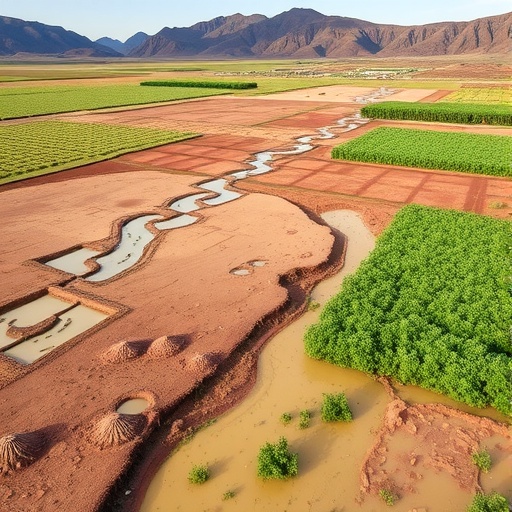
In a groundbreaking study, researchers have revealed significant insights into the spatiotemporal dynamics of soil moisture within a watershed located on the Loess Plateau. This area, renowned for its unique geological features, has become a focal point for understanding the environmental changes that accompany vegetation restoration. The diligent efforts of scientists led by Wang, Zhu, and Yu have unveiled how soil moisture variations correlate with the recovery of vegetation, a key component in combating desertification and improving ecological resilience across arid and semi-arid landscapes.
The Loess Plateau, a vast region characterized by its loess soil—silt-sized sediment accumulated through aeolian processes—is historically susceptible to erosion and degradation. The region has faced considerable environmental challenges, notably soil erosion and reduced agricultural productivity, largely triggered by overgrazing and deforestation. In recent years, large-scale vegetation restoration projects have been initiated to rehabilitate the landscape and restore the ecological balance. By analyzing soil moisture dynamics, the researchers aimed to shed light on the effectiveness of these restoration efforts.
Soil moisture is a critical determinant of both local and regional hydrological cycles, serving as a crucial buffer for moisture availability to plants. It influences the growth patterns and health of vegetation, playing an integral role in ecosystem stability. The researchers’ examination of soil moisture fluctuations allowed them to understand how moisture retention improves in areas where vegetation is restored, and how this, in turn, fosters a more robust agro-ecosystem.
Using sophisticated modeling techniques and extensive field measurements, the team assessed soil moisture levels at different depths across various locations within the watershed. Their findings revealed that as vegetation cover increased, soil moisture content experienced a notable improvement. This correlation demonstrates the positive feedback loop established between vegetation restoration and soil moisture retention, underscoring nature’s resilience.
The study’s spatiotemporal analysis revealed that soil moisture levels are significantly influenced by seasonal variations, with pronounced differences observed between dry and wet seasons. During the rainy season, restored vegetated areas exhibited enhanced moisture retention compared to barren lands, highlighting the effectiveness of vegetation in capturing and conserving precipitation. Conversely, during dry spells, moisture levels tended to drop more sharply in areas lacking vegetation, suggesting that restoration efforts could mitigate the impacts of drought.
Furthermore, the researchers noted that deeper soil layers, enriched by organic matter from the restored vegetation, exhibited increased moisture retention capabilities. This finding is particularly important as it illustrates the long-term benefits of vegetation restoration—not only does it enhance surface moisture but also bolsters deeper soil layers, securing water resources for extended periods. Such dynamics could prove invaluable in areas where water scarcity is prevalent.
The implications of these findings extend beyond the Loess Plateau, offering crucial insights for similar arid and semi-arid regions worldwide. As climate change continues to exert pressure on global ecosystems, understanding how vegetation restoration affects vital soil parameters like moisture will be essential for informed land management strategies. This research provides compelling evidence that investing in ecological restoration can yield dividends for soil health and long-term agricultural sustainability.
Importantly, the study contributes to the discourse on climate adaptation strategies. With rising temperatures and changing precipitation patterns, regions vulnerable to desertification must adopt proactive measures to bolster ecosystem resilience. By prioritizing vegetation restoration efforts, policymakers can create a buffer against climatic extremes, ultimately contributing to food security and sustainable livelihoods for local communities.
One of the major aspects of the research also involves the use of remote sensing technologies to monitor soil moisture changes over time. This innovative approach allows for large-scale assessments, enabling scientists to track the effectiveness of restoration strategies in real-time. These technological advancements could revolutionize how we manage and restore degraded landscapes, providing precise data that informs scientific and environmental policy decisions.
Moreover, the study reinforces the interconnectedness of ecological processes—whereby the restoration of a single component, such as vegetation, activates a chain reaction that influences multiple facets of the environment. As soils become healthier, they enhance biodiversity, which in turn supports a myriad of ecological functions within the watershed. This holistic perspective is crucial when considering conservation actions and the restoration of degraded lands.
In conclusion, Wang and colleagues’ research shines a spotlight on the vital role of soil moisture dynamics in vegetation restoration efforts on the Loess Plateau. Their findings not only document the immediate benefits of increased moisture retention but also highlight the enduring impacts of such ecological initiatives. As the world grapples with climate uncertainty and environmental degradation, studies like this serve as vital guides, showcasing the significance of embracing nature-based solutions to foster resilient ecosystems.
The future of our planet ultimately hinges on our ability to restore and rehabilitate damaged landscapes. This research establishes a compelling foundation for continued exploration into the intricate links between soil health, vegetation restoration, and resilience against climate variability. It encourages individuals, communities, and nations to view restoration efforts not as isolated projects but as interconnected components of a much larger environmental tapestry—one that we must collectively protect and nurture.
As more researchers delve into the intricate dynamics outlined by Wang et al., we hope to unlock further secrets of ecological recovery and sustainability. The path forward will require robust collaboration among scientists, policymakers, and local communities, all dedicated to restoring the planet’s health and securing a sustainable future for generations to come.
Wang, Z., Yu, Y., Zhu, H. et al. Spatiotemporal dynamics of soil moisture in a watershed in the Loess Plateau during vegetation restoration.
Environ Monit Assess 197, 1267 (2025). https://doi.org/10.1007/s10661-025-14728-6
Cite Scienmag News
Violet Maxwell. (October 29, 2025). Soil Moisture Dynamics in Loess Plateau Restoration. Scienmag. https://scienmag.com/soil-moisture-dynamics-in-loess-plateau-restoration/
Violet Maxwell. "Soil Moisture Dynamics in Loess Plateau Restoration." Scienmag, 29 October 2025, https://scienmag.com/soil-moisture-dynamics-in-loess-plateau-restoration/. Accessed 4 September 2026.
Violet Maxwell. "Soil Moisture Dynamics in Loess Plateau Restoration." Scienmag. October 29, 2025. https://scienmag.com/soil-moisture-dynamics-in-loess-plateau-restoration/


