

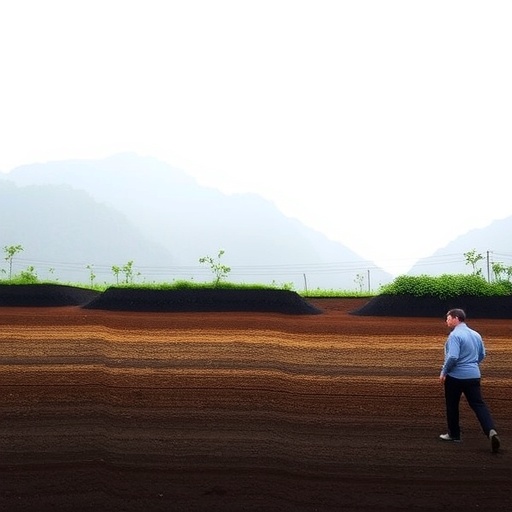
In the realm of environmental sciences, understanding the intricate dynamics of soil moisture is pivotal for sustainable land management, especially in regions undergoing anthropogenic disturbances. A groundbreaking study emerging from Northwest China has shed new light on this subject by investigating soil moisture cycling within fissure-filled soils of the Shendong mining subsidence area. This innovative research not only deepens scientific comprehension of soil hydrology in disturbed mining environments but also offers crucial insights for ecological restoration and water resource management.
Mining subsidence, a common consequence of extensive coal extraction in the Shendong region, causes significant ground deformation leading to the formation of fissures and cracks. These geomorphological changes alter the natural soil structure, posing substantial challenges in predicting soil moisture behavior. Traditionally, soil moisture dynamics are governed by the interaction between precipitation, soil texture, vegetation cover, and topography. However, the superimposition of subsidence-related fissures introduces complex vertical and lateral pathways for water movement, profoundly affecting moisture retention and redistribution.
The research team led by Wang, Peng, and He deployed an array of field measurements and advanced modeling techniques to unravel the moisture cycling mechanisms in these fissure-laden soils. By integrating soil moisture sensors, hydrological modeling, and remote sensing data, they captured detailed temporal and spatial variations of moisture content. What stands out in their approach is the meticulous quantification of water fluxes within fissured soil matrices, which had remained elusive in previous studies focused mostly on intact soil systems.
Their analysis revealed a dynamic interplay between fissure morphology and soil hydraulic properties. Fissures create preferential flow channels that accelerate infiltration during rainfall events but also amplify evaporation rates during dry periods. This dual role complicates water availability for vegetation and microbial communities, which depend on soil moisture stability. Intriguingly, the researchers observed that the depth and connectivity of fissures control the balance between vertical percolation and lateral redistribution, dictating localized drought or saturation zones.
Moreover, the study highlights the critical influence of mining-induced fissures on seasonal moisture cycling. During wetter months, enhanced infiltration through fissures leads to increased groundwater recharge, potentially mitigating surface runoff and erosion risks. Conversely, in dry seasons, the exposed fissure surfaces facilitate rapid moisture loss to the atmosphere, exacerbating soil desiccation and stress on plant roots. Such seasonal oscillations underscore the complicated hydrological feedback loops inherent in disturbed mining landscapes.
A significant technical advancement in this research is the development of a validated hydrological model tailored to fissure-filled soils. Unlike conventional models that assume homogenous soil properties, this novel framework incorporates fissure geometry and connectivity as dynamic parameters. The model robustly simulates soil moisture variations under diverse climatic scenarios, providing a predictive tool that can be instrumental for environmental engineers and policymakers engaged in reclamation and land-use planning.
The implications of these findings extend beyond the Shendong mining subsidence area. Globally, mining activities and other forms of subsidence are reshaping soil landscapes, altering hydrological cycles and ecosystem functions. This study offers a paradigm to assess and manage these transformations by recognizing the critical role of fissure-induced hydrological heterogeneity. Consequently, it advocates for integrating fissure characterization into soil and water conservation strategies, which could significantly enhance the resilience of degraded environments.
Furthermore, the research underscores the importance of balancing mining development with ecological sustainability. By elucidating the moisture dynamics in fissure-affected soils, it equips stakeholders with the knowledge to design targeted interventions such as controlled water supplementation, vegetation restoration adapted to moisture fluctuations, and fissure sealing when necessary. These measures could mitigate the adverse impacts of mining subsidence, fostering a more harmonious coexistence between industrial activities and natural ecosystems.
The study’s in-depth exploration also serves as a wake-up call regarding the long-term hydrological consequences of unchecked subsidence. Persistent fissure expansion and deepening might progressively degrade soil profiles, leading to reduced infiltration capacity and compromised groundwater recharge over extended timescales. Such degradation has far-reaching ramifications for regional water security, agricultural productivity, and biodiversity conservation, particularly in semi-arid regions like Northwest China.
Additionally, the interdisciplinary methodology employed by the researchers exemplifies how integrating geotechnical, hydrological, and ecological perspectives is essential to unraveling complex environmental phenomena. Their use of cutting-edge sensor technologies combined with spatially explicit modeling frameworks paves the way for future research initiatives aimed at other anthropogenically altered landscapes. This holistic vision is crucial for fostering innovation in environmental monitoring and remediation efforts worldwide.
An aspect worth highlighting is the role of climatic variability in modulating soil moisture responses within fissure-filled soils. The study’s temporal data series captures the influence of episodic heavy rainfall and protracted droughts, drawing attention to the vulnerability of subsidence zones under changing climate regimes. This nexus between climate change and mining-induced soil alteration represents a critical area for continued investigation, bearing consequences for adaptive resource management.
The authors also emphasize that while their work advances fundamental knowledge, challenges remain in scaling findings to broader geographic extents. Variations in lithology, mining methods, and land-use histories necessitate site-specific investigations to tailor hydrological models effectively. Nonetheless, their framework provides a transferable baseline for such studies, encouraging comparative analyses across mining regions with distinct environmental contexts.
From a socio-economic perspective, understanding soil moisture cycling in fissure-affected zones is vital to safeguarding local communities’ livelihoods. Water availability directly impacts agriculture, forestry, and ecosystem services, which in turn underpin regional economies. The insights gained from this study contribute to developing sustainable land management policies that reconcile resource extraction with environmental stewardship, thereby promoting long-term social welfare.
The comprehensive nature of this research, published in Environmental Earth Sciences, marks a major stride in environmental geosciences. The fusion of empirical evidence with theoretical modeling offers a nuanced depiction of how human activities transform fundamental soil-water interactions. As mining activities continue worldwide, such knowledge is indispensable for mitigating environmental degradation and enhancing ecosystem resilience.
In conclusion, the pioneering investigation into soil moisture cycling within fissure-filled soils of the Shendong mining subsidence area illuminates the complex hydrological realities produced by mining-induced ground deformations. Through rigorous fieldwork and innovative modeling, this research advances both scientific understanding and practical frameworks for managing disturbed soils. Its findings resonate beyond regional boundaries, setting a benchmark for future studies on anthropogenic impacts on soil hydrology and fostering a more informed approach to environmental sustainability in mining landscapes.
Subject of Research: Soil moisture dynamics and hydrological cycling in fissure-filled soils affected by mining subsidence in Northwest China.
Article Title: Investigating soil moisture cycling in fissure-filled soils of the Shendong mining subsidence area, Northwest China.
Article References:
Wang, X., Peng, S., He, Y. et al. Investigating soil moisture cycling in fissure-filled soils of the Shendong mining subsidence area, Northwest China. Environ Earth Sci 85, 5 (2026). https://doi.org/10.1007/s12665-025-12724-0
Image Credits: AI Generated


