


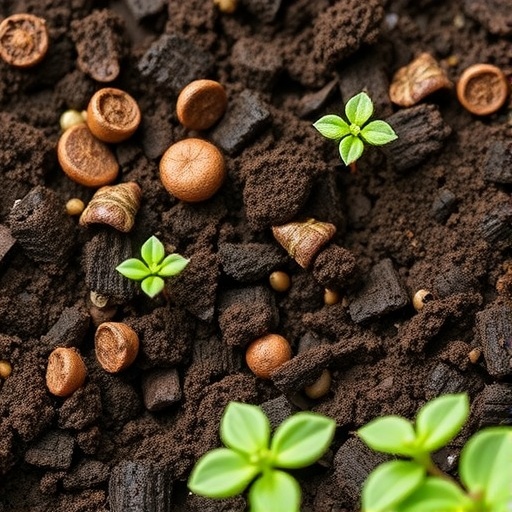
In a groundbreaking study published recently in Communications Earth & Environment, researchers Fu and Sun introduce an innovative multi-temporal window framework to unravel the complex temporal dynamics of soil microbiomes under warming conditions. As global temperatures continue to rise, understanding how soil microbial communities respond and stabilize over different time scales is becoming critical for predicting ecosystem resilience and biogeochemical cycling. This research delivers an unprecedented glimpse into the intricate temporal-scale-dependent behaviors of these subterranean ecosystems, providing a nuanced perspective far beyond traditional snapshot analyses.
Soil microbiomes, composed of bacteria, fungi, archaea, and other microorganisms, are vital to terrestrial ecosystem functions, including nutrient cycling, carbon sequestration, and plant health. However, the accelerating pace of climate warming poses challenges to these communities, threatening stability and ecosystem balance. What Fu and Sun’s study reveals is that soil microbiomes do not respond uniformly over time to warming stress; instead, their stability is highly contingent on the temporal scale considered. This temporal heterogeneity in ecological response was captured through a methodological breakthrough—the multi-temporal window framework—which allows for the analysis of microbial community dynamics across nested time intervals.
Traditional ecological studies often rely on fixed time points or single temporal resolutions, limiting our understanding of how microbial communities evolve under environmental stressors. Fu and Sun’s framework circumvents these limitations by partitioning data into a series of time “windows” that progressively aggregate smaller time frames into larger ones. This approach makes it possible to dissect the stability and variability of microbial assemblages in a manner that reflects the real-world temporal complexity of soil ecosystems. The incorporation of multi-scale temporal lenses significantly enhances the predictive accuracy of microbial stability assessments, making this framework a transformative tool for future ecological research.
Their research involved detailed longitudinal sampling of soil microbiomes subjected to controlled warming experiments. By applying their multi-temporal window analytical method, the authors discovered that microbial community stability manifests at longer temporal windows yet displays pronounced fluctuations at shorter periods. This reveals that soil microbiomes possess intrinsic buffering capacities that become apparent only when viewed through an extended temporal lens, suggesting adaptive microbial dynamics that may mitigate the immediate impacts of thermal stress. These findings challenge prior assumptions that microbial dysbiosis under warming occurs uniformly and irrevocably over time.
Moreover, Fu and Sun found that various functional groups within the soil microbial community exhibit distinct temporal stability profiles. For instance, certain bacterial taxa show rapid shifts and instability at fine temporal scales but converge towards stability when integrated over seasonal or annual windows. Conversely, fungal populations appear more resilient to short-term fluctuations but demonstrate sensitivity to prolonged warming exposure. This differential temporal stability among microbial guilds underscores the complexity of soil ecosystems and the necessity of multifaceted analytical tools.
The implications of these findings extend beyond academic interest, offering critical insights for ecosystem management and climate change mitigation strategies. Soil microorganisms drive key feedback loops in global carbon cycling. By delineating how microbial assemblages stabilize or destabilize over time under warming, this study provides a framework to model carbon flux predictions with greater precision. Such models can enhance the reliability of earth system models which inform international climate policy, emphasizing the intricate connections between microbial ecology and global climate dynamics.
Furthermore, Fu and Sun’s methodology champions the integration of temporal scale consideration into microbial ecology, urging researchers to rethink traditional experimental designs and observational frameworks. By accounting for temporal scale dependency, future studies could uncover latent patterns in microbial community succession, resilience, and functional adaptation that remained obscured in prior analyses. This has profound implications for understanding the microbial contribution to soil health, fertility, and sustainability in a warming world.
One of the study’s key contributions is its ability to distinguish temporary microbial fluctuations caused by transient environmental events from lasting shifts induced by chronic warming. The multi-temporal window framework facilitates this distinction by providing a dynamic stability index that evolves with increasing observation intervals. This capacity to separate noise from genuine ecological signals is essential for the development of robust ecological indicators and the formulation of adaptive land management practices that harness microbial resilience.
The research also highlights the need to consider temporal scale in the design of microbial monitoring programs. Short-term studies might misinterpret microbial instability as ecosystem degradation, while longer temporal integrations reveal homeostatic properties. Fu and Sun’s results advocate for the inclusion of multiple temporal resolutions in ecological surveillance, ensuring that data interpretation aligns with the true dynamism of soil microbiomes.
In addition, the study opens avenues for exploring the mechanistic underpinnings of microbial temporal stability. Understanding the molecular, physiological, and ecological processes that enable microbial communities to buffer thermal stress over specific time scales remains a pivotal frontier. Insights gained through this research may inform the development of bioinoculants or management practices aimed at enhancing microbial stability and ecosystem resilience in the face of ongoing climate change.
Fu and Sun’s work also prompts reconsideration of microbial community assembly theories. Their findings suggest that temporal scale must be integrated into conceptual models describing successional trajectories, competitive interactions, and functional redundancy in soil microbiomes. Temporal-scale-dependent stability implies that microbial communities are not static entities but are dynamically reorganized by environmental pressures in ways that depend critically on the observation window.
In conclusion, this pioneering study by Fu and Sun represents a major leap forward in soil microbial ecology by revealing the temporal-scale-dependent nature of microbial stability under warming. Their multi-temporal window framework is a powerful diagnostic and predictive tool that captures the complex, layered nature of microbial community responses to climate change. As societies worldwide grapple with the consequences of global warming, unlocking the temporal fabric of soil microbiomes provides hope for harnessing natural resilience mechanisms to sustain ecosystem services and food security in an uncertain future.
This research stands as a testament to the necessity of interdisciplinary approaches combining advanced statistical methodologies with ecological theory and environmental monitoring. The temporal dimension, often overlooked, proves to be a fundamental axis along which microbial responses must be understood. Fu and Sun’s approach will likely inspire a paradigm shift, encouraging the ecological community to embrace temporal complexity as a cornerstone of microbial and environmental research.
As this framework gains traction and is applied across various ecosystems and stressors, it has the potential to redefine how we perceive microbial temporal dynamics in the context of global change. The implications resonate not only for microbial ecologists but also for climate scientists, agriculturalists, and policymakers aiming to devise informed, adaptive, and effective strategies for ecosystem stewardship.
Cite Scienmag News
Morgan Morrow. (April 6, 2026). Soil Microbiome Stability Varies Across Time Under Warming. Scienmag. https://scienmag.com/soil-microbiome-stability-varies-across-time-under-warming/
Morgan Morrow. "Soil Microbiome Stability Varies Across Time Under Warming." Scienmag, 6 April 2026, https://scienmag.com/soil-microbiome-stability-varies-across-time-under-warming/. Accessed 4 September 2026.
Morgan Morrow. "Soil Microbiome Stability Varies Across Time Under Warming." Scienmag. April 6, 2026. https://scienmag.com/soil-microbiome-stability-varies-across-time-under-warming/


