

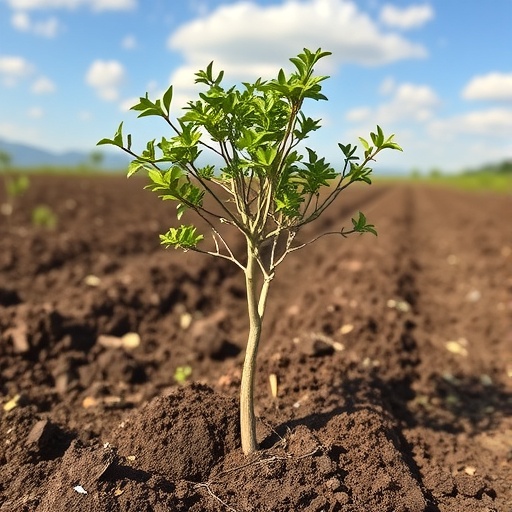
In the relentless quest to understand ecosystem resilience and enhance reforestation efforts in arid environments, researchers have unveiled groundbreaking insights into the symbiotic relationships underpinning dryland tree survival. The study, conducted by Zi, Hua, Wang, and colleagues and published in Nature Communications in 2025, sharply illuminates the intricate cooperation between mycorrhizal fungi and soil microbial communities as a pivotal determinant of tree establishment in dryland ecosystems. This revelation not only reshapes our understanding of dryland ecology but could catalyze transformative approaches to combating desertification and climate change-induced habitat degradation worldwide.
Drylands, which cover approximately 40% of Earth’s terrestrial surface, present formidable challenges for vegetation due to scarce water resources, nutrient-poor soils, and extreme temperature fluctuations. Traditional restoration strategies often fall short because they overlook the critical microbial underpinnings that facilitate plant adaptation and survival under these harsh conditions. The new research underscores that the success of tree seedlings in drylands hinges not just on inherent plant characteristics or environmental parameters but fundamentally on a cooperative network among soil microbes and mycorrhizal fungi colonizing the roots.
Mycorrhizal symbiosis, a mutualistic association between fungi and plant roots, is well-documented for enhancing nutrient uptake, improving water acquisition, and conferring stress tolerance. However, the nuance introduced by Zi et al.’s work is the explicit role of broader microbial cooperation networks within the soil matrix—beyond isolated fungal species—in facilitating effective mycorrhizal colonization. The study leverages cutting-edge metagenomic sequencing, isotopic tracing, and advanced microscopy to dissect the microbial consortia dynamics influencing this process, revealing that microbial synergy amplifies colonization efficiency far beyond previously assumed levels.
The researchers meticulously analyzed soil samples and root systems from key tree species indigenous to several representative dryland biomes across diverse continents, employing a multi-scalar approach that integrated molecular biology, ecology, and soil chemistry. Their data uncovered distinct microbial assemblages with complementary metabolic functions that enhance soil nutrient availability and modulate soil physicochemical properties, thereby creating optimal microhabitats for mycorrhizal fungi to establish and thrive.
Additionally, the study highlights how specific bacterial taxa contribute essential enzymatic activities, such as nitrogen fixation and phosphorus solubilization, which synergistically support fungal hyphal network expansion. These microbial interactions facilitate a mutually reinforcing environment where increased nutrient cycling and improved soil structure collectively boost seedling performance and resilience to abiotic stressors, including drought and high salinity. This cooperative microbial framework represents a paradigm shift, refocusing restoration ecology on fostering microbial communities as much as the plants themselves.
Importantly, Zi and colleagues emphasize temporal and spatial dynamics in microbial cooperation, showing that these interactions are not static but evolve throughout the tree establishment phases. Early successional microbial communities differ significantly from those in mature rhizospheres, suggesting that tailored microbial inoculation strategies could dramatically enhance reforestation success. This finding opens avenues for precision microbiome engineering in dryland restoration, where targeted microbial consortia could be deployed alongside seedlings to ensure robust mycorrhizal colonization and long-term ecosystem rehabilitation.
The implications extend far beyond ecological theory into practical applications. Current afforestation and reforestation projects often face high failure rates in arid zones, partly due to the neglect of belowground microbial dynamics. By elucidating the complex cooperative networks essential for mycorrhizal colonization, this research offers a toolkit for practitioners aiming to optimize tree establishment. Future restoration methodologies may incorporate microbial assessments and amendments as standard practice, reshaping forestry policies and land management strategies globally.
Moreover, the research suggests a feedback loop between microbial cooperation and plant health that could be harnessed to mitigate climate change impacts. Enhanced tree survival promotes carbon sequestration, helps stabilize soils, and maintains biodiversity in vulnerable drylands. The microbial facilitation highlighted in this study could therefore amplify ecosystem services rendered by dryland forests, bolstering their role as carbon sinks and buffers against desertification.
Mechanistically, the study dives deep into the molecular dialogues between fungi, bacteria, and host plants. Using transcriptomic analyses, the team identified genetic pathways activated within microbial consortia and roots that regulate nutrient exchange, stress signaling, and colonization processes. These insights not only deepen the biological understanding of symbiosis but suggest potential genetic targets for bioengineering efforts to develop drought-tolerant, microbe-friendly tree genotypes for restoration purposes.
Crucially, the study also underscores the role of soil physicochemical factors—such as pH, moisture content, and organic matter composition—in shaping microbial cooperation. By integrating soil science with microbial ecology, the researchers advocate for comprehensive soil health assessments in restoration protocols as opposed to traditional metrics focused solely on soil fertility or moisture levels. This holistic approach could improve the predictability and success rates of dryland restoration projects.
The innovative methodologies employed also deserve special mention. The combination of high-resolution imaging techniques with omics-based approaches allowed for unprecedented visualization and quantification of mycorrhizal colonization dynamics in situ. This multimodal strategy sets new standards for ecological research, enabling nuanced understanding of microbe-host interactions under field-relevant conditions rather than relying solely on laboratory cultures.
Finally, the global scope of the study is a testament to the universal importance of microbial cooperation in dryland tree ecology. Data gathered from arid zones across Africa, Asia, Australia, and the Americas reveal conserved microbial patterns and functional traits underlying mycorrhizal colonization success. This universality suggests that findings from this work can serve as a foundational reference, facilitating the formulation of globally applicable restoration frameworks tailored to different dryland environments.
In sum, the pioneering research by Zi, Hua, Wang, et al. delivers a compelling narrative about the indispensable role of soil microbial cooperation in enabling mycorrhizal colonization and subsequent dryland tree establishment. By unraveling the complexities of belowground microbial ecosystems and their interactions with plant roots, the study sets a new direction for ecological science and restoration practice. It holds promise for reversing desertification trends, promoting sustainable forestry, and enhancing the resilience of dryland ecosystems in the face of escalating environmental challenges.
As this work gains traction in the ecological and environmental science communities, it may well inspire a new generation of interdisciplinary research combining microbiology, plant science, and soil ecology. Practical applications rooted in these discoveries could profoundly alter the trajectories of restoration initiatives, offering hope for restoring degraded drylands and securing vital ecosystem services for future generations.
The intricate dance of microbial cooperation with mycorrhizal fungi is now recognized not just as a biological curiosity but as a cornerstone of ecological resilience in some of the planet’s most fragile and vital environments. Emerging from the detailed dissection of microbial networks, this insight is poised to reshape scientific thought and practical action in dryland restoration worldwide.
Subject of Research: Mycorrhizal colonization and soil microbial cooperation in dryland tree establishment
Article Title: Mycorrhizal colonization of dryland tree establishment depends on soil microbial cooperation
Article References:
Zi, H., Hua, Z., Wang, Y. et al. Mycorrhizal colonization of dryland tree establishment depends on soil microbial cooperation. Nat Commun (2025). https://doi.org/10.1038/s41467-025-67797-z
Image Credits: AI Generated


