


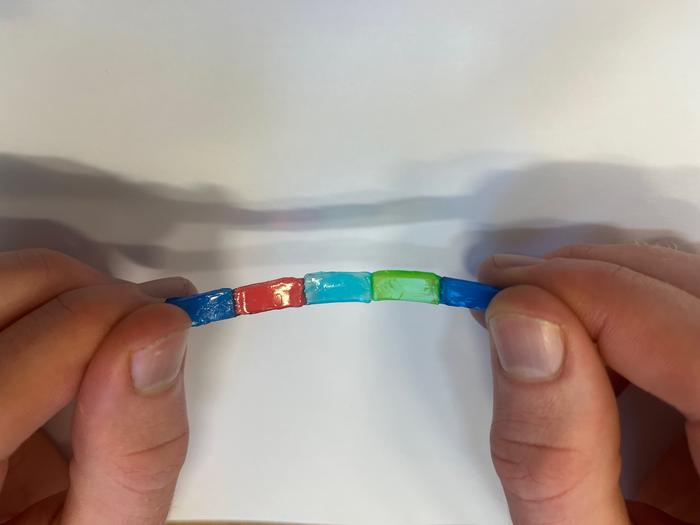
Researchers have developed soft, stretchable ‘jelly batteries’ that could be used for wearable devices or soft robotics, or even implanted in the brain to deliver drugs or treat conditions such as epilepsy.

Credit: University of Cambridge
Researchers have developed soft, stretchable ‘jelly batteries’ that could be used for wearable devices or soft robotics, or even implanted in the brain to deliver drugs or treat conditions such as epilepsy.
The researchers, from the University of Cambridge, took their inspiration from electric eels, which stun their prey with modified muscle cells called electrocytes.
Like electrocytes, the jelly-like materials developed by the Cambridge researchers have a layered structure, like sticky Lego, that makes them capable of delivering an electric current.
The self-healing jelly batteries can stretch to over ten times their original length without affecting their conductivity – the first time that such stretchability and conductivity has been combined in a single material. The results are reported in the journal Science Advances.
The jelly batteries are made from hydrogels: 3D networks of polymers that contain over 60% water. The polymers are held together by reversible on/off interactions that control the jelly’s mechanical properties.
The ability to precisely control mechanical properties and mimic the characteristics of human tissue makes hydrogels ideal candidates for soft robotics and bioelectronics; however, they need to be both conductive and stretchy for such applications.
“It’s difficult to design a material that is both highly stretchable and highly conductive, since those two properties are normally at odds with one another,” said first author Stephen O’Neill, from Cambridge’s Yusuf Hamied Department of Chemistry. “Typically, conductivity decreases when a material is stretched.”
“Normally, hydrogels are made of polymers that have a neutral charge, but if we charge them, they can become conductive,” said co-author Dr Jade McCune, also from the Department of Chemistry. “And by changing the salt component of each gel, we can make them sticky and squish them together in multiple layers, so we can build up a larger energy potential.”
Conventional electronics use rigid metallic materials with electrons as charge carriers, while the jelly batteries use ions to carry charge, like electric eels.
The hydrogels stick strongly to each other because of reversible bonds that can form between the different layers, using barrel-shaped molecules called cucurbiturils that are like molecular handcuffs. The strong adhesion between layers provided by the molecular handcuffs allows for the jelly batteries to be stretched, without the layers coming apart and crucially, without any loss of conductivity.
The properties of the jelly batteries make them promising for future use in biomedical implants, since they are soft and mould to human tissue. “We can customise the mechanical properties of the hydrogels so they match human tissue,” said Professor Oren Scherman, Director of the Melville Laboratory for Polymer Synthesis, who led the research in collaboration with Professor George Malliaras from the Department of Engineering. “Since they contain no rigid components such as metal, a hydrogel implant would be much less likely to be rejected by the body or cause the build-up of scar tissue.”
In addition to their softness, the hydrogels are also surprisingly tough. They can withstand being squashed without permanently losing their original shape, and can self-heal when damaged.
The researchers are planning future experiments to test the hydrogels in living organisms to assess their suitability for a range of medical applications.
The research was funded by the European Research Council and the Engineering and Physical Sciences Research Council (EPSRC), part of UK Research and Innovation (UKRI). Oren Scherman is a Fellow of Jesus College, Cambridge.
Journal
Science Advances
Article Title
Highly Stretchable Dynamic Hydrogels for Soft Multilayer Electronics
Article Publication Date
17-Jul-2024
Cite Scienmag News
Bethany Barker. (July 17, 2024). Soft, stretchy ‘jelly batteries’ inspired by electric eels. Scienmag. https://scienmag.com/soft-stretchy-jelly-batteries-inspired-by-electric-eels/
Bethany Barker. "Soft, stretchy ‘jelly batteries’ inspired by electric eels." Scienmag, 17 July 2024, https://scienmag.com/soft-stretchy-jelly-batteries-inspired-by-electric-eels/. Accessed 3 September 2026.
Bethany Barker. "Soft, stretchy ‘jelly batteries’ inspired by electric eels." Scienmag. July 17, 2024. https://scienmag.com/soft-stretchy-jelly-batteries-inspired-by-electric-eels/

