


In the enduring wake of the COVID-19 pandemic, one of the paramount challenges facing the scientific and medical communities is unraveling the complex tapestry of post-acute sequelae of SARS-CoV-2 infection (PASC), commonly known as Long COVID. A new landmark study spearheaded by Alcalde-Herraiz and colleagues, published in Nature Communications, has made striking advances in elucidating the sociodemographic determinants, biological markers, and comorbid conditions that contribute to the risk and manifestation of these lingering symptoms. Leveraging the unparalleled depth of the UK Biobank, the researchers have opened a new frontier in understanding the multifaceted and heterogeneous nature of Long COVID, with profound implications for clinical management and public health policy.
Long COVID remains a mysterious and multifactorial syndrome defined by a constellation of symptoms persisting well beyond the acute phase of infection. Individuals report enduring fatigue, cognitive deficits colloquially termed “brain fog,” respiratory difficulties, and cardiovascular complications, among other debilitating manifestations. Despite the widespread prevalence of post-viral syndromes, the biological underpinnings that predispose certain individuals to protracted illness while sparing others have remained elusive. Alcalde-Herraiz et al.’s meticulous analysis sheds light on this puzzle by integrating sociodemographic data, a broad spectrum of biomarkers, and pre-existing health conditions within a population scale dataset.
The study draws on the extensive repository provided by the UK Biobank, a cohort comprising hundreds of thousands of participants with deep phenotyping encompassing genetics, clinical data, and lifestyle factors. This resource allowed the researchers to overcome prior limitations of smaller observational studies by providing robust statistical power and granularity. Notably, they analyzed not only incidence rates of post-acute sequelae but also the interplay between social determinants such as age, sex, ethnicity, and socioeconomic status, intertwined with biological markers reflecting immune activation, inflammation, and organ system health.
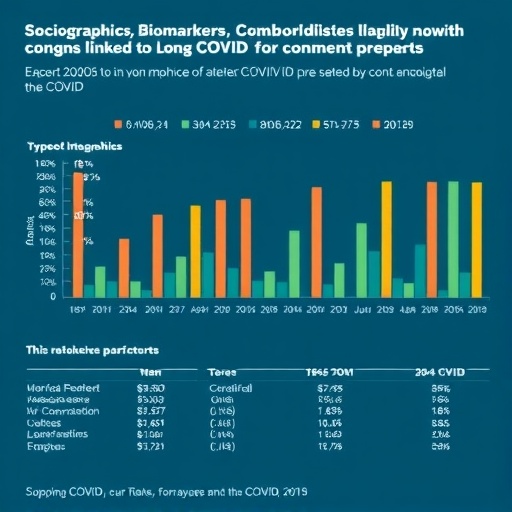
One of the pivotal findings relates to the sociodemographic gradients in Long COVID risk. Age emerged as a significant factor, with older adults demonstrating a disproportionately higher likelihood of enduring symptoms. However, this risk was modulated by sex, as females exhibited a paradoxically elevated vulnerability relative to males, an observation consistent with emerging hypotheses about sex-specific immune responses. Ethnicity also played a crucial role, revealing disparities that mirror broader health inequities exacerbated by the pandemic’s socio-economic ramifications.
Delving into biological correlates, the study identified a suite of biomarkers that portend a heightened risk for post-acute sequelae. Elevated levels of inflammatory markers, such as C-reactive protein and interleukin-6, indicative of ongoing systemic inflammation, were consistently associated with persistent symptoms. This lends strong molecular support to the idea that Long COVID may be driven, at least in part, by maladaptive immune responses that fail to resolve after viral clearance, leading to chronic tissue damage and dysregulated repair mechanisms.
Comorbidities, a cornerstone of vulnerability in acute COVID-19 outcomes, retained their predictive value in the post-acute context as well. Individuals with pre-existing cardiovascular disease, diabetes, and respiratory disorders demonstrated increased susceptibility to Long COVID manifestations. The interaction between these comorbid states and immune biomarkers suggests a complex pathophysiological synergy, where chronic disease states may prime aberrant inflammatory cascades upon viral insult, amplifying downstream morbidity.
The researchers further explored the role of mental health and neurological markers, uncovering associations between prior psychiatric diagnoses and increased risk of cognitive and neuropsychiatric sequelae following infection. This intersection between mental health vulnerabilities and post-viral syndromes underscores the importance of integrated approaches that address both somatic and psychological dimensions of recovery.
Methodologically, the study set a new standard by employing advanced multivariate modeling techniques capable of disentangling the confounding effects among intertwined risk factors. Using machine learning algorithms on high-dimensional data, the team was able to refine risk stratification models with notable predictive accuracy, a leap forward in the quest for personalized medicine in the Long COVID era. These models, if validated further, could inform clinical screening protocols and resource allocation to at-risk populations.
Beyond mere risk prediction, the study’s insights into the mechanistic underpinnings of Long COVID pave the way for targeted therapeutic avenues. By highlighting chronic inflammation and immune dysregulation as central drivers, the findings rationalize trials of immunomodulatory agents and anti-inflammatory therapies to ameliorate persistent symptoms. Moreover, monitoring identified biomarkers may also serve as surrogate endpoints in clinical trials, accelerating the evaluation of novel interventions.
The public health implications resonate on a global scale. As millions worldwide grapple with the chronic sequelae of COVID-19, the ability to identify vulnerable individuals preemptively could revolutionize post-pandemic recovery strategies. Tailored interventions, including tailored rehabilitation programs and mental health services, could be prioritized for those most at risk, mitigating long-term disability burdens and healthcare system strain.
Importantly, the study advocates for ongoing surveillance and data integration, emphasizing that the rapidly evolving viral landscape—with emergent variants and shifting vaccination contexts—may alter Long COVID phenotypes and risk factors. Continuous refinement of risk models grounded in large, diverse cohorts will remain critical in adapting responses to the pandemic’s enduring shadow.
This investigation also spotlights the indispensable value of biobank infrastructures and longitudinal population cohorts in addressing pressing biomedical challenges. The UK Biobank’s comprehensive framework, coupling genetic, clinical, and sociodemographic data, offers a reproducible template for future research into post-infectious syndromes and other complex diseases.
Intriguingly, the work raises provocative questions about the heterogeneity of Long COVID subtypes. Variability in symptom clusters, biomarker profiles, and sociodemographic contexts suggest that Long COVID may not represent a singular syndrome but rather a spectrum of overlapping conditions. Parsing these distinctions with greater resolution will be a vital step toward bespoke diagnostic criteria and management paradigms.
The study’s findings provoke a paradigm shift regarding the long-term health burden of COVID-19. It dispels the notion that recovery is a binary outcome, revealing instead a nuanced continuum influenced by an interplay of intrinsic host factors and social determinants. As the pandemic’s acute phase recedes, the focus must pivot decisively toward understanding and addressing the prolonged health consequences unveiled by this research.
In conclusion, Alcalde-Herraiz and colleagues have delivered a tour de force contribution to the Long COVID discourse. Their robust analysis transcends mere description, offering mechanistic insights, predictive frameworks, and pragmatic pathways to care that collectively advance the scientific and medical frontiers. As the world confronts the protracted fallout of the pandemic, such integrative research will be instrumental in transforming uncertainty into actionable knowledge and hope.
Cite Scienmag News
Ophelia Keating. (July 30, 2025). Sociodemographics, Biomarkers, Comorbidities Linked to Long COVID. Scienmag. https://scienmag.com/sociodemographics-biomarkers-comorbidities-linked-to-long-covid/
Ophelia Keating. "Sociodemographics, Biomarkers, Comorbidities Linked to Long COVID." Scienmag, 30 July 2025, https://scienmag.com/sociodemographics-biomarkers-comorbidities-linked-to-long-covid/. Accessed 4 September 2026.
Ophelia Keating. "Sociodemographics, Biomarkers, Comorbidities Linked to Long COVID." Scienmag. July 30, 2025. https://scienmag.com/sociodemographics-biomarkers-comorbidities-linked-to-long-covid/


