


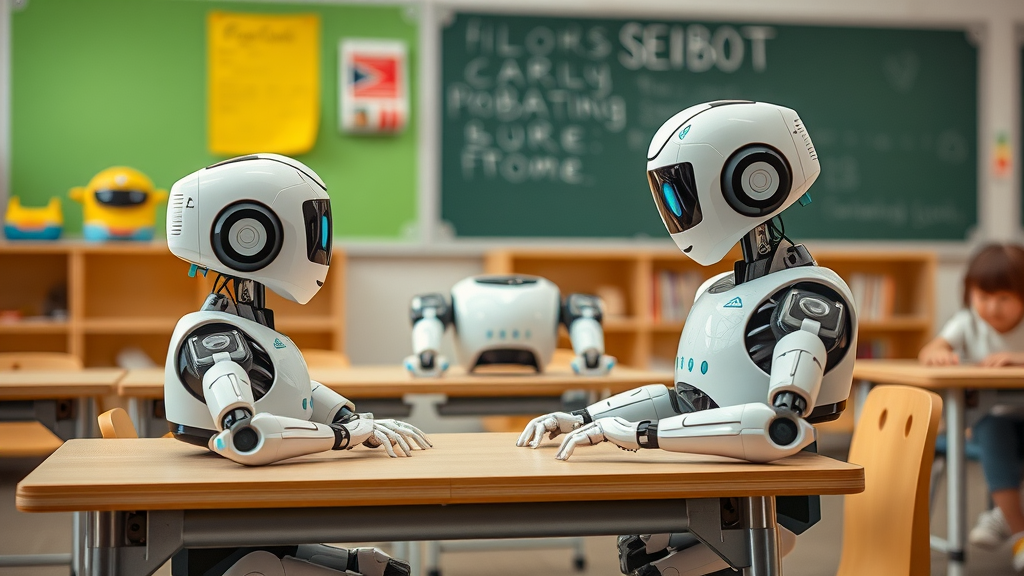
Robots that can talk, gesture, and respond to young children are moving rapidly from research laboratories into preschool classrooms, promising a future in which machines might help four-year-olds learn to share, manage frustration, and cooperate with peers. But how strong is the evidence behind that promise? A new scoping review published in the Early Childhood Education Journal offers one of the most systematic attempts to date to answer that question, and its conclusions are notably more cautious than the marketing hype surrounding educational robotics. After synthesizing twenty-five peer-reviewed studies involving preschool-aged children and mapping eighty-six child-level findings on social-emotional competence, researchers Liping Qin, Yunpeng Wu, and Hui Li conclude that embodied social robots are best understood as bounded, teacher-mediated supports rather than autonomous social tutors capable of transforming early childhood development on their own.
The review, conducted by researchers at The Education University of Hong Kong and Dezhou University, set out to resolve a question that has divided the field: are embodied social robots, or ESRs, genuine social catalysts that stimulate children’s interpersonal growth, or merely scripted tutors that deliver adult-designed content in an engaging package? Social-emotional competence, often abbreviated as SEC, encompasses a child’s ability to understand and manage emotions, show empathy, build relationships, and navigate social conflicts. It is widely regarded as a foundation for later academic success and mental health, which is precisely why the prospect of robot-assisted SEL, or social-emotional learning, has attracted such intense interest from educators, technologists, and investors alike.
Methodologically, the review followed established scoping review frameworks, including the Arksey and O’Malley methodological tradition and the PRISMA extension for scoping reviews, to identify, screen, and chart the relevant literature. The authors organized the eighty-six child-level findings they extracted into six condensed domains of social-emotional competence and then examined how those outcomes varied according to measurement approaches, robot and intervention characteristics, and the practical conditions under which the interventions were implemented. This multi-layered mapping matters because, as the authors demonstrate, the apparent effectiveness of a robot intervention depends heavily on how researchers choose to measure its impact and how the technology is actually deployed in real classrooms.
The headline finding is one of mixed evidence. Positive results clustered most consistently around what the authors call proximal indicators of social-emotional functioning: children’s participation, engagement, and communication during robot-mediated activities. Preschoolers in the reviewed studies frequently interacted readily with robots, sustained attention during structured tasks, and showed increased verbal or behavioral engagement compared with baseline conditions. By contrast, broader or more complex SEC-related outcomes, such as durable gains in empathy, emotion regulation, or generalized prosocial behavior across settings, far more often showed no effect or inconsistent patterns. In other words, robots reliably captured children’s attention and got them talking, but the evidence that they durably reshaped deeper social-emotional capacities remains thin.
A particularly striking technical insight from the review concerns the role of measurement methodology itself. Behavioral observation and structured experimental tasks were substantially more likely to detect positive change than interviews or indicators extracted automatically from robot system logs. The authors also flag a serious psychometric problem: only about one-third of the reported findings were backed by documented reliability or validation procedures for the instruments used. Interviews and system-recorded data, in particular, were rarely supported by evidence that they actually measured what they claimed to measure. This means that some of the more enthusiastic claims in the literature may reflect measurement artifacts rather than genuine developmental change, a caution that applies well beyond robotics to the broader field of educational technology evaluation.
The review also paints a sobering picture of the technology as it currently exists in classrooms. Most interventions relied on low-autonomy, non-personalized robots embedded in adult-guided activities. In practical terms, the robots were typically scripted or remotely operated devices with limited capacity to perceive a child’s emotional state, adapt their behavior, or personalize interactions over time. This is consistent with a well-known issue in human-robot interaction research: many celebrated demonstrations involve hidden human control, the so-called Wizard of Oz paradigm, whose influence is often underreported. Far from being independent social agents, most classroom robots today function as animated props within a teacher-orchestrated lesson, and the review argues that acknowledging this reality is essential for honest interpretation of the evidence.
Implementation conditions emerged as another weak point. Reporting of technical stability, implementation fidelity, and teacher preparedness or involvement was uneven across the twenty-five studies. The authors note that when a robot malfunctioned mid-session, when an intervention deviated from its intended script, or when teachers received inadequate training, these details frequently went unrecorded, making it difficult to judge whether null results reflected genuine ineffectiveness or simply poor execution. This gap has practical consequences: schools considering robot investments currently have little reliable guidance about the staffing, training, and technical infrastructure required to replicate the conditions of successful trials. The review’s call for ecologically grounded classroom research, conducted in ordinary settings rather than carefully staged laboratory-like conditions, is a direct response to this problem.
What should educators and parents take away from all this? The authors recommend a cautious but not dismissive interpretation. The evidence supports using embodied social robots as bounded, teacher-mediated supports, tools that can enrich adult-guided activities, motivate engagement, and possibly create structured opportunities for practicing communication and cooperation, particularly for children who may find human-only interactions intimidating. Indeed, some prior work reviewed by the authors suggests that shy preschoolers may interact differently, and sometimes more openly, when learning with a robot rather than a human instructor. But the review firmly rejects the notion of robots as stand-alone solutions for social-emotional development. A machine that cannot reliably read a child’s frustration, model authentic empathy, or repair a social rupture cannot substitute for the responsive human relationships that developmental science identifies as central to early social-emotional growth.
The review also points toward clearer ethical safeguards as the field matures. Young children are uniquely vulnerable research participants and technology users, and questions about attachment to machines, data collected by robot sensors, and the appropriate framing of robots as social versus mechanical entities remain actively debated in the literature. The authors argue that future studies must pair stronger measurement reporting with explicit ethical frameworks, ensuring that enthusiasm for innovative technology does not outrun the field’s obligations to the children involved. Their conclusion is ultimately a call for scientific maturity: more rigorous and validated measurement, honest reporting of implementation realities, research grounded in genuine classroom ecologies, and a realistic framing of what robots can and cannot contribute. For now, the most defensible role for embodied social robots in early childhood education is that of a well-supervised assistant to human teachers, not their replacement, and the research community is only beginning to map, carefully and skeptically, where that assistance genuinely helps preschoolers flourish.
Subject of Research: The effects of embodied social robots on preschool children's social-emotional competence
Article Title: Social Catalysts or Social Tutors? Embodied Social Robots and Preschoolers’ Social-Emotional Competence: a Scoping Review
Article References: Qin, L., Wu, Y., & Li, H. (2026). Social Catalysts or Social Tutors? Embodied Social Robots and Preschoolers’ Social-Emotional Competence: a Scoping Review. Early Childhood Education Journal. https://doi.org/10.1007/s10643-026-02347-w
Image Credits: AI Generated
DOI: 10.1007/s10643-026-02347-w
Keywords: embodied social robots, social-emotional competence, preschool children, scoping review, early childhood education, social-emotional learning, human-robot interaction, educational robotics, measurement validity, classroom implementation, teacher-mediated learning, research ethics
Cite Scienmag News
Courtney Benton. (September 13, 2026). Social Robots in Preschool Classrooms Show Promise as Supports, Not Stand-Alone Teachers. Scienmag. https://scienmag.com/social-robots-in-preschool-classrooms-show-promise-as-supports-not-stand-alone-teachers/
Courtney Benton. "Social Robots in Preschool Classrooms Show Promise as Supports, Not Stand-Alone Teachers." Scienmag, 13 September 2026, https://scienmag.com/social-robots-in-preschool-classrooms-show-promise-as-supports-not-stand-alone-teachers/. Accessed 4 October 2026.
Courtney Benton. "Social Robots in Preschool Classrooms Show Promise as Supports, Not Stand-Alone Teachers." Scienmag. September 13, 2026. https://scienmag.com/social-robots-in-preschool-classrooms-show-promise-as-supports-not-stand-alone-teachers/


