


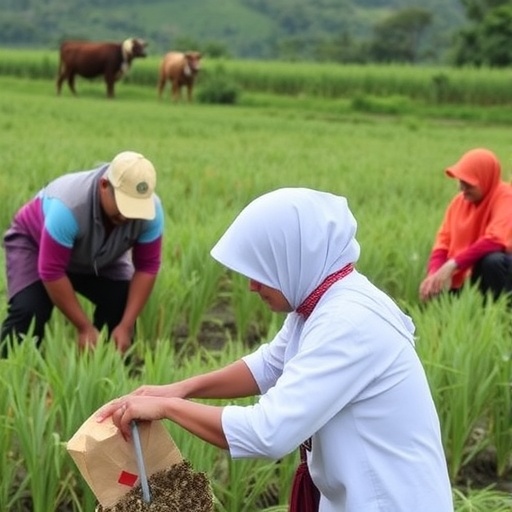
In a seminal study that promises to transform our understanding of the agricultural sector, researchers Y. Iskandar, A. Ardhiyansyah, and F.F. Ghifari have meticulously mapped out the ecosystem architecture of social enterprises operating within West Java. This groundbreaking research, published in ‘Discov Sustain,’ unveils the complexities and interdependencies that define the landscape of social entrepreneurship in agriculture. It offers a unique lens through which stakeholders can evaluate the sustainability and impact of agricultural initiatives.
The focus is on how social enterprises are structured and how they function within their ecosystems, highlighting a triadic relationship among community needs, agricultural practices, and economic viability. In West Java, where agriculture is a cornerstone of local culture and economy, social enterprises emerge as key players striving not only for profit but also for positive social outcomes. The findings underscore the increasing importance of integrating social objectives within business strategies, particularly in sectors traditionally dominated by corporate interests.
One of the key findings of the study is the identification of the various stakeholders involved in the ecosystem. These include farmers, local government, NGOs, and private sector partners, all working together in a complex web of interactions. The relationships formed within this ecosystem are pivotal in allowing social enterprises to scale their impact. The researchers have meticulously outlined these relationships, demonstrating how collaborative approaches can lead to increased resilience and adaptability in agricultural practices.
Moreover, the researchers delve deep into the challenges faced by social enterprises in this sector. They detail the bureaucratic hurdles, market access issues, and the constant balancing act between profitability and social missions. The study draws on multiple case studies, illustrating the myriad ways in which these enterprises navigate the multifaceted landscape of agriculture in West Java. Through these examples, readers gain insightful perspectives on real-world applications of theoretical frameworks surrounding social entrepreneurship.
A significant theme that emerges from this research is the innovative practices adopted by social enterprises. The study showcases how technology and traditional knowledge are harmoniously integrated to create sustainable agricultural practices. For instance, certain enterprises are leveraging mobile technology to connect farmers with consumers directly, thus eliminating intermediaries and increasing profit margins for producers. This not only enhances food security but also promotes local economies by keeping financial resources within communities.
As the researchers trace the evolution of social enterprises in West Java, they also reflect on the socio-economic impact these organizations have on rural livelihoods. The data collected highlights a substantial improvement in income levels among participating farmers, underscoring the potential of social enterprises to uplift marginalized communities. Furthermore, the study illustrates how these enterprises foster community solidarity, creating networks of support that enhance resilience against economic shocks.
Another critical aspect addressed in the research is the environmental implications of social enterprises in agriculture. By promoting sustainable farming practices, these enterprises contribute not only to the local economy but also to global environmental goals. The findings suggest that social enterprises actively embrace practices like organic farming, permaculture, and agroforestry, which are essential in combating climate change and preserving biodiversity in the region.
The researchers also emphasize the role of capacity building within the ecosystem. Training programs and knowledge-sharing workshops are areas where social enterprises excel, as they not only empower farmers but also align community goals with sustainable practices. These initiatives are crucial for ensuring that farming communities can adapt to changing environmental conditions, thereby enhancing food sovereignty.
Furthermore, the study reveals the importance of policy frameworks that support social entrepreneurship. Effective government policies can pave the way for a thriving ecosystem by facilitating access to resources, providing financial incentives, and fostering a supportive climate for innovation. The researchers argue for more robust policies that would recognize the unique nature of social enterprises and their significant contributions to the agricultural sector.
As the research concludes, it poses critical questions about the future of agriculture in West Java. How can social enterprises maintain their unique identity while competing with traditional business models? What role will technology play in shaping the next generation of agricultural practices? These questions are particularly pertinent as the global agricultural landscape continues to evolve rapidly in response to climate change, population growth, and shifting economic paradigms.
In essence, this research marks a substantial contribution to the field, opening up a dialogue about the future of social enterprises in agriculture. By providing a comprehensive framework of the ecosystem architecture, Iskandar, Ardhiyansyah, and Ghifari have offered insights that are not only academically rigorous but also practically applicable. Their findings advocate for a broader understanding of how social entrepreneurs can be catalysts for change, leveraging their unique capabilities to address both social and environmental challenges.
The research stimulates a sense of optimism about the potential of social enterprises to redefine agriculture in West Java. As they blend economic viability with social responsibility, these enterprises could lead the way for other regions grappling with similar issues. The insights gained from this study could serve as a model for policymakers, practitioners, and academics keen on fostering sustainable practices within their local contexts.
Through the lens of this comprehensive research, it is clear that social enterprises hold the key to unlocking the potential of agriculture in West Java. If the pathways explored in this research are pursued, a future where agriculture is not only profitable but also socially and environmentally responsible is within reach. As these enterprises continue to innovate and collaborate, they may very well craft a sustainable agricultural future that benefits both people and the planet.
Iskandar, Y., Ardhiyansyah, A. & Ghifari, F.F. Ecosystem architecture of social enterprises in the agricultural sector in West Java.
Discov Sustain (2026). https://doi.org/10.1007/s43621-026-02627-w
Cite Scienmag News
Gavin Prescott. (January 25, 2026). Social Enterprises Reshape West Java’s Agricultural Ecosystem. Scienmag. https://scienmag.com/social-enterprises-reshape-west-javas-agricultural-ecosystem/
Gavin Prescott. "Social Enterprises Reshape West Java’s Agricultural Ecosystem." Scienmag, 25 January 2026, https://scienmag.com/social-enterprises-reshape-west-javas-agricultural-ecosystem/. Accessed 3 September 2026.
Gavin Prescott. "Social Enterprises Reshape West Java’s Agricultural Ecosystem." Scienmag. January 25, 2026. https://scienmag.com/social-enterprises-reshape-west-javas-agricultural-ecosystem/


