


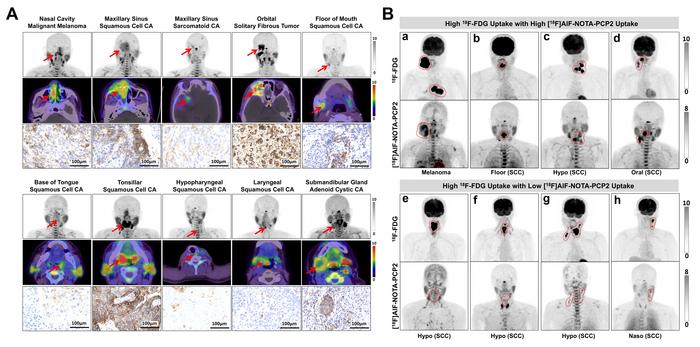
A groundbreaking advancement in molecular imaging has recently emerged from the realm of nuclear medicine, promising to redefine how clinicians assess and manage head and neck cancers. At the forefront of this innovation is a novel peptide-based PET tracer, ^18F-AlF-NOTA-PCP2, designed specifically to target programmed death-ligand 1 (PD-L1), a crucial immune checkpoint protein frequently overexpressed in head and neck squamous cell carcinoma (HNSCC). This development, unveiled at the Society of Nuclear Medicine and Molecular Imaging (SNMMI) 2025 Annual Meeting, demonstrates profound potential to surpass the widely-used but less specific ^18F-FDG tracer, heralding a new era of precision oncology imaging tailored to the molecular profile of tumors.
Traditionally, ^18F-FDG PET/CT scans have been the cornerstone of cancer imaging, capturing areas of elevated glucose metabolism that often correspond to malignant activity. However, this metabolic imaging technique only indirectly reflects the tumor’s microenvironment and immune landscape. Immune checkpoint molecules such as PD-L1 are now recognized as pivotal biomarkers guiding the application and effectiveness of immunotherapies. Yet, conventional immunohistochemistry (IHC), the gold standard for PD-L1 evaluation, falls short of capturing the heterogeneity of expression within entire tumors and between metastatic sites, often relying on small biopsy samples that provide only a snapshot of a complex, dynamic system.
Addressing these challenges, researchers at Shandong Cancer Hospital and Institute in China have engineered ^18F-AlF-NOTA-PCP2, a peptide-based tracer with enhanced hydrophilicity, high affinity, and specificity for PD-L1. Unlike ^68Ga-labeled analogs, the ^18F-AlF labeling technique offers advantages in production yield and logistical convenience, facilitating its transition into broader clinical applications. The tracer’s design optimizes tumor-to-background signal ratios, crucial for precise delineation of PD-L1 expression in vivo while minimizing nonspecific uptake that can obscure imaging results.
Preclinical investigations conducted in murine models bearing head and neck cancer xenografts established that ^18F-AlF-NOTA-PCP2 binds selectively to PD-L1-positive tumors. Competitive binding assays corroborated its specificity, reinforcing confidence in its molecular targeting capabilities. Subsequently, a carefully conducted clinical study involving 24 patients diagnosed with HNSCC provided pivotal insights into the tracer’s real-world applicability. Sixteen of these patients also underwent comparative imaging with ^18F-FDG PET scans, allowing a direct head-to-head performance assessment between the novel and conventional tracers.
The clinical findings substantiated that ^18F-AlF-NOTA-PCP2 uptake strongly correlates with PD-L1 expression determined via immunohistochemical analysis, validating its accuracy as a noninvasive biomarker imaging agent. In marked contrast, ^18F-FDG uptake exhibited only moderate correlation with PD-L1 levels, highlighting the limitation of metabolic imaging to reflect immunological nuances of the tumor microenvironment. This differential behavior underscores the potential pitfalls of relying solely on glucose metabolism-based imaging to infer the immune checkpoint status of tumors.
Safety and biodistribution profiles were meticulously evaluated, revealing that ^18F-AlF-NOTA-PCP2 was well-tolerated in patients with minimal adverse effects. The tracer demonstrated favorable pharmacokinetics characterized by rapid clearance from non-target tissues and sustained retention within PD-L1-expressing lesions, thereby optimizing signal clarity. Such pharmacological attributes are essential for practical clinical deployment, ensuring clear, interpretable images within a reasonable scanning timeframe while minimizing radiation exposure to patients.
The implications of this innovative imaging approach extend beyond mere diagnostic precision. By enabling spatially and temporally resolved visualization of PD-L1 expression, ^18F-AlF-NOTA-PCP2 has the potential to revolutionize patient stratification for immunotherapies, such as PD-1/PD-L1 checkpoint inhibitors. Clinicians could leverage this tool to identify patients likely to benefit from these treatments, monitor therapeutic response in real time, and adjust regimens dynamically to overcome resistance mechanisms, thereby optimizing outcomes in a personalized manner.
Experts attending the SNMMI meeting widely recognized the transformative potential of this targeted tracer. Heather Jacene, MD, Scientific Program Committee chair, emphasized that the advent of a PD-L1-specific PET tracer represents a paradigm shift in oncology imaging that enables clinicians to directly visualize immune-related biomarkers. This capability promises not only to refine diagnosis and prognosis but also to provide an actionable roadmap for the integration of molecular imaging into immunotherapy strategies, potentially elevating patient care standards across oncology disciplines.
Moreover, integrating ^18F-AlF-NOTA-PCP2 imaging with existing ^18F-FDG PET/CT scans offers a comprehensive dual-spectrum evaluation, capturing both metabolic activity and immune profiling of tumors. Such a multimodal imaging strategy can unravel the complex biology underpinning tumor behavior, facilitating more nuanced interpretations and enriching the clinical decision-making process with data-driven insights. This synergy could pave the way for more effective combination approaches that harness metabolic and immunologic dimensions of cancer.
While the initial data are undeniably promising, further large-scale, multi-center clinical trials are imperative to fully establish the tracer’s diagnostic accuracy, reproducibility, and clinical utility across diverse patient populations. Additionally, regulatory approvals and standardized manufacturing protocols will be critical milestones before ^18F-AlF-NOTA-PCP2 can be incorporated widely into routine clinical workflows. Nonetheless, the swift trajectory from bench to bedside reflected in this work underscores the rapid pace of innovation driving precision nuclear medicine.
Looking ahead, the introduction of ^18F-AlF-NOTA-PCP2 could catalyze a broader shift in nuclear imaging paradigms, encouraging the development of other receptor- or protein-specific tracers targeting different aspects of tumor immunobiology. This trend aligns with the overarching vision of theranostics—where diagnostic and therapeutic strategies converge to offer tailored interventions grounded in precise molecular characterization. As such, this tracer heralds a significant step forward in realizing the full potential of personalized oncology.
In conclusion, the pioneering work on ^18F-AlF-NOTA-PCP2 marks a seminal advance in noninvasive imaging of immune checkpoints in head and neck cancers. By enabling detailed, real-time assessment of PD-L1 expression, this tracer could dramatically improve patient selection and therapeutic monitoring for immunotherapies, ushering in a new era of molecularly informed cancer care. The momentum generated by this innovation highlights the crucial role that cutting-edge imaging technologies will continue to play in transforming oncology and enhancing patient outcomes worldwide.
Web References:
https://jnm.snmjournals.org/content/66/supplement_1/251095
https://jnm.snmjournals.org/content/66/supplement_1
http://www.snmmi.org/
Cite Scienmag News
Nathaniel Bowman. (June 24, 2025). SNMMI Image of the Year: Novel Immuno-PET Tracer Outperforms FDG PET in Predicting PD-L1 Expression in Head and Neck Cancer. Scienmag. https://scienmag.com/snmmi-image-of-the-year-novel-immuno-pet-tracer-outperforms-fdg-pet-in-predicting-pd-l1-expression-in-head-and-neck-cancer/
Nathaniel Bowman. "SNMMI Image of the Year: Novel Immuno-PET Tracer Outperforms FDG PET in Predicting PD-L1 Expression in Head and Neck Cancer." Scienmag, 24 June 2025, https://scienmag.com/snmmi-image-of-the-year-novel-immuno-pet-tracer-outperforms-fdg-pet-in-predicting-pd-l1-expression-in-head-and-neck-cancer/. Accessed 4 September 2026.
Nathaniel Bowman. "SNMMI Image of the Year: Novel Immuno-PET Tracer Outperforms FDG PET in Predicting PD-L1 Expression in Head and Neck Cancer." Scienmag. June 24, 2025. https://scienmag.com/snmmi-image-of-the-year-novel-immuno-pet-tracer-outperforms-fdg-pet-in-predicting-pd-l1-expression-in-head-and-neck-cancer/


