


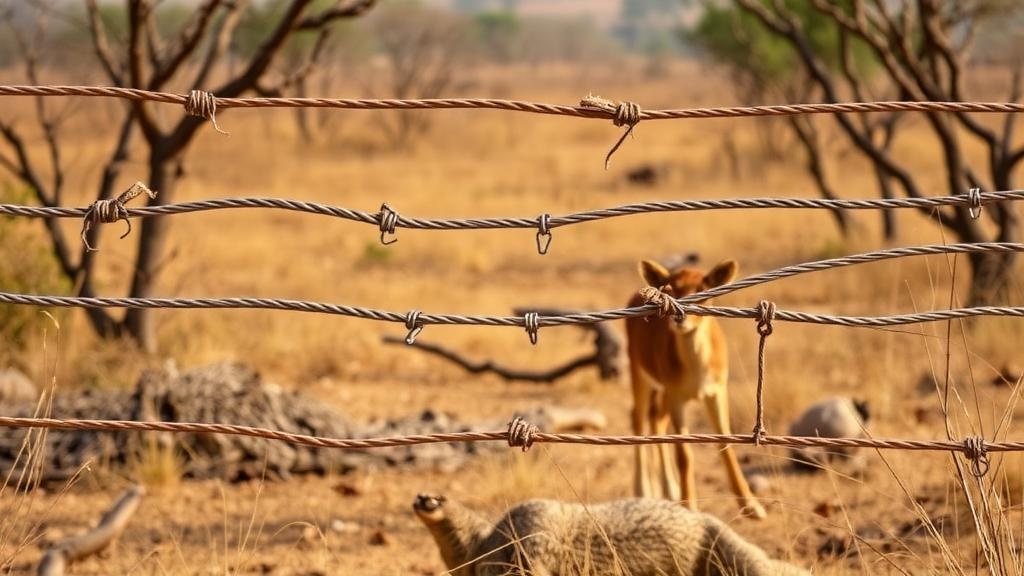
Across the mountains, forests and arid scrublands of Pakistan, an invisible killer is tightening its grip on wildlife. A new study drawing on the field experience of 131 rangers has found that snares, cheap, silent and indiscriminate, are far more widespread in the country’s protected and conserved areas than previously documented. Published in Discover Conservation, the research represents the first multi-site assessment of snaring practices in Pakistan, and its findings echo the alarm bells already ringing across Southeast Asia and Africa, where wire nooses have emptied forests of their mammals and birds.
The study, led by Hamera Aisha of WWF-Pakistan together with colleagues from WWF offices in the United States and Cambodia, the International Water Management Institute and Pakistani academic institutions, surveyed rangers in 12 protected and conserved areas spanning Sindh, Punjab, Khyber Pakhtunkhwa, Balochistan, Gilgit-Baltistan, Azad Jammu and Kashmir and Islamabad. These sites range from the high-altitude alpine ecosystems of Khunjerab, Central Karakoram and Deosai to the moist temperate forests of Ayubia and Margalla Hills and the arid landscapes of Kirthar, Hingol and Hathiano. Together they shelter some of Asia’s most charismatic species, including snow leopards, common leopards, Asiatic black bears, grey wolves, Himalayan ibex, urial, Sindh ibex and musk deer, all of which are known targets of poaching and illegal hunting.
Because snaring records were not consistently available across the regions, the researchers turned to the people who know these landscapes best. Rangers were selected through structured interviews with close-ended questions, each lasting roughly 50 minutes to an hour, supplemented by 14 focus group discussions held in small groups of two to three participants. The questionnaire, developed by WWF as part of a broader regional study, was reviewed and endorsed by the Bio-Ethical Committee of the College of Earth and Environmental Sciences at the University of the Punjab. To eliminate confusion arising from differing local terminology, participants were shown photographs of the three snare types examined in the study: rope traps, wire snares and metal traps. Quantitative responses were analysed in SPSS using descriptive statistics and chi-square tests, while qualitative discussion data were coded thematically in NVivo, and ArcGIS Pro was used to map the spatial distribution of reported snaring.
The headline figure is stark: 88 per cent of rangers reported seeing or confiscating snares within the 12 months preceding the study. Rope traps emerged as the most pervasive method, reported in all 12 protected areas, making them the baseline threat across Pakistan’s remarkable ecological diversity. Wire snares ranked second, encountered by 57.3 per cent of respondents, with a distinct northern concentration. In seven high-altitude and forested mountain sites, including Ayubia, Central Karakoram, Chitral Gol, Deosai, Khunjerab, Margalla Hills and Tushi Game Reserve, every single ranger interviewed reported encountering wire snares in the past year. Metal traps were the least common, reported by 23.7 per cent of respondents and concentrated in Machiara, Hathiano and Kirthar, where rangers noted they were once favoured for targeting large carnivores such as leopards and bears but have declined in use over time.
Statistical analysis confirmed that these spatial differences were not random. Variation in reported encounters was highly significant for all three snare types: rope traps yielded a chi-squared value of 40.58, wire snares 80.87 and metal traps 54.35, each with 11 degrees of freedom and a probability value below 0.001. Four sites, Machiara, Ayubia, Chitral Gol and Kirthar, reported all three trap types within the past year, demonstrating that diverse snaring practices cut across biogeographic boundaries rather than clustering in a single ecological realm. The regional patterns align with species-specific evidence: a previous study documented 101 snow leopard poaching incidents in Pakistan between 2005 and 2017 and found snaring to be the second most common capture method after firearms, particularly where the killings were intended for commercial trade. Musk deer, hunted for meat, musk pods, skins and canines, are likewise frequently taken in snares.
The study also probed how rangers rank snaring against other poaching methods. When compared with firearms, 58.5 per cent of rangers viewed snaring as the lesser threat, though discussions revealed an important nuance: guns typically target specific species, whereas snares indiscriminately trap a wide range of animals. Against poisoning, however, the verdict flipped decisively, with 62.3 per cent of rangers considering snaring the greater threat. Poisoning, they explained, is usually deployed in human-wildlife conflict contexts against particular taxa such as leopards, snow leopards, black bears and canids. Intriguingly, experience shaped perception. Among rangers with 26 or more years of service, 68.8 per cent judged snaring more threatening than firearms, while novices with one to five years of experience predominantly rated guns as the bigger danger, a difference the authors attribute to veterans’ accumulated encounters with the silent, indiscriminate mortality that snares inflict.
The technical character of snares explains why they are so lethal and so hard to police. They are inexpensive, easy to construct and can be deployed in enormous numbers, adjusted in size and strength to capture animals from small mammals to large carnivores. They are entirely non-selective, unable to distinguish between species of similar size or between individuals of different sex and age, so non-target wildlife is routinely caught. Trapped animals may remain ensnared for days or weeks, succumbing slowly to injury, dehydration and starvation. Detection is equally difficult: gunshots betray firearm poachers, but snares are silent and concealed, with detection probability shaped by habitat, seasonality, terrain, community activity and snare type. Research elsewhere shows that linked snare lines are easier to locate than individual nooses and that training measurably improves detection outcomes.
Enforcement effort, at least on paper, appears substantial. More than 90 per cent of rangers reported conducting snare detection and removal patrols daily or weekly, with 54.2 per cent describing daily patrols and 38.2 per cent weekly ones. Yet the rangers themselves flagged a caveat: such self-reports may overstate consistency, since staff may underreport irregularities in routine duties. Most cases of apprehended snare-setters, 46.15 per cent, resulted in both fines and jail time, with fines alone in 34.62 per cent of cases and jail terms alone in 16.15 per cent. Verbal warnings were rare. Nevertheless, nearly two-thirds of rangers, 66.15 per cent, said current laws lack sufficient strength to deter offenders, and a further 19.23 per cent felt poachers simply do not fear legal consequences because penalties are mild or inconsistently enforced. Only 14.62 per cent believed the laws are strong enough. This is notable given that most Pakistani provinces and territories have revised their wildlife legislation in recent years, while Gilgit-Baltistan still operates under the Northern Areas Wildlife Protection Act of 1975.
When asked what would actually help, rangers pointed overwhelmingly to resources. Roughly 52 per cent of focus group responses emphasised urgent needs for field tool kits, binoculars, camera traps, watchtowers, transport and fuel. About 34 per cent highlighted human resources and incentives, including more rangers, better salaries, improved working conditions and targeted training in snare detection and dismantling. Governance and institutional concerns, including corruption and the need for accountability and inter-agency cooperation, accounted for around 17 per cent, while roughly 9 per cent stressed community engagement through local reporting of wildlife crime and incentive-based models to discourage snaring. The authors suggest that integrating technologies such as SMART patrols, which have significantly improved threat detection in Bhutan, could help overcome the absence of systematic snare records, which in Pakistan remain largely confined to seizure reports and challan forms.
The study’s reliance on ranger perceptions is both its strength and its limitation. Ranger-based monitoring offers a cost-efficient alternative to resource-intensive ecological surveys in a country where systematic data on snare densities and population trends are scarce, and rangers, over 95 per cent of whom lived within 20 kilometres of their workstations and came from local communities, bring deep contextual knowledge to the task. But patrol effort is rarely uniform across space and time, and rangers must balance data collection against direct law enforcement duties. The authors call for future research that integrates field-based snare removal records, camera trap evidence and longitudinal population data to quantify how snaring trends evolve and impact wildlife, and to compare prevalence inside and outside protected areas. As a baseline, however, the message is unambiguous: the snaring crisis documented across Asia’s forests has quietly taken root in Pakistan, and tackling it will demand better-equipped rangers, stronger enforcement and conservation strategies that address the poverty driving people to set nooses in the first place.
Subject of Research: Ranger-based assessment of wildlife snaring occurrence, snare types and enforcement responses in Pakistan's protected and conserved areas
Article Title: Ranger perceptions of snaring occurrence and spatial patterns in selected protected and conserved areas (PCAs) in Pakistan
Article References: Aisha, H., Singh, R., Wyatt, A., Aeman, H., Waseem, M., Dar, N., Qadir, A., & Anjum, M. A. (2025). Ranger perceptions of snaring occurrence and spatial patterns in selected protected and conserved areas (PCAs) in Pakistan. Discover Conservation, 2(1), Article 45. https://doi.org/10.1007/s44353-025-00065-9
Image Credits: AI Generated
DOI: 10.1007/s44353-025-00065-9
Keywords: snaring, poaching, rangers, protected areas, Pakistan, wildlife crime, conservation, wire snares, rope traps, law enforcement, snow leopard, biodiversity
Cite Scienmag News
Margaret Porter. (October 3, 2026). Snares Silent Threat: Rangers Reveal Widespread Wildlife Trapping Across Pakistan’s Parks. Scienmag. https://scienmag.com/snares-silent-threat-rangers-reveal-widespread-wildlife-trapping-across-pakistans-parks/
Margaret Porter. "Snares Silent Threat: Rangers Reveal Widespread Wildlife Trapping Across Pakistan’s Parks." Scienmag, 3 October 2026, https://scienmag.com/snares-silent-threat-rangers-reveal-widespread-wildlife-trapping-across-pakistans-parks/. Accessed 4 October 2026.
Margaret Porter. "Snares Silent Threat: Rangers Reveal Widespread Wildlife Trapping Across Pakistan’s Parks." Scienmag. October 3, 2026. https://scienmag.com/snares-silent-threat-rangers-reveal-widespread-wildlife-trapping-across-pakistans-parks/


