


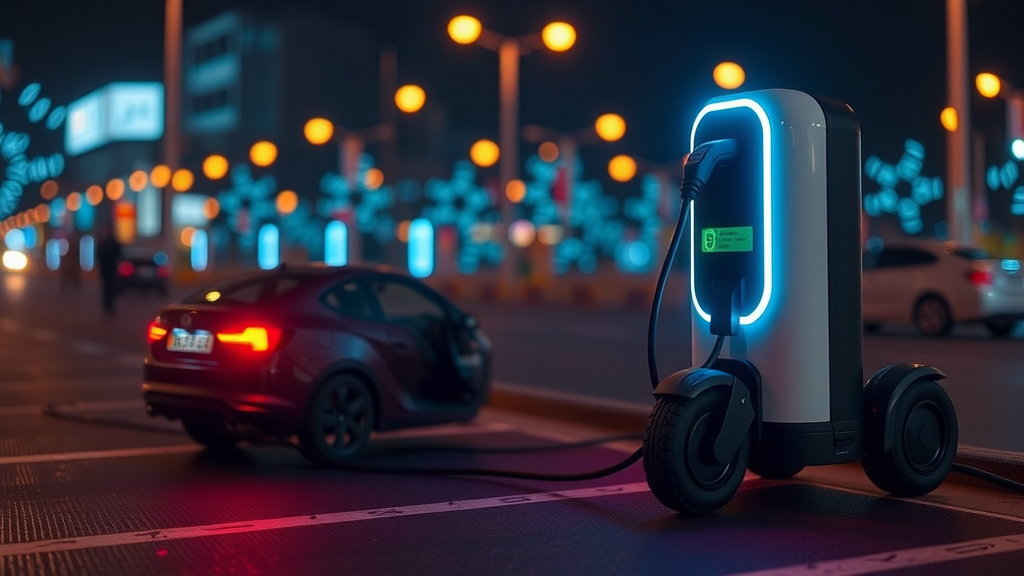
Wireless sensor networks have quietly become the nervous system of the modern world. They monitor bridges for structural stress, track soil moisture on smart farms, watch for wildfires in remote forests, and stream data from factory floors. Yet all of this invisible vigilance depends on a stubbornly mundane problem: batteries run out. In rechargeable wireless sensor networks, or RWSNs, the answer is to send a mobile charger, a vehicle that roams the network and replenishes node energy wirelessly. A new study published in Cluster Computing by Sadia Batool of Zhejiang University and colleagues, including researchers from the University of Education in Lahore, McGill University, Mohammed VI Polytechnic University, Prince Mohammad Bin Fahd University and St. Cloud State University, tackles a deceptively simple question with fresh mathematical rigor: what route should that charger take?
The answer matters more than it might first appear. A mobile charger burns its own energy traveling between nodes, and every minute spent driving is a minute in which some sensor elsewhere in the network may be sliding toward depletion. If the charger visits nodes in a poorly chosen order, it wastes fuel and time while critically low nodes die, fragmenting the network and cutting off data flow. Charging a single sensor node can be fast, but charging hundreds of them in the wrong sequence is slow, expensive, and ultimately fatal to the mission. The researchers therefore framed path planning not as a single-goal routing problem but as a balancing act among three competing objectives: maximizing the energy actually delivered to sensors, minimizing the energy the charger itself consumes, and minimizing total charging time.
Multi-objective problems of this kind are notoriously difficult because the goals conflict. The shortest route may skip nodes that urgently need power. The most thorough charging schedule may demand an impractically long tour. Traditional approaches often collapse these objectives into a single weighted score, but that forces network operators to guess in advance how much each factor matters, a guess that changes with terrain, node density, and traffic patterns. The team behind the new work instead treats the objectives simultaneously, searching for routes that offer strong performance across all three dimensions rather than excelling in one at the expense of the others.
The core of the method is a two-stage strategy built on Voronoi diagrams, a geometric construction familiar to anyone who has seen a map divided into territories around service centers. The researchers partition the deployment area so that every sensor node belongs to the region nearest to a given anchor point. This spatial division tames the combinatorial explosion of possible routes: instead of solving one enormous traveling-salesman-style problem over the whole network, the algorithm first organizes nodes into manageable cells and then plans paths within and across those cells. Voronoi partitioning has long been used for facility location and wireless coverage planning, and here it serves a similar purpose, ensuring that the charger’s workload is structured geographically rather than treated as an undifferentiated list of nodes.
The second stage is where the study’s central insight appears. Rather than planning a single uniform route, the framework splits the charging itinerary into two distinct paths based on node urgency. Sensors that require high energy, meaning nodes whose batteries are dangerously low or whose data loads are heavy, are grouped into one route, while nodes needing only a modest top-up form another. The charger can then prioritize the high-demand route first, delivering energy where network survival is at stake, before sweeping the low-energy route at a more leisurely pace. This triage-like logic mirrors emergency medicine, where the most critical patients are treated first regardless of queue order, and it directly addresses the failure mode that kills many sensor networks: a handful of starved nodes silently disconnecting the whole mesh.
The technical payoff comes from the interplay between the geometry and the scheduling. Voronoi cells reduce travel overhead because neighboring nodes are serviced in sequence, cutting the charger’s own energy expenditure, which in a battery-powered or fuel-limited vehicle is itself a scarce resource. Meanwhile, separating routes by energy demand means the charger’s dwell time at each node can be tuned: high-need nodes receive longer charging sessions, low-need nodes get quick transfers, and the total tour shrinks. Because the framework optimizes across multiple objectives simultaneously, the resulting routes are not merely short or fast but represent a defensible compromise among delivery, consumption, and time, which is precisely the trade-off network operators face in the field.
Simulation results reported by the team suggest the approach can considerably enhance the lifetime of the network compared with conventional charging strategies, and that the optimization translates into tangible operational efficiencies. By reducing the charger’s energy consumption and minimizing maintenance downtime, RWSN managers can achieve substantial cost savings, the authors note. In deployments where sensor networks stretch across agricultural land, pipelines, or disaster zones, sending human technicians to swap batteries is one of the largest recurring expenses, so any algorithm that extends the interval between interventions has immediate economic as well as scientific value.
The work sits within a rapidly evolving research landscape. Recent years have seen mobile charging approached through modified ant colony optimization for routing reliability, deep reinforcement learning for on-demand charging schedules, genetic algorithms for periodic charging, and deep-Q-networks for dynamic scheduling with partial charging. Others have pursued coordination among multiple chargers, joint charging-and-data-collection tours, and double warning thresholds that trigger preemptive charging before nodes reach crisis levels. What distinguishes the new framework is its explicit fusion of geometric network partitioning with urgency-based route separation under a multi-objective lens, a combination that keeps the optimization tractable while remaining sensitive to the real asymmetries of energy demand within a network.
There are natural next steps. The simulations demonstrate the concept, but real-world deployments would need to contend with obstacles, changing node populations, and the randomness of renewable harvesting inputs such as solar. The authors indicate that datasets are available upon request, inviting replication and extension. Still, the study arrives at a moment when the Internet of Things is expanding into environments where cabling and manual battery replacement are impossible, from precision agriculture to environmental monitoring in protected habitats. Keeping those invisible networks powered efficiently is a prerequisite for everything they promise.
For now, the message of the research is elegantly simple: when a robot charger rolls out to rescue a sensor network, the order in which it stops matters as much as the fact that it stops at all. By dividing the map into territories, separating the urgent from the merely convenient, and letting multiple objectives guide the journey, the algorithm offers a blueprint for chargers that spend less, travel smarter, and keep the world’s distributed nervous system alive for longer.
Subject of Research: Optimal path planning for mobile chargers in rechargeable wireless sensor networks using multi-objective optimization
Article Title: Optimal path planning for mobile charger in RWSNs with a multi-objective approach
Article References: Batool, S., Asif, M., Abid, A. A., Abbas, S., Fatima, M., & Butt, S. A. (2026). Optimal path planning for mobile charger in RWSNs with a multi-objective approach. Cluster Computing, 29(14), Article 791. https://doi.org/10.1007/s10586-026-06600-0
Image Credits: AI Generated
DOI: 10.1007/s10586-026-06600-0
Keywords: rechargeable wireless sensor networks, mobile charger, path planning, multi-objective optimization, Voronoi diagram, network lifetime, wireless power transfer, energy management, Cluster Computing, Internet of Things, energy efficiency, scheduling
Cite Scienmag News
Denise Maddox. (September 26, 2026). Smarter Routes for Robotic Chargers Could Keep Sensor Networks Alive Longer. Scienmag. https://scienmag.com/smarter-routes-for-robotic-chargers-could-keep-sensor-networks-alive-longer/
Denise Maddox. "Smarter Routes for Robotic Chargers Could Keep Sensor Networks Alive Longer." Scienmag, 26 September 2026, https://scienmag.com/smarter-routes-for-robotic-chargers-could-keep-sensor-networks-alive-longer/. Accessed 6 October 2026.
Denise Maddox. "Smarter Routes for Robotic Chargers Could Keep Sensor Networks Alive Longer." Scienmag. September 26, 2026. https://scienmag.com/smarter-routes-for-robotic-chargers-could-keep-sensor-networks-alive-longer/


