


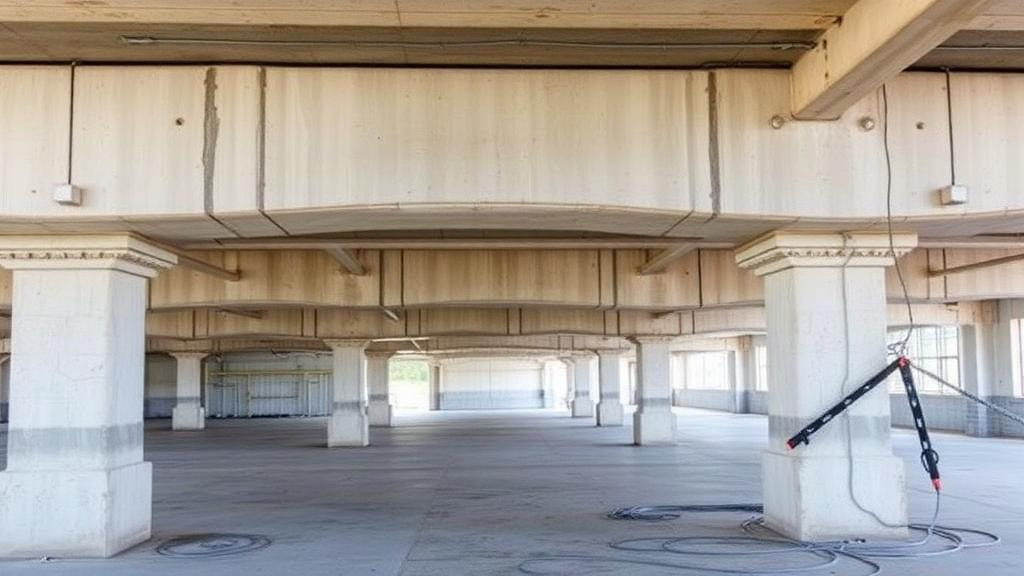
Reinforced concrete is the backbone of coastal infrastructure, from bridge piers to harbor columns, yet seawater is quietly working against it. Chloride ions from marine environments penetrate the concrete cover and, once they reach the steel reinforcement in sufficient concentration, destroy the passive protective layer that keeps the metal from rusting. A new study published in Results in Engineering by Quynh-Chau Truong, Charbel-Pierre El Soueidy, and Emilio Bastidas-Arteaga presents a probabilistic framework that promises to transform how engineers decide when and how to repair these structures, replacing guesswork and rigid schedules with risk-based optimization grounded in uncertainty quantification.
The degradation of reinforced concrete in marine settings follows a well-characterized two-phase sequence. During the initiation phase, chlorides diffuse through the concrete cover toward the embedded steel; the propagation phase begins once the chloride concentration at the rebar depth exceeds a critical threshold, triggering corrosion that produces rust products, cracking, and eventually spalling of the cover. Without intervention, this process can culminate in severe structural damage or outright failure. Traditional inspection techniques, including visual surveys and destructive or non-destructive testing, can detect corrosion, but they are costly, time-consuming, and in some cases risk misdiagnosis or further damage to the structure itself.
Modeling approaches have evolved considerably over the decades. Early studies relied on deterministic formulations of chloride transport, often using analytical solutions to Fick’s second law of diffusion. Later work introduced probabilistic methods to account for the substantial uncertainties in material properties, environmental exposure, model error, and construction quality. However, most of these probabilistic studies relied on one-dimensional chloride ingress models combined with Monte Carlo simulation or reliability methods such as FORM and SORM. That one-dimensional assumption is a serious limitation for real structural elements like columns and beams, where chlorides attack from multiple directions simultaneously. At the corners of polygonal members, chloride penetrates from two orthogonal faces, concentrating the attack precisely where the reinforcement is most vulnerable. One-dimensional models therefore tend to overestimate the time to corrosion initiation at these critical corner regions, potentially leaving structures at risk.
Two-dimensional probabilistic models have addressed the corner problem, but they have largely focused on new, single-layer concrete and ignored what happens after a repair. Repair introduces a genuinely difficult physics problem: when chloride-contaminated concrete is removed and replaced, the residual chlorides left in the original substrate do not simply stay put. They redistribute, diffusing from the old, contaminated concrete into the fresh, chloride-free repair material through the interface between the two layers. This interaction between old and new concrete, including the formation of so-called incipient anodes at the interface, has been captured by detailed deterministic finite element and finite difference models, but extending these physically rich two-dimensional repair simulations to a probabilistic setting has been computationally prohibitive. A single deterministic simulation of a 75-year maintenance history takes roughly 30 minutes on a workstation, and probabilistic assessment typically demands thousands to millions of such runs.
The research team’s solution is a surrogate modeling strategy based on polynomial chaos expansion, or PCE. Instead of running the full numerical model for every uncertainty scenario, PCE constructs a mathematical approximation of the model’s response as a series of multivariate orthogonal polynomials in the random input variables. The coefficients of this expansion, computed by least-squares minimization over a limited set of full model evaluations, map how each input and each interaction between inputs contributes to the output variability. Using least angle regression, the method retains only the polynomial terms with the largest impact, producing a sparse surrogate that captures nonlinear relationships with remarkable economy. In the case study, a surrogate built from just 200 full model evaluations achieved a leave-one-out cross-validation error of 5 times 10 to the power of minus 4, corresponding to a target accuracy of 0.999, with a polynomial order of six and 96 basis elements. Monte Carlo simulation on the surrogate then yields the probability of corrosion initiation at a tiny fraction of the original computational cost.
The underlying physics model, implemented in the open-source software FreeFem++, solves the two-dimensional chloride diffusion equation with a spatially and temporally varying apparent diffusion coefficient. This coefficient accounts for chloride binding, modeled with a Langmuir isotherm, as well as the effects of temperature, concrete aging, and humidity on transport. The repair model divides the column cross-section into two domains: the newly placed, chloride-free repair material and the original aged concrete retaining its residual chlorides. The repair geometry itself is thoughtfully designed, with a circular boundary drawn from the column center to the side reinforcement, so that concrete removal extends deepest near the corner rebars, where contamination is worst, while sparing uncontaminated interior concrete. This circular replacement strategy is both cost-effective and sustainable, minimizing the volume of material that must be removed and replaced.
The illustrative case study examines a 0.4 by 0.4 meter square column in an extreme coastal splash and tidal environment, with a 65-millimeter design cover depth specified according to Eurocode 2. Nine input parameters were treated as random variables, including surface chloride concentration, the critical chloride threshold for corrosion initiation, reference and repair diffusion coefficients, activation energy, the aging factor, and cover thicknesses, each assigned distributions drawn from prior experimental and probabilistic literature. Two repair materials were compared: S1, a conventional concrete similar to the original, and S2, a wet-mix shotcrete with a denser microstructure and lower chloride diffusivity. Repairs were assumed to be triggered when the probability of corrosion initiation reached 10 percent, a threshold consistent with the fib Model Code’s deterioration limit state and close to the Eurocode serviceability reliability target.
The results carry practical weight. With repairs every 10 years using either material, the probability of corrosion initiation stayed around 6.6 percent, safely below the 10 percent threshold, confirming the effectiveness of the circular replacement strategy even under uncertainty. But the higher-quality S2 material showed a clear advantage: after the first repair cycle, the corrosion initiation probability dropped from 6.6 percent to 3.6 percent, reflecting the dense shotcrete’s superior resistance to chloride ingress. When the framework was used to optimize the maintenance schedule rather than simply test a fixed one, the differences became economic. For the conventional S1 material, the optimal plan called for six repairs over a 75-year service life, at years 12, 24, 36, 48, 60, and 72. The superior S2 material stretched the intervals to 15 years, requiring only five repairs at years 12, 27, 42, 57, and 72. Fewer repair campaigns mean lower direct costs and a smaller environmental footprint from materials, demolition waste, and construction traffic.
Equally valuable is the framework’s global sensitivity analysis, made possible by post-processing the polynomial chaos coefficients into Sobol indices. Before repair, concrete cover thickness dominated, with a first-order Sobol index exceeding 60 percent of the output variance, a finding amplified by the two-dimensional corner geometry where the cover is the only barrier against attack from two directions. Surface chloride concentration ranked second, followed by the reference diffusion coefficient and the aging factor, while the activation energy for diffusion proved negligible under the study’s relatively stable temperature conditions. After repair, the hierarchy shifted: the diffusion coefficient of the repair material became the second most influential parameter, underscoring that material selection for repairs is a durability decision, not merely a structural one. The amount of concrete replaced, which determines the renewed cover thickness, took over the protective role previously played by the original cover. Notably, differences between first-order and total Sobol indices remained below 10 percent, indicating that the input parameters act largely independently rather than through strong interactions.
The authors are careful to frame the resulting 12-to-15-year repair intervals as illustrative outputs of an idealized preventive strategy rather than universal recommendations, and they emphasize that field observations in aggressive marine environments have documented corrosion-induced deterioration after only 20 to 25 years of exposure, sometimes earlier. The framework’s real contribution is methodological: a computationally tractable way to make proactive, reliability-based maintenance decisions for structures whose deterioration is inherently two-dimensional and whose repairs create new, coupled transport domains. The researchers identify clear next steps, including integrating empirical data on parameter correlations, characterizing geometric uncertainties after repair, and coupling the probabilistic model with life-cycle cost analysis and inspection data. As coastal infrastructure ages and climate change intensifies marine exposure, tools that convert uncertainty from an obstacle into a design variable may prove essential for keeping the world’s concrete assets safe, serviceable, and affordable to maintain.
Subject of Research: Probabilistic optimization of maintenance for chloride-corroded reinforced concrete structures in marine environments
Article Title: A probabilistic framework for optimizing maintenance of reinforced concrete structures in marine environments
Article References: Truong, Q.-C., El Soueidy, C.-P., & Bastidas-Arteaga, E. (2026). A probabilistic framework for optimizing maintenance of reinforced concrete structures in marine environments. Results in Engineering, 32, Article 113164. https://doi.org/10.1016/j.rineng.2026.113164
Image Credits: AI Generated
DOI: 10.1016/j.rineng.2026.113164
Keywords: reinforced concrete, chloride-induced corrosion, marine environment, polynomial chaos expansion, probabilistic modeling, maintenance optimization, surrogate modeling, sensitivity analysis, concrete repair, structural reliability, chloride ingress, service life prediction
Cite Scienmag News
Denise Maddox. (September 30, 2026). Smarter Repairs: New Probabilistic Model Schedules Concrete Maintenance Before Corrosion Strikes. Scienmag. https://scienmag.com/smarter-repairs-new-probabilistic-model-schedules-concrete-maintenance-before-corrosion-strikes/
Denise Maddox. "Smarter Repairs: New Probabilistic Model Schedules Concrete Maintenance Before Corrosion Strikes." Scienmag, 30 September 2026, https://scienmag.com/smarter-repairs-new-probabilistic-model-schedules-concrete-maintenance-before-corrosion-strikes/. Accessed 4 October 2026.
Denise Maddox. "Smarter Repairs: New Probabilistic Model Schedules Concrete Maintenance Before Corrosion Strikes." Scienmag. September 30, 2026. https://scienmag.com/smarter-repairs-new-probabilistic-model-schedules-concrete-maintenance-before-corrosion-strikes/


