


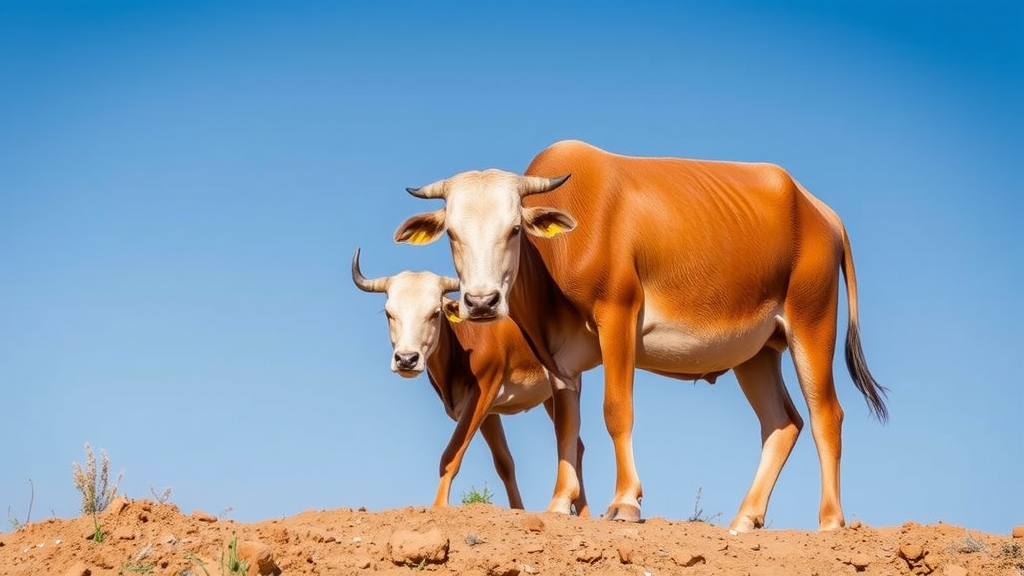
Across the drylands of Africa, millions of pastoralist households depend on rainfall that is becoming steadily less predictable. A new study published in Nature Sustainability argues that the adaptations these communities are being urged to adopt are not cost-free choices, and that the trade-offs embedded within them can be managed more intelligently when seasonal weather forecasting is paired with a strategy the researchers describe as risk smoothing. The work arrives at a moment when changing rainfall patterns and intensifying extremes have made adaptation less an option than a necessity for the herders who move livestock across some of the continent’s most variable landscapes.
Pastoralism is one of the oldest and most sophisticated land-use systems in Africa. In the arid and semi-arid rangelands that stretch from the Sahel to the Horn of Africa and southward into East and Southern Africa, herding families have long survived by tracking scarce and scattered forage with mobile herds of cattle, camels, goats and sheep. Mobility, herd diversification, social lending networks and opportunistic breeding strategies form a portfolio of responses to an environment in which rain may fail in one district while falling abundantly in another. The system works not by eliminating risk but by spreading it across space, time and social relationships.
Climate change is now testing that logic in new ways. Scientific assessments of the region consistently point to rising temperatures, greater evaporative demand and shifts in the timing, concentration and intensity of rainfall. Even where total annual rainfall changes little, the season’s structure may transform: rains may arrive late, fall in a handful of destructive downpours, or break into longer dry spells within the growing season. For herders, the consequences ripple through forage availability, water points, disease dynamics and the market prices at which animals are bought and sold. Adaptation, the Nature Sustainability authors emphasize, has therefore become unavoidable.
Yet the study’s central insight is that adaptation decisions are rarely simple upgrades. Measures that reduce one kind of risk often heighten another. Settling in one place to access services and markets can strip a household of the mobility that protects it during drought. Destocking animals before a poor season protects rangelands and may secure cash, but it sacrifices the herd capital on which future recovery depends. Intensifying production on fenced parcels can raise short-term output while undermining the flexible, extensive grazing that buffers herds against localized forage failure. These are the trade-offs that adaptation programs, in the authors’ view, have too often ignored or treated as unavoidable collateral damage.
The researchers’ proposed remedy rests on two complementary pillars. The first is improved weather forecasting: better information about how the coming season is likely to unfold, delivered in forms herders can actually use. Seasonal forecasts, when credible and accessible, allow households to plan movements, adjust herd sizes, negotiate grazing agreements or time the sale of animals ahead of anticipated stress. Forecasting does not remove uncertainty, but it shifts decisions from reactive coping toward anticipatory management, which is generally far less costly in both economic and biological terms.
The second pillar, risk smoothing, addresses the temporal structure of losses. Rather than allowing risk to concentrate into rare, catastrophic events that can wipe out decades of herd-building in a single drought, risk smoothing deliberately spreads exposure more evenly across years. In practice this can involve moderate, regular destocking rather than crisis-driven fire sales, gradual rebuilding of herds after losses, and management rules that cap the proportion of livestock a household commits in any single season. The logic echoes portfolio theory in finance: a slightly lower average return is an acceptable price for avoiding ruinous downside outcomes. For pastoral households, avoiding collapse is often worth more than maximizing the upside of a good year.
The study’s analytical contribution is to show how these two tools interact. Forecasting without risk smoothing can tempt households to bet heavily on favorable outlooks, concentrating their exposure and leaving them vulnerable when forecasts prove wrong. Risk smoothing without forecasting can become overly conservative, forfeiting opportunities in good years and eroding household income. Combined, the authors find, the two approaches allow herders to navigate the trade-offs of adaptation with far less loss of welfare: households can pursue adaptive measures such as sedentarization, herd diversification or intensified management while the forecasting and smoothing framework protects them from the worst consequences when conditions defy expectations.
The implications extend well beyond the herding communities themselves. African rangelands are among the largest semi-natural ecosystems on Earth, supporting wildlife migrations, carbon stored in soils and vegetation, and livelihoods for tens of millions of people. Adaptation policies that push herders toward fixed, intensified production without accounting for trade-offs risk degrading these landscapes, eroding the mobility that sustains both livestock and biodiversity, and deepening the vulnerability of the very households the policies aim to help. The authors’ framework offers policymakers a way to design interventions that respect the risk architecture of pastoral systems rather than dismantling it.
The research also speaks to a broader debate in climate science and development: the difference between coping and adapting. Coping absorbs shocks after they strike; adaptation restructures systems before they do. But poorly designed adaptation can simply relocate risk, from households to ecosystems, from the present to the future, or from one hazard to another. By making trade-offs explicit and giving herders tools to manage them, the study argues, adaptation policy can move from a checklist of measures toward a genuine strategy for living well with variability. In African rangelands, where variability is the defining feature of the climate rather than an aberration, that reframing may prove one of the most important climate insights of the decade.
For the pastoralists of the Sahel, East Africa and beyond, the message is pragmatic rather than utopian. The climate they face will not return to the patterns their grandparents knew, and no forecast will ever be perfect. But decisions made with better information, and risks spread deliberately rather than endured accidentally, can keep households viable through the volatile decades ahead. In a world where climate adaptation funding is growing but often poorly targeted, the study’s pairing of forecasting with risk smoothing offers a rare example of a framework that is technically grounded, economically coherent and built around the realities of the people it is meant to serve.
Subject of Research: Managing trade-offs in climate change adaptation strategies for African pastoralist rangelands
Article Title: Minimizing climate change adaptation trade-offs in African rangelands
Article References: Clark, M., Fröhner, C., Jørgensen, A. C. S., Pienkowski, T., Yekela, S., Isaacs, A., Crowe, O., Andrews, J., Smaldino, P. E., Gallizioli, I. T., Arena, G., & Mills, M. (2026). Minimizing climate change adaptation trade-offs in African rangelands. Nature Sustainability. https://doi.org/10.1038/s41893-026-01938-0
Image Credits: AI Generated
DOI: 10.1038/s41893-026-01938-0
Keywords: climate change adaptation, African rangelands, pastoralism, seasonal forecasting, risk smoothing, rainfall variability, livestock management, drylands, Nature Sustainability, food security, Sahel, climate policy
Cite Scienmag News
Sloane Callahan. (September 20, 2026). Smarter Forecasting Could Ease Climate Adaptation Trade-Offs for African Herders. Scienmag. https://scienmag.com/smarter-forecasting-could-ease-climate-adaptation-trade-offs-for-african-herders/
Sloane Callahan. "Smarter Forecasting Could Ease Climate Adaptation Trade-Offs for African Herders." Scienmag, 20 September 2026, https://scienmag.com/smarter-forecasting-could-ease-climate-adaptation-trade-offs-for-african-herders/. Accessed 5 October 2026.
Sloane Callahan. "Smarter Forecasting Could Ease Climate Adaptation Trade-Offs for African Herders." Scienmag. September 20, 2026. https://scienmag.com/smarter-forecasting-could-ease-climate-adaptation-trade-offs-for-african-herders/


