


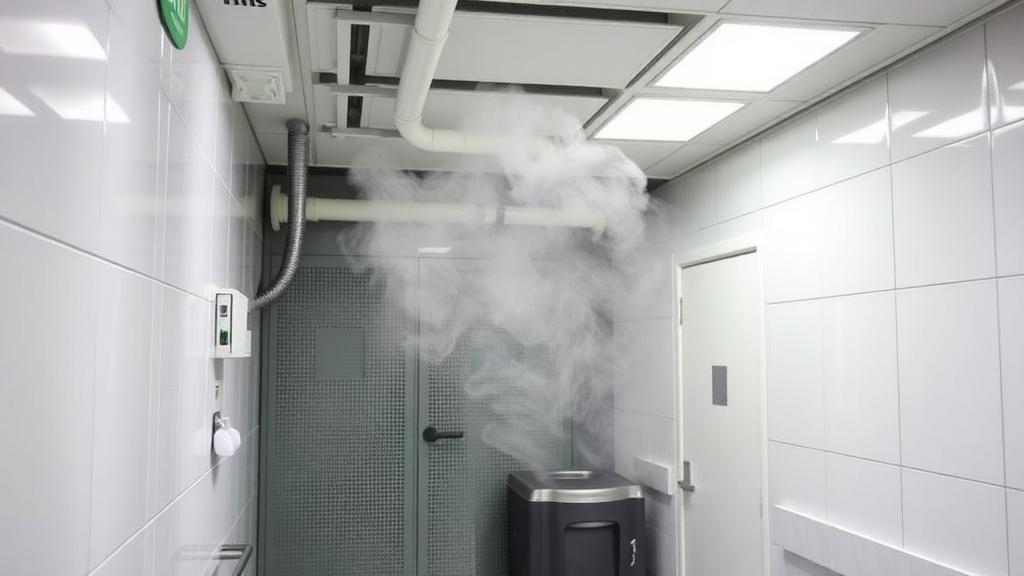
In the central sterile supply departments of hospitals, the machines that keep surgical instruments safe carry a hidden hazard. Hatch-type boiling disinfectors sterilize equipment with boiling water and steam, but every time a technician lifts the top cover, a burst of scalding vapor erupts upward, directly into the operator’s face and breathing zone. A new study published in PLOS One describes a simple, self-controlled retrofit that captures this steam at the moment of release, cutting the temperature at the technician’s face by nearly a third and reducing airborne particles by more than half.
The device, called an interlocked centrifugal exhaust system, or ICES, was developed by Xiaoxue Sun, Qinqin Wang, and Wei Zheng to address a persistent occupational exposure problem. Boiling disinfectors are widely used in hospital sterilization units because they are inexpensive and effective, yet their hatch-style lids mean that opening the chamber releases an instantaneous plume of hot steam. Traditional fixes, such as fixed overhead hoods, cannot respond to the exact moment the cover opens, and they often interfere with workflow or fail to capture the rising plume before it reaches the operator.
The engineering insight behind the ICES is that the exhaust should activate only when it is needed, and it should do so without any action from the operator. To achieve this, the researchers assembled the system from a centrifugal fan, a Hall effect switch, an instant relay, a time-delay relay, a solid-state relay, and a set of connecting pipes. The Hall effect switch, a magnetic sensor mounted so that it detects the position of the top cover, serves as the trigger. When the cover is lifted, the switch changes state, and the relay circuitry immediately powers the centrifugal fan. When the cover is closed again, the fan shuts off automatically.
The time-delay relay plays a crucial role in this interlock. Steam release does not stop the instant the lid begins to move; residual vapor continues to escape for a short period after the cover is opened. By keeping the fan running for a set interval after the switch detects the open state, the system ensures that the delayed tail of the steam plume is still captured. The solid-state relay, which switches the fan motor without mechanical contacts, provides quiet, durable operation that can withstand the frequent on-off cycling typical of a busy sterilization department.
To test whether the system actually protected workers, the team installed it on a single hatch-type boiling disinfector and measured conditions with and without the exhaust running. They placed temperature sensors at two points: one at the edge of the chamber opening, designated T1, and one at the technician’s facial position, designated T2. They also counted airborne particles of six different sizes at the facial position, since steam bursts can aerosolize particles and carry them into the breathing zone. The measurements were then compared statistically using the Wilcoxon signed-rank test, a nonparametric method suited to paired before-and-after data.
The results were striking. With the ICES enabled, the temperature at the chamber edge fell by 20.89 percent, and the temperature at the technician’s face dropped by 31.31 percent. The median facial temperature reached 21.5 degrees Celsius, essentially indistinguishable from the ambient room temperature. In practical terms, the operator no longer felt the blast of heat that normally accompanies each lid opening. All differences between the two conditions were statistically significant, with P values below 0.001 across every measured variable.
The particle counts told a similar story. At the technician’s facial position, the reduction ratios for airborne particles of six different sizes ranged from 53.09 percent to 67.83 percent. This matters because airborne particles in a sterilization environment can include residues from the disinfection process itself, and inhaling them repeatedly over a career contributes to cumulative occupational risk. By capturing the plume at its source, the exhaust system prevents these particles from ever reaching the breathing zone rather than diluting them after the fact.
Beyond the raw numbers, the researchers emphasize the practical advantages of their design. The interlock is imperceptible to the operator: there is no button to press, no switch to remember, and no change to the workflow of loading or unloading the disinfector. The components are inexpensive and widely available, and the piping can be adapted to different machine layouts, giving the system wide installation adaptability. Maintenance is straightforward, since the critical parts are standard relays and a commercial centrifugal fan rather than custom electronics. This makes the ICES a candidate for retrofitting existing machines rather than requiring hospitals to replace equipment.
The study does carry limitations inherent to its design. It was conducted on a single disinfector in one department, and the measurements reflect the specific geometry of that installation. The authors note, however, that the self-controlled principle, in which the exhaust responds directly to the cover’s open-or-closed status, should generalize to other hatch-type machines with minimal modification. Because the fan only runs when the cover is open, the energy cost is low, and the system does not add noise or airflow to the room during normal closed operation.
For the hospital workers who open these machines dozens of times a day, the significance is immediate. Steam burns to the face and airways are a recognized hazard in sterile supply departments, and chronic exposure to hot, humid air and aerosolized particles adds a slower burden. A retrofit that costs little, requires no operator training, and cuts facial-zone heat exposure by a third offers a rare combination of simplicity and measurable protection. As hospitals review safety standards for sterilization staff, studies like this one provide the engineering evidence needed to turn a routine, risky motion into a safe one.
Subject of Research: Development and testing of an interlocked centrifugal exhaust system that reduces steam overflow and airborne particle exposure when hatch-type boiling disinfectors are opened in hospital sterile supply departments.
Article Title: Design and verification of an interlocked centrifugal exhaust system for hatch-type boiling disinfectors
Article References: Sun, X., Wang, Q., & Zheng, W. (2026). Design and verification of an interlocked centrifugal exhaust system for hatch-type boiling disinfectors. PLOS One, 21(10), e0360909. https://doi.org/10.1371/journal.pone.0360909
Image Credits: AI Generated
DOI: 10.1371/journal.pone.0360909
Keywords: occupational safety, hospital sterilization, steam exposure, centrifugal exhaust, central sterile supply, engineering control, airborne particles, PLOS One, disinfection equipment, workplace health, Design, verification
Cite Scienmag News
Denise Maddox. (October 18, 2026). Smart exhaust system strips scalding steam from hospital disinfectors. Scienmag. https://scienmag.com/smart-exhaust-system-strips-scalding-steam-from-hospital-disinfectors/
Denise Maddox. "Smart exhaust system strips scalding steam from hospital disinfectors." Scienmag, 18 October 2026, https://scienmag.com/smart-exhaust-system-strips-scalding-steam-from-hospital-disinfectors/. Accessed 18 October 2026.
Denise Maddox. "Smart exhaust system strips scalding steam from hospital disinfectors." Scienmag. October 18, 2026. https://scienmag.com/smart-exhaust-system-strips-scalding-steam-from-hospital-disinfectors/


