


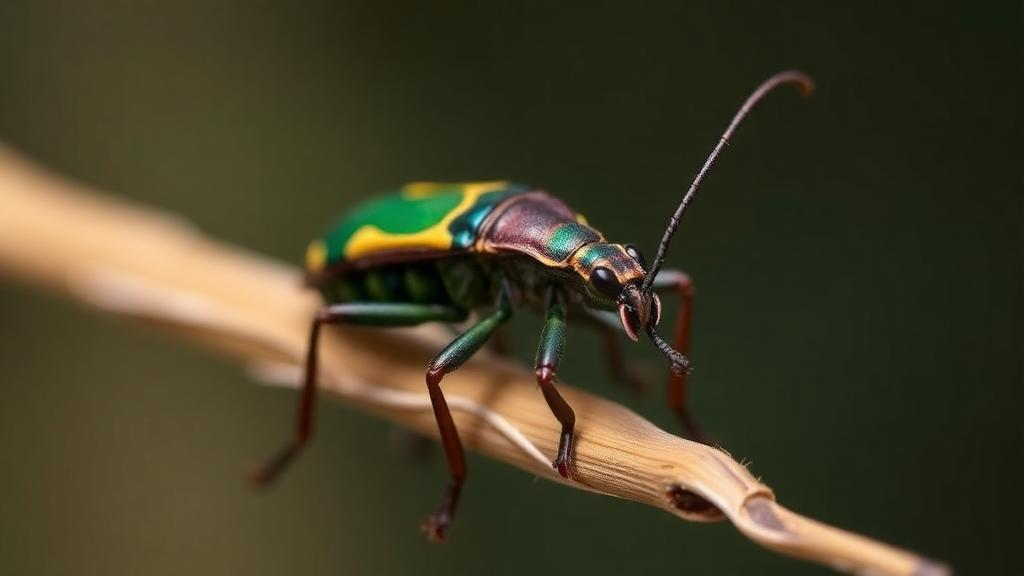
Deep in the bamboo forests of southern China and Southeast Asia lives a group of insects so inconspicuous that most people have never noticed them, yet so evolutionarily distinctive that scientists have spent 150 years trying to sort them into the right categories. Now, a team of entomologists has used the full power of modern genomics to rewrite the family tree of these bamboo-feeding coreid bugs, and the results are striking: one of the longest-recognized genera in the group is not what it seemed. The DNA says it is actually two separate lineages, and one of them deserves its own name. The researchers have formally established a new genus, Gemenesis, named for the gem-like metallic sheen its members display as they cling to bamboo shoot apices.
The story begins in 1873, when the Swedish entomologist Carl Stål established the tribe Cloresmini, a collection of true bugs in the family Coreidae that feed almost exclusively on bamboo. Stål diagnosed the group by a set of subtle anatomical features: posterior coxal cavities that are less deeply excised from the metasternum than in relatives, a transversely rugose scent gland area, a process extending from the elevated anterior margin of the scent gland sulcus, and thickened, spinose hind femora. For more than a century, the tribe grew slowly, accumulating genera and species as collectors worked across Asia and Oceania. Today it comprises five recognized genera and 43 species, three of which, encompassing 11 species, occur in China.
Morphologically and biogeographically, the tribe has always appeared neatly divided into two endemic lineages. An Oriental clade, comprising the genera Cloresmus, Notobitus, and Notobitiella, is restricted to South and Southeast Asia, while an Oceanian clade, comprising Priocnemicoris and Wasbauerellus, is confined to New Guinea and neighboring regions. Earlier phylogenetic work using ultraconserved elements and mitochondrial genomes suggested that Cloresmini originated roughly 60 million years ago, with a relationship to other coreid tribes that places them alongside Colpurini, Agriopocorini, Amorbini, and Mictini. But within the tribe itself, evolutionary relationships remained murky. Limited taxon sampling and the low phylogenetic informativeness of the commonly used COI gene fragment hindered deeper inference, leaving taxonomists uncertain whether the genera as defined reflected true evolutionary boundaries.
To resolve these questions, the research team assembled a molecular dataset of 33 samples representing 15 species, including 12 ingroup species covering all genera of the Oriental clade and three outgroup species. Genomic DNA was extracted from thoracic muscle tissue, and whole mitochondrial genomes were sequenced on the Illumina HiSeq 2000 platform, generating approximately 2 gigabytes of raw data per sample. The mitochondrial genomes were assembled de novo using MitoZ 2.4 and independently verified with IDBA-UD using k-mer values from 40 to 120 base pairs to ensure assembly accuracy. Transfer RNA genes were annotated with MITOS2 on the Galaxy platform using the invertebrate mitochondrial genetic code, and the 13 protein-coding genes were identified and manually verified with NCBI ORFfinder before alignment in MAFFT 7.0.
The team constructed four concatenated mitochondrial datasets to assess phylogenetic signal under different models: one with all 13 protein-coding genes and third codon positions removed, one with all codon positions retained, one adding the two ribosomal RNAs and 22 transfer RNAs, and one using the amino acid translations of all protein-coding genes. Nuclear 18S and 28S ribosomal DNA sequences were obtained through PCR amplification and Sanger sequencing, aligned separately, and combined with the mitochondrial datasets to verify the reliability of the resulting tree topologies. Phylogenetic analyses employed both maximum likelihood with 1000 bootstrap replicates in IQ-TREE v. 2 and Bayesian inference with four independent Markov Chain Monte Carlo searches in MrBayes v. 3.2.7a, each run for 2 million generations until the average standard deviation of split frequencies fell below 0.01.
The molecular results were unambiguous on one crucial point: the genus Cloresmus is paraphyletic. Across every mitochondrial dataset, the topology consistently recovered Cloresmus as two separate clades, with the genus Notobitiella nested between them. The 18S-28S rDNA data, though lacking sufficient signal to fully resolve relationships among all species, strongly supported the same conclusion with a maximum likelihood bootstrap value of 98 and a Bayesian posterior probability of 1.0. The nuclear data robustly supported a monophyletic group comprising Cloresmus yunnanensis and Cloresmus pulchellus as sister to Notobitiella rather than to the other Cloresmus species. In other words, what taxonomists had treated as a single natural genus for 150 years was actually an artificial assemblage stitched together from two unrelated lineages.
Guided by these molecular findings, the researchers reexamined the morphology of over 800 alcohol-preserved and dried specimens, and the bugs themselves confirmed what the DNA had revealed. The two clades of Cloresmus differ distinctly in the venation of the forewing corium. In Cloresmus Clade II, the median fissure and the M vein are posteriorly fused but anteriorly separated, whereas in Clade I they are completely fused. Critically, the type species of the genus, Cloresmus signoreti Stål, 1860, exhibits the same completely fused vein pattern as Clade I, meaning that Clade I retains the genus name while Clade II must be erected as something new. The researchers also found that Gemenesis can be distinguished from Cloresmus by the basoventral surface of the hind femora being armed with a row of small spines, a feature the latter lacks, and by the lateral margin of the pronotum being rounded and smooth rather than bearing verrucous protuberances.
Beyond the venation, ecology and coloration tell a parallel story. Species of Cloresmus are typically found concealed within the basal sheaths of mature bamboo and are frequently black or brown, while members of Gemenesis occur on bamboo shoot apices and usually display a green, metallic body that catches the light like a polished stone. This clear spatial and microhabitat divergence aligns perfectly with the molecular phylogenetic results, suggesting that the two lineages have followed distinct evolutionary trajectories not just in their anatomy but in how they live on the plant. The researchers note that this ecological and coloration pattern is currently based solely on Chinese specimens and requires further validation through broader geographical sampling across South and Southeast Asia.
As a result of the taxonomic reassessment, the researchers formally establish Gemenesis gen. nov. and propose two new combinations: Gemenesis pulchellus comb. nov. and Gemenesis yunnanensis comb. nov., the latter designated as the type species. The genus is known from China’s Yunnan, Guangdong, and Guangxi provinces as well as Vietnam, Thailand, and Myanmar. Members are small to medium-sized bugs with metallic green or blue lustre, densely covered with punctures and short fine hairs, with red protruding ocelli, cylindrical antennae whose fourth segment is the longest, and hind femora armed with rows of small spines on the inner margin. A revised key to all six genera of Cloresmini now separates Gemenesis from Notobitiella by body shape, with Gemenesis flat and Notobitiella cylindrical, and by the reach of the second rostral segment.
The study also delivers a brand-new species: Cloresmus tibiaspinus sp. nov., from Yunnan, China, described from a holotype male and paratypes collected at Liyue in Jingdong County at 1700 meters elevation, with additional material from the Ailaoshan mountains. The species is small, measuring 12.4 to 14.4 millimeters, yellowish-brown with dense black punctures, and is diagnosed by pronotal anterior angles produced anteriorly and angulate, and by the mid-ventral surface of the hind tibia bearing one or two juxtaposed large leaf-like broad spines, the feature that gives the species its name. The male genital capsule is always trilobate with a yellow stout mesial projection and rounded brown lateral lobes. Interspecific COI genetic distances within the tribe ranged from 8.2 to 16.9 percent, with most pairwise comparisons exceeding 10 percent, providing a robust genetic framework for species delineation.
The researchers acknowledge that their sampling encompassed only 11 of the 33 recognized species in the Oriental clade, which may limit the ability to fully resolve generic boundaries, and that the exact phylogenetic relationships within Notobitus require more nuclear gene data for verification. Future work will focus on expanding taxon sampling from India, Bhutan, Myanmar, Malaysia, Indonesia, and Thailand. For the Oceanian clade, molecular data remain scarce because specimens are often more than 100 years old, rendering their genomic DNA highly degraded, so obtaining fresh alcohol-preserved samples is imperative. With the tribe now comprising six genera and a robust multi-locus phylogenetic framework in place, the evolutionary history of these shimmering bamboo dwellers is finally coming into focus, one gem-like bug at a time.
Subject of Research: Taxonomy and phylogenetics of bamboo-feeding coreid bugs
Article Title: Molecular and morphological evidence of the Oriental clade of the tribe Cloresmini ( Hemiptera , Coreidae ) reveals a new genus: Gemenesis gen. nov.
Article References: Jiang, K., Zheng, C., Wang, S., Li, Y., Chen, J., Zhu, X., Hu, H., & Bu, W. (2026). Molecular and morphological evidence of the Oriental clade of the tribe Cloresmini (Hemiptera, Coreidae) reveals a new genus: Gemenesis gen. nov.. ZooKeys, 1291, 223-238. https://doi.org/10.3897/zookeys.1291.189894
Image Credits: AI Generated
DOI: 10.3897/zookeys.1291.189894
Keywords: Cloresmini, Coreidae, Hemiptera, new genus, Gemenesis, mitochondrial genomes, phylogenetics, taxonomy, bamboo bugs, China, Molecular, morphological
Cite Scienmag News
Gavin Prescott. (October 18, 2026). Hidden DNA Split Reveals Gem-Like New Genus of Bamboo Bugs. Scienmag. https://scienmag.com/hidden-dna-split-reveals-gem-like-new-genus-of-bamboo-bugs/
Gavin Prescott. "Hidden DNA Split Reveals Gem-Like New Genus of Bamboo Bugs." Scienmag, 18 October 2026, https://scienmag.com/hidden-dna-split-reveals-gem-like-new-genus-of-bamboo-bugs/. Accessed 18 October 2026.
Gavin Prescott. "Hidden DNA Split Reveals Gem-Like New Genus of Bamboo Bugs." Scienmag. October 18, 2026. https://scienmag.com/hidden-dna-split-reveals-gem-like-new-genus-of-bamboo-bugs/


