


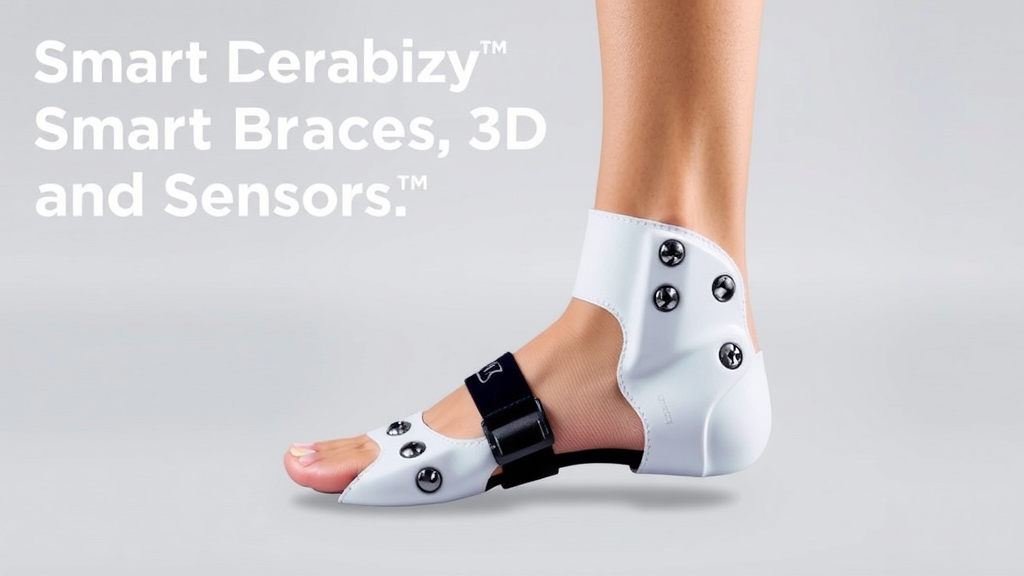
For millions of people living with stroke, cerebral palsy, multiple sclerosis and other neurological conditions, the simple act of walking can become a daily battle against foot drop, unstable ankles and exhausting, inefficient gait patterns. The ankle–foot orthosis, or AFO, has long been one of rehabilitation medicine’s most trusted answers: a brace worn around the lower leg and foot that stabilizes the ankle, clears the toes during swing phase and restores a safer, more symmetrical stride. But the humble AFO is no longer just a molded piece of plastic. A sweeping new systematic scoping review and evidence map, published in BioMedical Engineering OnLine, has for the first time systematically charted the modern landscape of modified AFO technologies, from carbon-fiber dynamic braces to 3D-printed custom devices, sensor-laden smart orthoses, actively powered systems and hybrid combinations with functional electrical stimulation.
The review, conducted by Khosro Rezaee, Somayeh Abdollahi-Holagh and Mojtaba Ansari of the Department of Biomedical Engineering at Meybod University in Iran, set out to answer a deceptively simple question: which modified-AFO technologies have actually been investigated in neurological rehabilitation, and what kinds of clinical, biomechanical, patient-reported, safety and implementation outcomes does the existing evidence cover? To answer it, the team searched six major databases, including PubMed/MEDLINE, Scopus, Web of Science Core Collection, Embase, the Cochrane Library and IEEE Xplore, capturing peer-reviewed evidence published between January 2018 and April 2026. That window deliberately targeted the most recent era of orthotic innovation, when digital fabrication and wearable sensing began transforming the field.
Methodologically, the review is a scoping exercise rather than a traditional meta-analysis, and the authors are transparent about its boundaries. Eligible primary studies and review-level sources were charted according to population, AFO technology, study design, comparator, outcome domain and implementation characteristics, then synthesized narratively. To avoid inflating the apparent size of the evidence base, primary and review-level sources were analyzed separately, reducing double counting of the same underlying trials. Importantly, the authors did not perform a formal risk-of-bias or certainty-of-evidence assessment, which means the map describes where evidence exists rather than how strong that evidence is, a distinction that matters when interpreting the findings.
After screening, 44 eligible evidence sources made the final map: 29 primary or primary-like studies and 15 review-level publications. The distribution across neurological populations is striking. Stroke dominated the literature, accounting for 14 of the 44 sources, followed by cerebral palsy with 12 and multiple sclerosis with 5. This concentration reflects both the prevalence of these conditions and the characteristic gait impairments they produce. In stroke survivors, hemiparesis often leaves the ankle unable to dorsiflex adequately, producing the classic foot-drop pattern that AFOs are designed to correct. In cerebral palsy, spasticity and contractures create complex, highly individualized ankle-foot deformities, while in multiple sclerosis, fluctuating fatigue and weakness demand devices that can adapt to changing function across the day.
The outcome measures reported across these studies reveal both the strengths and blind spots of the field. Gait speed was the most frequently represented outcome, appearing in 29 of the 44 sources, with ankle kinematics close behind at 26 and step length or symmetry at 25. These are the bread-and-butter metrics of gait laboratories: fast, objective and readily captured with motion-capture systems, instrumented walkways and wearable inertial sensors. Yet the authors found a sharp drop-off when it came to outcomes that matter most to patients in daily life. Quality of life or participation appeared in only 8 sources, safety or adverse-event reporting in just 7, and cost or accessibility in a mere 5. In other words, the field has become exceptionally good at measuring how people walk in a lab while remaining comparatively silent about whether the devices improve lives, cause harm, or are affordable and available to those who need them.
The technology map itself is equally revealing. Conventional and articulated AFOs, the workhorses of clinical practice, enjoyed the broadest clinical representation across the literature. These passive mechanical devices control ankle position through material stiffness and geometric design, and decades of clinical familiarity have built a substantial evidence base around them. Carbon-fiber dynamic AFOs, which store and release energy during gait much like a spring, have also accumulated meaningful clinical data, particularly for foot drop in stroke and multiple sclerosis. By contrast, the newest categories, 3D-printed and customized orthoses, smart or sensor-based devices, and active-assistance systems, were represented by more heterogeneous evidence that was often short-term or oriented toward technical validation rather than clinical outcomes.
This heterogeneity is not surprising given the engineering challenges involved. Additive manufacturing allows orthotists to produce braces tailored to a patient’s exact anatomy, with locally tuned stiffness zones that no off-the-shelf device can match, but the design space is enormous and standardized design guidelines are still emerging. Smart AFOs embed inertial measurement units, pressure sensors or electromyography electrodes to monitor gait in real time, opening the door to remote clinical monitoring and closed-loop control, yet most published studies remain proof-of-concept demonstrations with small samples and brief follow-up. Active-assistance orthoses go further, using actuators to deliver dorsiflexion assistance or plantarflexion control, and hybrid AFO-functional electrical stimulation systems combine mechanical support with timed electrical stimulation of the peroneal nerve. These approaches are technologically dazzling, but the review shows that their clinical evidence remains fragmented and immature compared with conventional devices.
Perhaps the most consequential conclusion of the review is what it does not find. The authors explicitly caution against reading the evidence map as a hierarchy of device effectiveness. Instead, they argue, the findings support individualized interpretation of AFO characteristics: the right device depends on the patient’s specific impairment pattern, goals, environment and resources, not on a universal ranking of technologies. A sophisticated powered orthosis may be transformative for one patient and impractical for another, while a simple articulated brace may deliver the best long-term value for many. This message pushes back against a common temptation in rehabilitation engineering, where novelty is often conflated with superiority, and it underscores the need for comparative studies that pit new technologies against established ones rather than against no-treatment baselines alone.
The review also lays out a clear agenda for the field’s next decade. The authors call for comparative evaluation across device categories, standardized technical reporting so that devices can actually be replicated and compared, and longer-term real-world follow-up that extends beyond the laboratory and the acute study period. They emphasize consistent assessment of patient-centered outcomes, adherence, safety, cost and accessibility, the domains the map shows to be chronically underrepresented. Without such data, clinicians and health systems cannot make informed decisions about which technologies deserve investment, and patients cannot be countheled realistically about what a given device will mean for their independence, comfort and finances. The evidence map thus functions as both a snapshot and a challenge: it shows a field that has successfully spanned the spectrum from passive mechanical control to digitally customized, sensor-integrated and actively assisted systems, while exposing exactly where the scientific foundation is thinnest.
For patients, clinicians and device developers alike, the message is one of cautious optimism. The engineering revolution in ankle-foot orthotics is real, and the tools now exist to personalize, sense and actively assist gait in ways unimaginable a generation ago. But turning that engineering promise into reliable clinical benefit will require the kind of rigorous, patient-centered, long-term comparative research that this review identifies as missing. As wearable technology continues its rapid advance, the evidence map offers researchers a compass: the destination is not more gadgets, but better lives, measured not only in meters per second on a gait lab walkway, but in participation, safety, affordability and the quiet confidence of a steadier step.
Subject of Research: Modified ankle–foot orthosis technologies in neurological rehabilitation, evaluated through a systematic scoping review and evidence map
Article Title: Modified ankle–foot orthoses in neurological rehabilitation: a systematic scoping review and evidence map
Article References: Rezaee, K., Abdollahi-Holagh, S., & Ansari, M. (2026). Modified ankle–foot orthoses in neurological rehabilitation: a systematic scoping review and evidence map. BioMedical Engineering OnLine. https://doi.org/10.1186/s12938-026-01630-6
Image Credits: AI Generated
DOI: 10.1186/s12938-026-01630-6
Keywords: ankle-foot orthosis, neurological rehabilitation, stroke, cerebral palsy, multiple sclerosis, 3D printing, smart orthosis, functional electrical stimulation, gait analysis, evidence mapping, wearable technology, biomedical engineering
Cite Scienmag News
Denise Maddox. (September 20, 2026). Smart Braces, 3D Printing and Sensors: New Evidence Map Charts the Future of Ankle-Foot Orthoses in Neurological Rehab. Scienmag. https://scienmag.com/smart-braces-3d-printing-and-sensors-new-evidence-map-charts-the-future-of-ankle-foot-orthoses-in-neurological-rehab/
Denise Maddox. "Smart Braces, 3D Printing and Sensors: New Evidence Map Charts the Future of Ankle-Foot Orthoses in Neurological Rehab." Scienmag, 20 September 2026, https://scienmag.com/smart-braces-3d-printing-and-sensors-new-evidence-map-charts-the-future-of-ankle-foot-orthoses-in-neurological-rehab/. Accessed 4 October 2026.
Denise Maddox. "Smart Braces, 3D Printing and Sensors: New Evidence Map Charts the Future of Ankle-Foot Orthoses in Neurological Rehab." Scienmag. September 20, 2026. https://scienmag.com/smart-braces-3d-printing-and-sensors-new-evidence-map-charts-the-future-of-ankle-foot-orthoses-in-neurological-rehab/


