


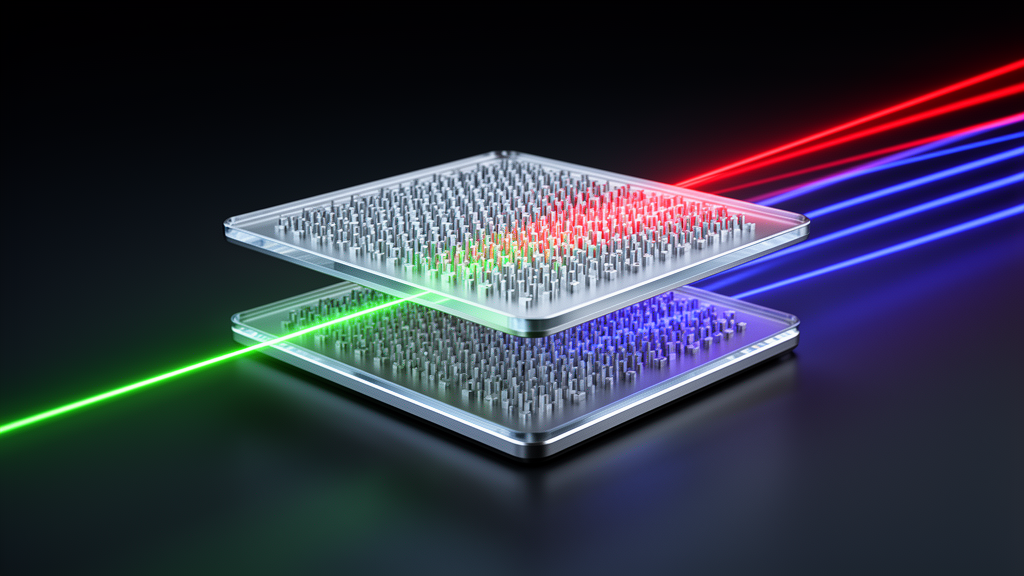
Metasurfaces, the ultrathin arrays of engineered subwavelength structures that have become the backbone of the ongoing photonics revolution, have long promised a tantalizing goal: a single flat optic that can simultaneously decide which frequencies pass through and where the resulting beam points. In practice, that promise has been hard to keep. Spatial control of light and microwaves has typically been achieved through engineered phase gradients that redirect electromagnetic energy, while spectral control has relied on resonant responses that selectively transmit, reflect, or absorb particular frequencies. These two capabilities have largely evolved along separate research paths, and combining them has almost always demanded active electronics, complex tuning mechanisms, or exotic materials that add cost, power consumption, and fabrication headaches.
A recent study by H. Shi, W. Zhu, G. Hu and co-workers, highlighted in a News and Views article in Light: Science & Applications by Lei Xu and Mohsen Rahmani of Nottingham Trent University, now demonstrates a strikingly simple way out of this impasse. Instead of dynamically modifying the electromagnetic response of individual meta-atoms with PIN diodes, varactors, or phase-change materials, the researchers replaced local reconfiguration with a global geometric displacement: a controlled lateral slide between two complementary metasurface layers. By simply shifting one layer relative to the other, the device generates an effective phase gradient across the surface, rigidly translates the angular spectrum, and steers the transmitted beam over a wide range of angles, all without a single active component or any tuning of individual resonators.
The elegance of the approach lies in how it can be understood in reciprocal space. When the two metasurface layers are perfectly aligned, their phase contributions cancel one another, and the transmitted beam propagates straight along the optical axis. As the layers are displaced relative to each other, a linear phase gradient naturally emerges across the aperture. This gradient shifts the spectral centroid of the transmitted field and consequently redirects the beam, in much the same way that a prism bends light, but with continuously adjustable deflection set purely by geometry. The result is a compact platform capable of wide-angle beam steering that preserves the intrinsic spectral filtering properties of the metasurface, enabling simultaneous control over frequency and propagation direction within one device.
The physical implementation is as carefully engineered as the concept is simple. The unit cell of the metasurface consists of multiple stacked metallic and dielectric layers that form the resonant elements. These resonances generate effective inductive and capacitive responses, allowing the multilayer architecture to support a well-defined passband together with strong out-of-band suppression. Crucially, by controlling two independent geometric degrees of freedom of the fifth-layer split-ring resonator, namely the split orientation and the opening angle, the design provides stable phase biases within the transmission passband. This means the phase profile needed for steering can be dialed in without disturbing the sharp frequency selectivity that the same structure delivers.
The measured performance figures are impressive for a fully passive device. The metasurface delivers a sharp bandpass response within the 26.5 to 29.5 gigahertz range, squarely in the millimeter-wave territory coveted by next-generation wireless networks, with out-of-band suppression exceeding 20 decibels. Across that passband, the device maintains low insertion loss and stable phase relationships, ensuring consistent beamforming performance over a scanning range of plus or minus 57 degrees. Together, these capabilities form what the authors describe as a two-dimensional frequency-angle selection window: a region of parameter space in which both the spectral content and the propagation direction of electromagnetic waves can be controlled continuously and independently within a single compact element.
Why does this matter beyond the laboratory? Spectral congestion is one of the defining challenges of modern communications. Radar systems, satellite links, and 5G and future 6G networks all compete for crowded bands of the electromagnetic spectrum, and the ability to filter a signal and point it in a precise direction at the same time is exactly what beam-space multiplexing and adaptive antennas require. Conventional solutions stack separate components, a filter followed by a phased array, each with its own losses, calibration burdens, and control electronics. A single passive slab that performs both functions, and whose behavior is changed by nothing more than a mechanical slide, could simplify architectures dramatically while reducing power draw and cost.
The passive, geometry-driven nature of the tuning mechanism is also what makes the concept so scalable. Active metasurfaces often suffer from limited tuning ranges, work only within specific frequency bands, or require dense networks of bias lines and control circuitry that degrade performance and complicate manufacturing. Sliding metasurfaces sidestep all of that. The mechanism is material-independent, meaning the same sliding principle could be reproduced with whatever resonator technology suits a given wavelength band. The authors point out that the concept can be readily extended to other parts of the electromagnetic spectrum, including the terahertz and optical regimes, where miniaturized mechanical translation is equally feasible with microelectromechanical systems.
The broader implications reach into several frontier areas of photonics. The News and Views authors note that combining geometric reconfiguration from sliding metasurfaces with functionalities such as polarization control, holography, nonlinear frequency conversion, spatiotemporal modulation, and recently developed virtual metasurfaces could push the development of future devices that achieve multiple adaptive operations within a single compact architecture. Virtual metasurfaces, which reshape electromagnetic waves at a distance rather than at the physical surface, and nonlinear virtual lenses for programmable multispectral infrared upconversion imaging, illustrate how quickly the field is diversifying. A sliding mechanism that adds a continuously tunable degree of freedom to such platforms, without adding electronics, could become a common building block across them.
There are, of course, practical questions that will shape how quickly the idea moves from demonstration to deployment. Mechanical translation introduces moving parts, and any real system must address actuation speed, reliability, and vibration sensitivity, particularly for airborne or spaceborne platforms. The demonstrated device operates in the microwave range, where millimeter-scale displacements suffice; scaling to optical wavelengths would demand nanometer-precision positioning, which is challenging but well within the capability of modern MEMS and nanopositioning technology. The trade-off between mechanical simplicity and electronic complexity is nonetheless an attractive one, because mechanical stages are mature, energy-efficient, and immune to many of the thermal and nonlinear failure modes that plague semiconductor tuning elements.
Even so, the conceptual contribution stands on its own. By reframing multifunctional wave control as a problem of relative geometry rather than local reconfiguration, the work introduces a simple yet innovative route to a two-dimensional frequency-angle selection window and opens new opportunities for passive wave-based information processing. In a field that has often equated adaptability with ever more elaborate active circuitry, the message is refreshingly counterintuitive: sometimes the smartest way to reconfigure a photonic device is simply to slide it. As researchers pursue adaptive and intelligent imaging, sensing, and information processing across the electromagnetic spectrum, sliding metasurfaces offer a compelling reminder that elegance in engineering often means doing more with less.
Subject of Research: Passive sliding metasurfaces that combine frequency-selective filtering and wide-angle beam steering through geometric translation
Article Title: Sliding metasurfaces: a two-in-one meta-device for frequency filtering and beam steering
Article References: Xu, L., & Rahmani, M. (2026). Sliding metasurfaces: a two-in-one meta-device for frequency filtering and beam steering. Light: Science & Applications, 15(1), Article 388. https://doi.org/10.1038/s41377-026-02470-8
Image Credits: AI Generated
DOI: 10.1038/s41377-026-02470-8
Keywords: metasurfaces, beam steering, frequency filtering, photonics, millimeter waves, split-ring resonators, passive devices, angular spectrum, terahertz, wireless communications, wavefront shaping, Light Science and Applications
Cite Scienmag News
Denise Maddox. (October 16, 2026). Sliding metasurfaces steer beams and filter frequencies with no electronics. Scienmag. https://scienmag.com/sliding-metasurfaces-steer-beams-and-filter-frequencies-with-no-electronics/
Denise Maddox. "Sliding metasurfaces steer beams and filter frequencies with no electronics." Scienmag, 16 October 2026, https://scienmag.com/sliding-metasurfaces-steer-beams-and-filter-frequencies-with-no-electronics/. Accessed 16 October 2026.
Denise Maddox. "Sliding metasurfaces steer beams and filter frequencies with no electronics." Scienmag. October 16, 2026. https://scienmag.com/sliding-metasurfaces-steer-beams-and-filter-frequencies-with-no-electronics/


