


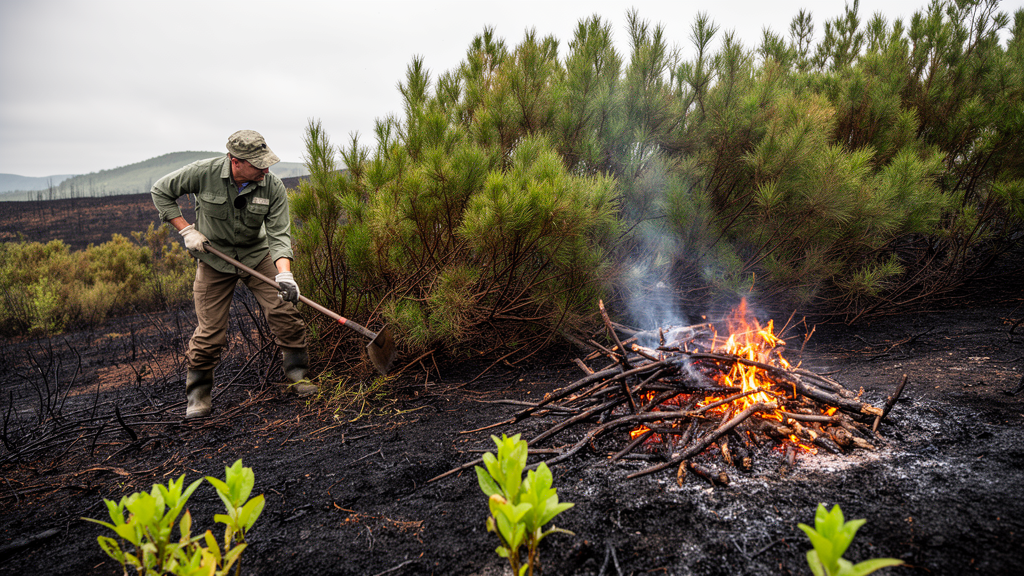
In the fire-prone landscapes of central Portugal, an Australian shrub has been quietly rewriting the rules of invasion. Hakea decurrens, a fire-adapted member of the Proteaceae family, stores its seeds in woody follicles within its crown for up to 10–15 years, releasing them en masse after burning. This strategy, known as serotiny, allows the species to synchronize recruitment with the favourable post-fire conditions that follow a blaze. Now, a new study published in NeoBiota reveals that the very adaptations that make H. decurrens such a formidable invader can be turned against it — but only if managers choose the right combination of control techniques.
The research, conducted across five pure stands of H. decurrens in the districts of Aveiro and Coimbra, tested four treatments: Burn, Slash, Slash & Burn, and an untreated Control. Each stand received all four treatments in randomly distributed 5 × 5 metre plots, and the sites were monitored for 1080 days — nearly three years — to assess seedling density and resprouting capacity. The results were striking. Burn plots supported significantly higher seedling densities than any other treatment, confirming the species’ deep adaptation to fire. In contrast, Slash and Slash & Burn treatments were far more effective at reducing recruitment than burning alone.
The mechanism behind these differences lies in the species’ reproductive biology. H. decurrens seeds are stored in closed follicles that open only in response to heat or desiccation — a process called pyriscence when triggered by fire and necriscence when triggered by the death of the shrub or supporting branches. When plants are burned, follicles open simultaneously, releasing a massive wave of seeds onto freshly burned ground where competition is minimal and nutrients are abundant. This creates a self-reinforcing feedback loop: fire facilitates invasion, which in turn increases fuel accumulation and fire hazard.
Slashing, by contrast, cuts plants to ground level using mechanical brushcutters, leaving the felled material on site. While this might seem like a straightforward approach, the study found that slashing alone produced negligible seedling recruitment — not because seeds failed to release, but because post-release conditions were unfavourable. Accumulated slash reduced seed-to-soil contact, altered microclimatic conditions, and created litter layers that trapped seeds but inhibited emergence. The combination of Slash & Burn produced intermediate outcomes, with recruitment stimulated by fire but significantly lower than in Burn alone.
The resprouting experiment added another layer of complexity. Of the 33 plants with complete records, 20 (61%) resprouted after slashing, reaching an average height of 41.3 cm after 360 days. However, the logistic regression model revealed that resprouting probability declined steeply with increasing trunk basal diameter, with resprouting virtually absent above approximately 3 cm. This ontogenetic decline in resprouting ability suggests that older, larger individuals are more effectively controlled by slashing, while younger plants may survive and recover.
The laboratory experiments provided crucial insights into the thermal thresholds governing seed release and viability. Follicles exposed to experimental fire for increasing residence times showed progressively faster dehiscence, with opening time decreasing significantly as flame exposure increased up to 180 seconds. However, not all follicles opened under the highest exposure treatments. The number of open follicles increased with exposure time up to 120 seconds but declined sharply at 180 seconds, when deep charring of tissues prevented opening. Seed viability followed a parallel trend: no significant differences from the control were detected up to 60 seconds, but viability declined steeply from 120 seconds onwards, approaching zero at 180 seconds.
These findings have important implications for prescribed burning programmes. In shrubland fires, flame residence times at the canopy scale are typically on the order of seconds to tens of seconds, meaning that exposures approaching 180 seconds are expected only under exceptional conditions such as smouldering or dense slash accumulation. This creates an operational dilemma: achieving fire conditions intense enough to deplete the canopy seed bank without simultaneously stimulating follicle opening and recruitment is extremely difficult. The study suggests that the timing of prescribed burns relative to slashing may critically influence control outcomes.
In South Africa, where similar techniques have been used to control the closely related Hakea sericea in fynbos shrublands, Slash and Burn operations deliberately leave felled plants to cure for approximately 12–18 months before a prescribed burn. This allows follicles to open through desiccation prior to the fire, so that the subsequent burn kills the resulting seedling cohort. The Portuguese study indicates that combining slashing with a delayed burning window aligned to site curing conditions may offer the most effective strategy for managing H. decurrens, though operational constraints must be carefully considered.
Hakea decurrens has been naturalised in Portugal since at least the 1970s and was recognized as invasive as early as 1999, but efforts to control it are more recent. The species was initially misidentified as the similar Hakea sericea, leading to confusion in the literature. Both species are native to Australia and invasive in various regions including New Zealand, South Africa, France, Spain and Portugal. Their ecological impacts include replacement of native species, alteration of community composition, changes in soil processes, and increased fire hazard.
The study’s authors emphasize that control of H. decurrens requires several interventions to deal with new seedlings, and that invaded areas must be monitored and integrated into recovery programmes, especially where fires are frequent. In the Mediterranean landscapes where H. decurrens has become invasive, fire is a recurring process, often occurring at intervals of a few years, with many areas burning three to four times within two decades. This strongly shapes vegetation structure and regeneration dynamics, making understanding of post-disturbance responses particularly important for management. The findings not only inform strategies for H. decurrens but also provide insights into the control of other invasive woody species with similar regenerative traits, particularly those with serotinous seed banks and some resprouting capacity.
Subject of Research: Control of the invasive fire-adapted shrub Hakea decurrens using slash and burn treatments in Portugal
Article Title: Slash and burn treatments effectively reduce post-fire recruitment of the invasive shrub Hakea decurrens
Article References: Gerber, D., Azevedo, J. C., Marchante, E., Deus, E., Nereu, M., & Silva, J. S. (2026). Slash and burn treatments effectively reduce post-fire recruitment of the invasive shrub Hakea decurrens. NeoBiota, 108, 195-211. https://doi.org/10.3897/neobiota.108.173099
Image Credits: AI Generated
DOI: 10.3897/neobiota.108.173099
Keywords: invasive species, fire ecology, Hakea decurrens, serotiny, prescribed burning, Portugal, NeoBiota, ecosystem management, Slash, burn, treatments, effectively
Cite Scienmag News
Gavin Prescott. (October 17, 2026). Slash and Burn Treatments Effectively Reduce Post-Fire Recruitment of the Invasive Shrub Hakea decurrens. Scienmag. https://scienmag.com/slash-and-burn-treatments-effectively-reduce-post-fire-recruitment-of-the-invasive-shrub-hakea-decurrens/
Gavin Prescott. "Slash and Burn Treatments Effectively Reduce Post-Fire Recruitment of the Invasive Shrub Hakea decurrens." Scienmag, 17 October 2026, https://scienmag.com/slash-and-burn-treatments-effectively-reduce-post-fire-recruitment-of-the-invasive-shrub-hakea-decurrens/. Accessed 17 October 2026.
Gavin Prescott. "Slash and Burn Treatments Effectively Reduce Post-Fire Recruitment of the Invasive Shrub Hakea decurrens." Scienmag. October 17, 2026. https://scienmag.com/slash-and-burn-treatments-effectively-reduce-post-fire-recruitment-of-the-invasive-shrub-hakea-decurrens/


