


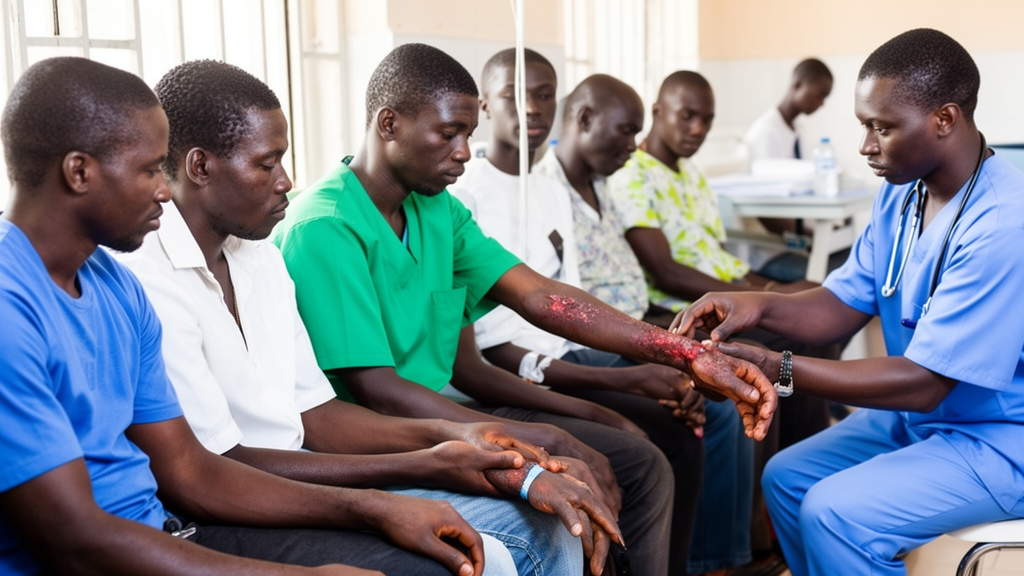
A prospective observational study at Bamenda Regional Hospital in Cameroon has found that acute skin and soft tissue infections (SSTIs) accounted for 1.2% of emergency and surgical consultations over a four-month period, presenting predominantly in working-age adults and leaving nearly a quarter of patients with severe complications within three weeks of starting treatment. The research, published in BMC Infectious Diseases, provides a localized snapshot of how these infections present and progress in a resource-limited regional African setting where routine diagnostic microbiological support is limited.
Between April and July 2024, researchers enrolled 81 eligible adult patients from the hospital’s emergency and surgical units out of 6,823 total consultations recorded during the study window. The cohort was predominantly male, with 54 men (66.7%) and 27 women (33.3%), and the mean age was 45.9 years with a standard deviation of 16.4. Adults aged 31 to 40 years represented the largest age group at 28.4% of cases.
Clinically, localized swelling was present in 98.8% of patients at presentation and acute pain in 97.5%, making these the most frequent complaints. When the team categorized infections by the degree of tissue destruction, non-necrotizing forms predominated, accounting for 61 of the 81 cases (75.3%). Cellulitis was the most common diagnosis at 37.0%, followed by cutaneous abscesses at 32.1%. The lower limbs were the primary infection site in 65.9% of patients.
Combined medical and surgical interventions were administered to 70.4% of the cohort. The spectrum of disease in the study ranged from superficial cellulitis to life-threatening conditions such as necrotizing fasciitis.
The three-week follow-up revealed a substantial complication burden. Twenty patients, or 24.7% of the cohort, developed severe complications, most frequently systemic sepsis, acute kidney injury, and secondary lower-limb amputations. Two patients died during active inpatient care, yielding a crude mortality rate of 2.5%.
To capture recovery in a structured way, the researchers tracked patients’ functional physical status using the Eastern Cooperative Oncology Group (ECOG) performance scale, an ordinal measure analyzed with non-parametric methods. The median ECOG score improved significantly from 3 at admission, with an interquartile range of 2 to 3, to 1 at three weeks, with an interquartile range of 0 to 1, a change that was statistically significant at p < 0.001 by the Wilcoxon signed-rank test.
Recovery, however, was not uniform. The study found that the development of an acute complication was associated with a failure of functional recovery, an association that reached statistical significance at p = 0.017. Patients who developed complications were less likely to show functional improvement within the three-week observation window.
The authors analyzed the data using SPSS version 26, evaluating categorical associations with the Chi-squared test and Fisher’s exact test, with statistical significance set at p < 0.05. As a hospital-based prospective observational study conducted at a single institution over four months, the work captures institutional prevalence and short-term outcomes rather than population-level incidence, and its findings are specific to the Bamenda Regional Hospital context.
The researchers conclude that the findings underscore the need for early clinical risk stratification, implementation of objective triage tracks, and proactive prevention of systemic complications in regional African settings. They note that localized clinical tracking establishing regional epidemiological trends and short-term prospective outcomes is vital to guide empiric management protocols in low-income settings where routine diagnostic microbiological support is limited.
Subject of Research: Epidemiology, clinical patterns, and three-week treatment outcomes of acute skin and soft tissue infections at a regional hospital in Cameroon
Article Title: Epidemiology, clinical patterns, and treatment outcomes of patients with acute skin and soft tissue infections at the regional hospital Bamenda
Article References: Berinyuy Wiysahnyuy, A., Kwemu Njakoi, C., Njwengba Owajege, C., & Itambi Asoh, M. (2026). Epidemiology, clinical patterns, and treatment outcomes of patients with acute skin and soft tissue infections at the regional hospital Bamenda. BMC Infectious Diseases. https://doi.org/10.1186/s12879-026-14666-9
Image Credits: AI Generated
DOI: 10.1186/s12879-026-14666-9
Keywords: skin and soft tissue infections, cellulitis, cutaneous abscess, Cameroon, sepsis, acute kidney injury, amputation, ECOG performance scale, prospective observational study, resource-limited settings, Bamenda Regional Hospital, functional recovery
Cite Scienmag News
Kristina Jarvis. (October 26, 2026). Skin and Soft Tissue Infections Hit Working-Age Adults Hardest in Cameroon Hospital Study. Scienmag. https://scienmag.com/skin-and-soft-tissue-infections-hit-working-age-adults-hardest-in-cameroon-hospital-study/
Kristina Jarvis. "Skin and Soft Tissue Infections Hit Working-Age Adults Hardest in Cameroon Hospital Study." Scienmag, 26 October 2026, https://scienmag.com/skin-and-soft-tissue-infections-hit-working-age-adults-hardest-in-cameroon-hospital-study/. Accessed 26 October 2026.
Kristina Jarvis. "Skin and Soft Tissue Infections Hit Working-Age Adults Hardest in Cameroon Hospital Study." Scienmag. October 26, 2026. https://scienmag.com/skin-and-soft-tissue-infections-hit-working-age-adults-hardest-in-cameroon-hospital-study/


