


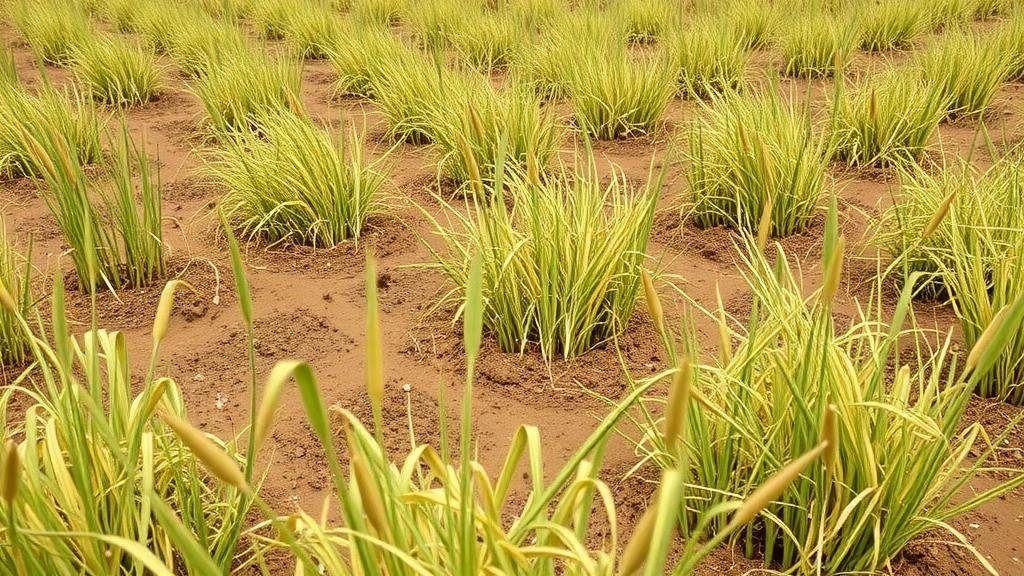
In the parched farmlands of Burkina Faso, where erratic rains and exhausted soils make every harvest a gamble, farmers wage a quiet, relentless war against weeds. A remarkable new study has now pulled back the curtain on this struggle using one of the most extraordinary scientific resources in West Africa: a continuous field experiment that has been running since 1960. By examining two growing seasons within this six-decade-old trial, researchers have shown that a simple choice of crop rotation, pairing sorghum with cowpea, can significantly suppress weed ground cover, while the type of fertilizer spread on the soil dramatically reshapes weed biomass. The findings, published in Discover Plants, offer smallholder farmers across the Sudano-Sahelian zone a rare piece of good news grounded in hard, long-term data.
The research took place at the Saria Research Station, roughly 70 kilometers from Ouagadougou, in the heart of Burkina Faso’s Sudano-Sahelian climatic zone. The site hosts the country’s only long-term agricultural experiment, established in 1960 to track how different cropping practices alter the soil over time. The soil itself is a Ferric Acrisol, notoriously poor in fertility, with low water retention and low infiltration capacity. The top 15 centimeters contain just 10.91 percent clay, 16.92 percent silt, and a dominant 72.17 percent sand. Annual rainfall in the region fluctuates between roughly 626 and 999 millimeters, and during the study years the station recorded 864.4 millimeters in 2018 and 911.9 millimeters in 2019, with average annual temperatures hovering around 28 degrees Celsius. These are conditions in which every plant competes fiercely for water and nutrients, and weeds often win.
The experimental design was a split-plot layout with six replications, combining six fertilization treatments with three crop rotation systems across 108 subplots of 48 square meters each. The fertilization treatments ranged from an unfertilized control to low and high mineral fertilizer regimes, sorghum straw residue incorporation, and organic manure produced by decomposing sorghum straw and cow dung for about six months. The rotation systems included continuous sorghum monoculture, a sorghum-cotton rotation, and a sorghum-cowpea rotation. In 2018, all plots were planted with sorghum, but in 2019, some plots were switched to cotton or cowpea, creating the annual rotation effect. The crops themselves were improved varieties selected for their adaptability: sorghum ICSV1049, cotton STAM 59A, and the drought-tolerant, Striga-resistant cowpea KVX 755-33-2G. Plots were weeded twice each season with hand hoes, at 35 and 65 days after sowing.
What the researchers found was a weed flora of striking richness and resilience. Across the two-year study, they identified 61 weed species belonging to 19 plant families. Grasses of the Poaceae family dominated with 21 species, followed by Fabaceae with 7, Cyperaceae with 5, and Malvaceae with 4; together these four families accounted for 60.7 percent of all species recorded. Even more telling was the biological profile of the flora: therophytes, plants that complete their entire life cycle within a single season and survive harsh periods as seeds, made up between 75 and 79 percent of all weed species. This overwhelming dominance of short-lived, disturbance-adapted plants is a signature of semi-arid agricultural environments, where drought and repeated cultivation filter out anything less opportunistic.
Some individual species proved extraordinarily persistent. Digitaria horizontalis, a sprawling annual grass, appeared in 85 to 99 percent of surveyed plots, making it the most frequent weed of the entire experiment. Mitracarpus hirtus and Mariscus squarrosus also maintained consistently high frequencies, occurring in up to 93 percent and 92 percent of plots respectively. Other species shifted dramatically between years: Celosia trigyna was absent from the first-year survey before the initial weeding but reached a frequency of 66.67 percent in the second year, while Mollugo nudicaulis jumped from 5.56 to 56.48 percent between years. These fluctuations underscore how sensitive weed communities are to year-to-year variation in rainfall and seed bank dynamics.
The timing of weeding emerged as the single most influential factor shaping weed diversity. Species richness per plot jumped from 7.75 plus or minus 0.41 species before the first weeding to 15.60 plus or minus 0.72 species after it, a highly significant increase. The Shannon index followed the same pattern, and Pielou’s evenness index remained consistently high, above 0.50, indicating a balanced community in which no single species monopolized resources. The researchers interpret this post-weeding diversity surge as a consequence of selective disturbance: hand hoeing eliminates the vigorous, dominant weeds that would otherwise monopolize light, water, and nutrients, thereby freeing ecological niches for subordinate and stress-tolerant species to germinate and establish. High evenness, as other weed ecologists have argued, reduces the risk that highly competitive species take over, and can itself reflect sustainable management practices such as crop rotation.
When it came to weed biomass and ground cover, the story changed. Biomass was strongly influenced by both weeding timing and fertilization. Before weeding in the second year, weeds accumulated 103.3 plus or minus 46.20 grams per square meter, more than five times the 16.5 plus or minus 4.41 grams recorded before weeding in the first year, a difference the authors attribute largely to the wetter second season. Fertilization produced a clear gradient: plots receiving low-dose mineral-organic fertilizer supported the highest weed biomass at 53.25 plus or minus 14.007 grams per square meter, high mineral-organic fertilizer followed at 48.91 plus or minus 12.90 grams, while unfertilized control plots held only 5.92 plus or minus 1.78 grams. Ground cover responded in parallel, with the fertilized treatments reaching cover rates of 24 to 26 percent against just 5.43 percent in the controls. The message is sobering: every kilogram of nutrients that feeds the crop also feeds the weeds, and the combination of slow-release organic nutrients with fast-acting minerals appears especially effective at boosting weed growth.
The standout result, however, belonged to the cowpea. Rotation effects on biomass did not reach statistical significance, but their effect on ground cover was unmistakable. The sorghum-cowpea rotation produced the lowest weed cover of any system, 16.4 plus or minus 2.90 percent, compared with 19.6 plus or minus 3.46 percent under continuous sorghum. The mechanism is elegant: cowpea, a nitrogen-fixing legume, establishes a dense canopy rapidly, shading out weeds and suppressing their cover, an effect that previous research suggests can reduce weed cover by 20 to 40 percent relative to sorghum monocrops. Sorghum adds its own weapon in the form of natural allelopathy, releasing compounds such as sorgoleone that inhibit weed germination between cycles. Rotating the two crops also disrupts weed life cycles year after year, preventing any single species from building up in the seed bank. In a region where herbicides pose well-documented risks of water and soil contamination through runoff and leaching, this biological suppression is a genuinely attractive alternative.
The broader significance of the study lies in its setting. Long-term agricultural experiments are vanishingly rare in West Africa, and this 60-year trial at Saria is the only one of its kind in Burkina Faso. Despite six decades of continuous cultivation, the plots still harbor 61 weed species, evidence that these communities have not been eliminated but rather reshaped into distinct assemblages adapted to specific combinations of rotation, fertilization, and weeding. Far from being purely a nuisance, weeds contribute to agroecosystem biodiversity, supporting pest regulation, soil fertility, pollinators, and the cycling of carbon, nitrogen, and phosphorus. The challenge, as the authors emphasize, is to balance these ecological functions against the very real yield losses that uncontrolled weed growth inflicts on smallholder farms.
For the millions of farmers who till the Sahel’s thin soils, the practical takeaway is refreshingly concrete. Crop rotation is already widely practiced across the Sudano-Sahelian zone, and this study confirms that the sorghum-cowpea rotation is the most favorable option for reducing weed ground cover. Pairing that rotation with low-dose mineral-organic fertilization offers a viable agroecological package: enough nutrition to sustain crop yields, without the explosive weed growth that heavier fertilization invites. At the same time, the persistence of high weed cover under residue mulching cautions that farmers transitioning to conservation agriculture may face weed pressure far longer than commonly assumed. In a warming, increasingly unpredictable climate, the humble cowpea, backed by sixty years of patient science, may prove one of the Sahel’s most valuable allies in the fight for every harvest.
Subject of Research: Effects of crop rotation and soil fertilization on weed diversity, biomass and cover in Sudano-Sahelian agriculture
Article Title: Influence of soil amendments and crop rotation systems on weed diversity, biomass and cover in Sudano-Sahelian Africa
Article References: Sanna, S., Yonli, D., Sanou, A., Palé, S., Soma, M., Cissé, M., Barro, A., Middendorf, J. B., Prasad, V. P. V., Stewart, Z. P., Traoré, H., & Traoré, S. (2026). Influence of soil amendments and crop rotation systems on weed diversity, biomass and cover in Sudano-Sahelian Africa. Discover Plants, 3(1), Article 392. https://doi.org/10.1007/s44372-026-00859-8
Image Credits: AI Generated
DOI: 10.1007/s44372-026-00859-8
Keywords: weed management, crop rotation, soil fertilization, sorghum, cowpea, Burkina Faso, Sudano-Sahelian agriculture, weed diversity, long-term experiment, agroecology, weed biomass, ground cover
Cite Scienmag News
Alan Morgan. (October 4, 2026). Sixty-Year Farming Experiment Reveals How Rotations Tame Weeds in the Sahel. Scienmag. https://scienmag.com/sixty-year-farming-experiment-reveals-how-rotations-tame-weeds-in-the-sahel/
Alan Morgan. "Sixty-Year Farming Experiment Reveals How Rotations Tame Weeds in the Sahel." Scienmag, 4 October 2026, https://scienmag.com/sixty-year-farming-experiment-reveals-how-rotations-tame-weeds-in-the-sahel/. Accessed 4 October 2026.
Alan Morgan. "Sixty-Year Farming Experiment Reveals How Rotations Tame Weeds in the Sahel." Scienmag. October 4, 2026. https://scienmag.com/sixty-year-farming-experiment-reveals-how-rotations-tame-weeds-in-the-sahel/


