


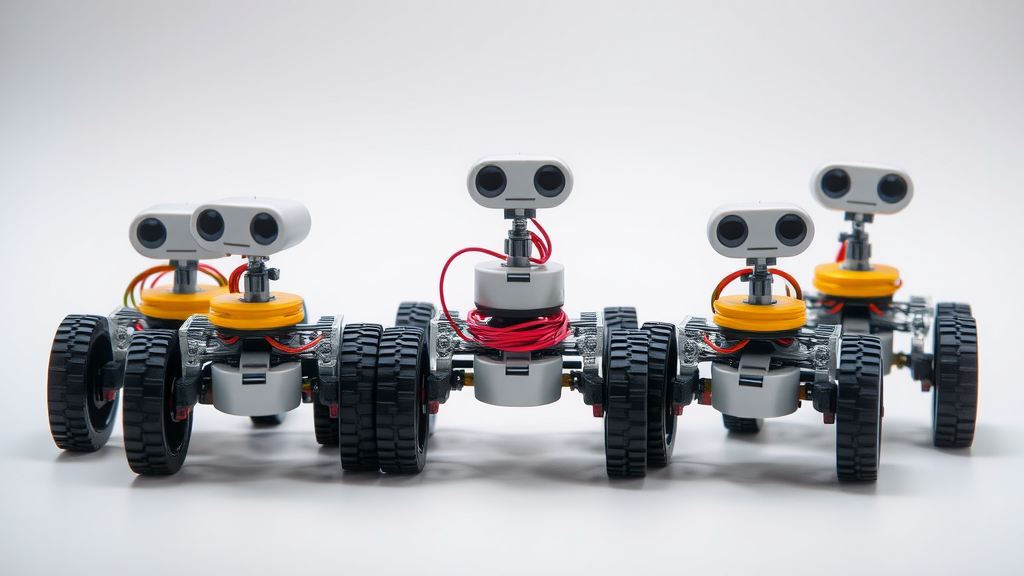
Mobile robots are everywhere, from hospital corridors delivering supplies to factory floors hauling components, and yet the humble task of keeping their wheels spinning at exactly the right speed remains a surprisingly hard control problem. A research team spanning Egypt, the United Arab Emirates and Saudi Arabia now reports a new kind of neural network controller that promises to make wheeled robots faster to compute, cheaper to run and far more resistant to the messy realities of the physical world. The work, published in the International Journal of Intelligent Robotics and Applications, introduces a hybrid polynomial-diagonal recurrent neural network controller, or HP-DRNNC, that manages to deliver robust adaptive control using only six adjustable weights in its entire architecture.
The central insight behind the design is a marriage of two ideas that each solve half of the problem. The first half is memory. Conventional feedforward neural networks treat every moment as fresh, with no recollection of what happened a millisecond ago. For a robot rolling across uneven ground, that amnesia is costly, because the dynamics of the machine carry history within them: inertia, slipping wheels, lagging motors. The researchers address this by building their hidden neurons with self-feedback loops, a configuration known as a diagonal recurrent structure. Each hidden neuron feeds its own previous output back into itself, giving the network a lightweight form of memory without the sprawling cross-connections that make fully recurrent networks computationally expensive and notoriously difficult to train stably.
The second half of the problem is expressiveness. Standard neural controllers typically rely on fixed activation functions, such as sigmoids or hyperbolic tangents, to transform signals. The new controller instead employs polynomial activation functions, which can represent nonlinear relationships with remarkable flexibility while remaining analytically tractable. Polynomial functions have a long pedigree in control theory, and their smooth, well-behaved derivatives make them particularly attractive when the control algorithm must be proven stable rather than merely observed to work. By combining polynomial activations with diagonal recurrence, the hybrid architecture captures both the nonlinear character of the robot’s dynamics and the temporal dependencies that a pure feedforward design would miss.
What truly distinguishes the work, however, is its radical economy. Where conventional adaptive neural controllers may tune hundreds or thousands of parameters online, the proposed HP-DRNNC requires only six adjustable weights. This is not merely an aesthetic preference for minimalism. Every tunable parameter in an online learning system demands computation on every control cycle, and on the embedded processors that drive real robots, that computation budget is scarce. With six weights, the controller can adapt sample by sample, updating itself in real time as the robot moves, without the need for a pre-collected training dataset. The controller learns on the job, in the field, from the live behavior of the machine it is steering.
Efficiency alone is worthless if learning is unstable, and this is where the team leans on one of the oldest and most respected tools in control engineering: Lyapunov stability theory. Rather than choosing a learning rate by trial and error and hoping the network does not oscillate or diverge, the authors derive their adaptation law directly from a Lyapunov function, a mathematical construct whose decreasing value certifies that the system’s error energy is shrinking. By requiring that the Lyapunov function decrease along every learning step, they guarantee that the weight updates cannot destabilize the controller. On top of this guarantee, they derive an adaptive learning rate rule that optimizes the speed of convergence, allowing the network to learn as fast as stability permits and no faster. The result is a learning algorithm with a mathematical certificate of stability, not just empirical evidence.
To test the design, the researchers implemented the controller on a mobile robot tasked with executing multiple practical missions, the kind of mixed duty cycles that real deployments demand. The experiments subjected the robot to two of the most common enemies of control performance: mass uncertainty and external disturbance. Mass uncertainty arises naturally when a robot carries varying payloads, since the inertia the controller must overcome changes with every load. External disturbances, from friction variations to pushes and uneven terrain, inject errors that a rigid, pre-programmed controller cannot anticipate. The HP-DRNNC absorbed both challenges, re-tuning its six weights online and holding its tracking performance where lesser controllers drifted.
The numbers reported are striking. Across the practical missions tested, the proposed controller improved the performance indices over existing controllers by 51 percent in tasks involving mass uncertainty and by 40 percent in tasks involving external disturbance. Those are not marginal gains. In robotics, performance indices aggregate tracking error over a mission, so improvements of that magnitude translate into visibly tighter trajectories, shorter settling times and less wasted energy. The comparison against other established controllers suggests that the combination of recurrence, polynomial activation and Lyapunov-certified adaptation extracts more control quality per parameter than the heavier architectures it was measured against.
The implications extend well beyond one laboratory robot. Because the architecture is so light, it is a natural fit for low-cost microcontrollers and embedded systems, the computational environments where most commercial robots actually live. The same research group has a track record of realizing intelligent controllers on inexpensive hardware, and the six-weight design follows that philosophy to its logical conclusion. A controller that adapts sample by sample without a dataset also sidesteps one of the most tedious steps in modern robotics practice: collecting, curating and validating training data before deployment. For applications such as warehouse logistics, service robotics, agricultural automation and hospital delivery, where robots encounter conditions that no offline dataset fully anticipates, that online adaptability is a genuine operational advantage.
There is also a broader lesson in the work about the value of hybrid design in an era dominated by ever-larger neural networks. While much of machine learning races toward scale, this controller moves in the opposite direction, showing that careful architectural choices, grounded in classical stability theory, can shrink a network to a handful of parameters without sacrificing capability. The diagonal recurrent structure supplies memory, the polynomial activations supply expressive power, and the Lyapunov-derived learning law supplies mathematical assurance, each component covering a weakness of the others. For engineers designing the next generation of autonomous machines, the message is that intelligence in robotics is not only about bigger models. Sometimes it is about smarter ones, small enough to run on a chip, stable enough to trust with a moving vehicle, and adaptive enough to handle a world that refuses to sit still for a training set.
Subject of Research: A hybrid polynomial-diagonal recurrent neural network controller for stable adaptive control of mobile robots
Article Title: A stable and efficient hybrid polynomial-diagonal recurrent neural network controller for mobile robot applications
Article References: Hanna, Y. F., El-Nagar, A. M., El-Bardini, M., & Khater, A. A. (2026). A stable and efficient hybrid polynomial-diagonal recurrent neural network controller for mobile robot applications. International Journal of Intelligent Robotics and Applications. https://doi.org/10.1007/s41315-026-00591-2
Image Credits: AI Generated
DOI: 10.1007/s41315-026-00591-2
Keywords: mobile robots, recurrent neural network, polynomial activation, Lyapunov stability, adaptive control, trajectory tracking, nonholonomic robots, adaptive learning rate, embedded robotics, online learning, stable, efficient
Cite Scienmag News
Cassandra Pierce. (September 20, 2026). Six Weights, One Stable Brain: New Neural Controller Keeps Mobile Robots on Track. Scienmag. https://scienmag.com/six-weights-one-stable-brain-new-neural-controller-keeps-mobile-robots-on-track/
Cassandra Pierce. "Six Weights, One Stable Brain: New Neural Controller Keeps Mobile Robots on Track." Scienmag, 20 September 2026, https://scienmag.com/six-weights-one-stable-brain-new-neural-controller-keeps-mobile-robots-on-track/. Accessed 4 October 2026.
Cassandra Pierce. "Six Weights, One Stable Brain: New Neural Controller Keeps Mobile Robots on Track." Scienmag. September 20, 2026. https://scienmag.com/six-weights-one-stable-brain-new-neural-controller-keeps-mobile-robots-on-track/


