


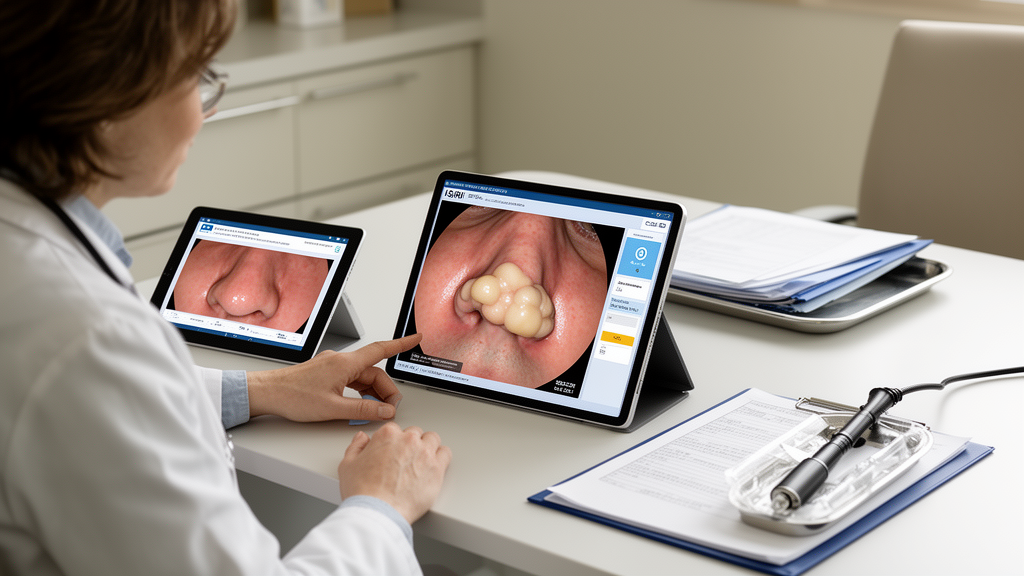
A readily available blood marker was associated with recurrent nasal polyps after endoscopic sinus surgery, but its ability to improve routine clinical prediction remained modest and uncertain. In a retrospective study of 805 adults with chronic rhinosinusitis with nasal polyps, each doubling of the preoperative systemic inflammation response index, or SIRI, was associated with 47% higher adjusted odds of endoscopic recurrence at the planned 12-month assessment. The finding was broadly preserved in analyses of missing outcomes and in a group excluding participants with nonsteroidal anti-inflammatory drug hypersensitivity who did not meet the clinical definition of aspirin-exacerbated respiratory disease.
The study used routine-care records from two campuses of Anhui No. 2 Provincial People’s Hospital in Hefei, China. The Main Campus development cohort included 445 adults who underwent endoscopic sinus surgery between January 2021 and July 2024, while the Huangshan Road Campus held-out cohort included 360 treated between February 2021 and November 2024. The surgery periods overlapped, and both campuses belonged to the same institution, so the second group was a non-overlapping, different-campus held-out evaluation rather than a temporal or fully external validation cohort. Twelve-month outcomes were available for 400 members of the development cohort and 320 members of the held-out cohort; 85 participants, or 10.6% of the full sample, lacked an evaluable endpoint.
SIRI is calculated from the absolute neutrophil, monocyte and lymphocyte counts in the same preoperative blood sample: neutrophils multiplied by monocytes, then divided by lymphocytes. For this analysis, positive values were transformed with a base-2 logarithm, allowing the main odds ratio to represent the change associated with a doubling of SIRI. Participants were required to have a blood count obtained zero to seven days before surgery, no systemic glucocorticoid exposure during the preceding 14 days, and no recorded acute infection or fever at baseline. A total of 44 participants were classified as having aspirin-exacerbated respiratory disease, defined from the clinical record as chronic rhinosinusitis with nasal polyps and asthma accompanied by a respiratory reaction to aspirin or another cyclooxygenase-1-inhibiting anti-inflammatory drug.
Among participants whose outcomes could be evaluated, recurrence occurred in 124 of 400 in the development cohort, or 31.0%, and in 99 of 320 in the held-out cohort, or 30.9%. The endpoint was defined as a total bilateral nasal polyp score of at least one on either side at the planned postoperative assessment. Visits were scheduled at approximately three, six and 12 months, with an allowable 12-month window of 11.3 to 13.0 months after surgery. Earlier documented recurrence also contributed to the binary outcome. Because the analysis was visit-based rather than a time-to-event analysis, the results do not estimate the exact probability of recurrence on postoperative day 365 or address the timing of recurrence between visits.
Descriptive comparisons showed that participants with recurrence generally had greater disease burden, including higher baseline nasal polyp, endoscopic and CT scores, more blood eosinophils, and higher C-reactive protein and total immunoglobulin E concentrations. Median SIRI was 1.367 in development participants with recurrence, compared with 0.847 among those without recurrence. The same pattern appeared in the held-out cohort, where the corresponding medians were 1.512 and 0.842. These unadjusted comparisons establish only that high SIRI was more common among people whose polyps returned; they do not show that SIRI causes recurrence or identifies a distinct inflammatory subtype of chronic rhinosinusitis with nasal polyps.
The researchers fitted three unpenalized logistic regression models in the development cohort: one using log-transformed SIRI alone, one using eight routine clinical predictors, and an extended model that added SIRI to those predictors. The clinical model included age, sex, asthma, AERD, number of previous sinus operations, Lund–Mackay CT score, total baseline nasal polyp score and blood eosinophil count. Continuous predictors were retained continuously rather than selected through univariable significance testing. In the extended model, each doubling of SIRI was associated with an adjusted odds ratio of 1.47 for recurrence, with a 95% confidence interval of 1.06 to 2.04 and a P value of 0.022. A five-point increase in CT score was also associated with higher adjusted odds, with an odds ratio of 1.73 and a 95% confidence interval of 1.23 to 2.44. The adjusted SIRI estimate represents higher odds, not a 47% increase in absolute recurrence probability for each individual patient.
All three models showed moderate discrimination, but adding SIRI changed performance only marginally. In the development cohort, the area under the receiver operating characteristic curve was 0.708 for the SIRI-only model, 0.757 for the clinical model and 0.764 for the extended model. Adding SIRI therefore increased AUC by 0.007; a paired refit-bootstrap 95% confidence interval of −0.002 to 0.026 included no change. The corresponding Brier score improved by 0.0036, with a 95% confidence interval of 0.00006 to 0.0108. When the development coefficients were applied unchanged to the held-out cohort, the three AUCs were 0.726, 0.781 and 0.791. SIRI increased the held-out AUC by 0.010, but its confidence interval ranged from −0.016 to 0.030, while the Brier-score improvement of 0.0044 had a confidence interval of −0.0025 to 0.0111.
The association was broadly stable under alternative assumptions about incomplete follow-up. Stabilized inverse-probability weighting produced an odds ratio of 1.46 per doubling of SIRI, and pooling 200 proper stochastic imputations produced 1.47. Assigning all 85 missing outcomes to non-recurrence yielded 1.44, whereas assigning every missing outcome to recurrence attenuated the estimate to 1.31, with a 95% confidence interval of 0.99 to 1.74 and a P value of 0.062. The latter was a deliberately extreme scenario rather than a plausible estimate of the missing cases, but it demonstrated that the statistical result depends partly on how outcomes absent from the records are handled. Excluding 25 participants with general hypersensitivity to non-steroidal anti-inflammatory drugs who did not meet the clinical AERD definition did not materially change the SIRI estimate, which remained 1.46 with a 95% confidence interval of 1.05 to 2.04.
Several limitations constrain the interpretation of the result. The cohorts shared an institutional system and overlapping operating periods, so the held-out analysis did not establish transportability to independent hospitals. Follow-up was incomplete and its absence was associated with younger age, although fixed-model predicted risks were similar for participants with and without an endpoint. Retrospective records may also contain residual confounding, incomplete treatment information and imperfect clinical ascertainment of AERD, particularly because no uniform study-mandated aspirin challenge was used. The number of AERD cases was small, making its adjusted estimate imprecise. The unpenalized models also showed signs of overfitting, and the clinical comparator omitted some measured inflammatory variables, including C-reactive protein, so the estimated contribution of SIRI was conditional on the predictors included. No clinical-impact evaluation, decision-curve analysis or prespecified treatment threshold was available.
Overall, the results position SIRI as an accessible candidate marker for prospective prognostic research rather than a ready-made clinical test. Its components are already measured in routine complete blood counts, making the index readily obtainable for future prediction studies. The present evidence supports an association between higher preoperative systemic inflammation and endoscopic polyp recurrence after sinus surgery, but it does not establish that the index should guide postoperative anti-inflammatory treatment, biologic therapy, surveillance or revision surgery. Independent prospective validation, better follow-up completeness, recalibration and assessment of a defined clinical decision are needed before the modest predictive gain could be judged useful in practice.
Subject of Research: Preoperative systemic inflammation response index as a prognostic marker for nasal polyp recurrence after endoscopic sinus surgery
Article Title: Preoperative systemic inflammation response index and 12-month endoscopic recurrence after endoscopic sinus surgery in chronic rhinosinusitis with nasal polyps: association and incremental predictive performance in a same-institution, two-campus cohort
Article References: Qian, X., Tong, S., Wei, P., & Wu, F. (2026). Preoperative systemic inflammation response index and 12-month endoscopic recurrence after endoscopic sinus surgery in chronic rhinosinusitis with nasal polyps: association and incremental predictive performance in a same-institution, two-campus cohort. Frontiers in Medicine, 13, Article 1983990. https://doi.org/10.3389/fmed.2026.1983990
Image Credits: AI Generated
DOI: 10.3389/fmed.2026.1983990
Keywords: systemic inflammation response index, chronic rhinosinusitis, nasal polyps, endoscopic sinus surgery, postoperative recurrence, clinical prediction model, aspirin-exacerbated respiratory disease, blood count, retrospective cohort, Preoperative, systemic, inflammation
Cite Scienmag News
Ophelia Keating. (October 21, 2026). SIRI links to 12-month nasal polyp recurrence in retrospective two-campus cohort. Scienmag. https://scienmag.com/siri-links-to-12-month-nasal-polyp-recurrence-in-retrospective-two-campus-cohort/
Ophelia Keating. "SIRI links to 12-month nasal polyp recurrence in retrospective two-campus cohort." Scienmag, 21 October 2026, https://scienmag.com/siri-links-to-12-month-nasal-polyp-recurrence-in-retrospective-two-campus-cohort/. Accessed 21 October 2026.
Ophelia Keating. "SIRI links to 12-month nasal polyp recurrence in retrospective two-campus cohort." Scienmag. October 21, 2026. https://scienmag.com/siri-links-to-12-month-nasal-polyp-recurrence-in-retrospective-two-campus-cohort/


