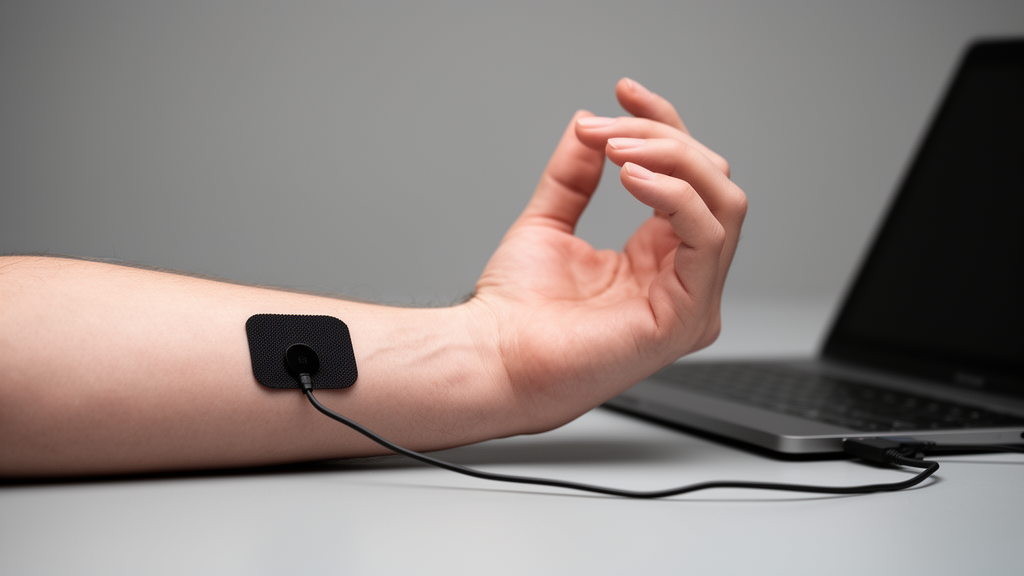
A single surface electromyography electrode strapped over one forearm muscle may be enough to drive a hand-gesture interface, but only if the system knows when to hold back rather than guess. That is the central practical message of a new subject-independent evaluation published in Medical & Biological Engineering & Computing, which tested uncertainty-aware classification on 83 quality-screened subjects and then tried to transfer the whole pipeline to an external public database. The result is an unusually candid negative finding for the fashionable field of uncertainty quantification: the expensive probabilistic machinery added nothing that a plain softmax confidence score did not already deliver.
The research team, Yiğit Aydoğan and İsmail Cantürk, recorded surface EMG from 113 healthy volunteers with a mean age of 23.4 years using a BIOPAC MP36 amplifier sampling at 10 kilohertz. Each subject performed five hand movements — rest, fist, wrist flexion, wrist extension and hand stretching — holding each for roughly four seconds. Only the Flexor Carpi Radialis (FCR) channel was used throughout, deliberately modelling the lowest-hardware scenario a prosthetic or human-computer interface might face. After trimming transition artefacts, downsampling and windowing, the pipeline yielded 16,185 windows, perfectly balanced at 3,237 per class.
Quality screening proved decisive. A systematic grounding problem plagued the recording session: 104 of the 113 subjects showed a DC offset ratio above 3.0, a sign of poor ground electrode contact. But the authors argue that DC offset alone does not invalidate a recording, because muscle activation rides on top of the offset floor. They therefore assessed quality by the ratio of active-segment to rest-segment standard deviation after DC removal. Eighty-three subjects retained at least 1.5-fold standard deviation contrast across all movements — 66 rated GOOD and 17 REVIEW — while 30 were discarded. Notably, excluded subjects actually had lower DC offset ratios on average (25.8 versus 57.1), confirming that exclusion was driven by insufficient EMG modulation rather than offset severity. The authors caution that a full demographic comparison was unavailable, so indirect selection bias from unmeasured characteristics cannot be ruled out.
Classification used nine time-domain features per 200-millisecond window with 50 percent overlap: mean absolute value, root mean square, variance, integrated EMG, waveform length, zero crossings, slope sign changes, skewness and kurtosis. These fed linear discriminant analysis, a 200-tree Random Forest, XGBoost and a multilayer perceptron (MLP), with a raw-window one-dimensional convolutional neural network (1D-CNN) and a Temporal Convolutional Network (TCN) as end-to-end comparators. Within-subject evaluation, the standard upper-bound protocol in the field, put Random Forest on top at 73.3 percent ± 13.3 percent, with LDA close behind at 73.2 percent and overlapping confidence intervals.
The picture changed sharply under leave-one-subject-out cross-validation (LOSOCV), the honest test of generalisation to unseen users. The mean gap between within-subject and cross-subject accuracy across the four feature-based classifiers was roughly 22 percentage points — 19.9 points for the MLP alone. The MLP baseline achieved 51.1 percent ± 10.3 percent full-coverage LOSOCV accuracy, well above the 20 percent chance level but far from laboratory-grade performance. This gap reflects a fundamental constraint of single-channel acquisition: without spatial diversity across electrode sites, the model cannot compensate for subject-specific differences in electrode placement, skin impedance, muscle anatomy and motor unit recruitment. The FCR electrode is also primarily sensitive to wrist flexion and fist movements, leaving wrist extension and hand stretching — movements that recruit largely silent antagonist muscles — inherently ambiguous.
Three uncertainty quantification methods were bolted onto the same MLP backbone for a controlled comparison: Monte Carlo (MC) Dropout with 30 stochastic forward passes, Deep Ensembles of three independently initialised networks, and Evidential Deep Learning (EDL), which places a Dirichlet prior over class probabilities. At full coverage, all three were statistically indistinguishable from the deterministic baseline after Holm correction across eight pre-specified paired Wilcoxon tests; for example, MC Dropout versus the MLP baseline gave a Holm-adjusted p-value of 0.329 with a mean accuracy difference of just +0.002. The end-to-end architectures fared no better: the 1D-CNN reached 44.6 percent and the TCN 44.3 percent LOSOCV accuracy on 17 sampled folds, numerically below the MLP pipeline though not significantly so. The authors attribute this to per-sample amplitude normalisation, required for stable cross-subject training of raw-waveform models, which strips out the absolute amplitude cue that the time-domain features preserve.
Selective prediction — rejecting the least confident windows and acting only on the rest — did lift accuracy substantially, from 51.1 percent to 68.3 percent at 50 percent per-subject coverage and to 83.9 percent at 30 percent coverage. But the curves for MC Dropout, Deep Ensembles and plain softmax were nearly indistinguishable, gains of +17.0, +16.8 and +17.2 percentage points respectively at 50 percent coverage. The improvement, the authors conclude, comes from the confidence-ordering property of softmax outputs, not from stochastic inference. A fixed-threshold analysis using only training-set statistics (50th-percentile confidence of 0.426) achieved 91.6 percent accuracy at 27.5 percent mean coverage, showing the abstention scheme can be configured without test-subject labels. Calibration told the same story: the deterministic MLP posted the best Expected Calibration Error at 0.024, while negative log-likelihood and Brier scores were virtually identical across all methods. EDL was the outright failure, suffering vacuity collapse with an ECE of 0.341 and actually degrading under selective prediction, falling from 51.0 percent to 39.5 percent accuracy, because its uncertainty scores ordered windows inversely to correctness.
The most sobering analysis is per-class. At 50 percent coverage, the rest class was retained at 97.5 percent coverage with near-perfect 99.7 percent accuracy, while active gestures were heavily pruned — wrist flexion kept at 38.4 percent, wrist extension at 29.5 percent and hand stretching at 32.0 percent. Excluding rest, active-gesture accuracy rose only from 39.5 percent at full coverage to 46.5 percent at 50 percent coverage. The headline selective-prediction gain is therefore structurally concentrated in rest windows, which the model classifies with extreme confidence because their amplitude is systematically higher than active-movement windows in single-channel FCR recordings. The authors argue this rest-class dominance is a structural property of sEMG datasets containing a rest class and should be explicitly accounted for whenever selective prediction is evaluated in this domain.
External validation on NinaPro DB2 — 40 intact subjects, Exercise B, and a single circumferential forearm channel rather than an anatomically targeted FCR electrode — confirmed that the feature pipeline itself generalises across recording systems: classification significantly exceeded chance across all 40 subjects (p < 0.0001), reaching 34.1 percent LOSOCV accuracy. But the uncertainty mechanism did not transfer. The per-subject uncertainty–accuracy correlation was a meaningless r = +0.047, and mean per-subject uncertainty sat near 0.92 on a 0-to-1 scale, meaning the model operated close to maximum entropy for every subject regardless of how well it performed. Selective prediction yielded only +2.6 percentage points at 50 percent coverage and +6.1 at 30 percent. Under this degree of distributional shift, the authors note, high uniform uncertainty renders abstention uninformative — a caution for anyone planning confidence-based rejection in cross-dataset deployment.
The authors are explicit about the limits of their work: only one channel was used, all subjects were healthy so amputee performance cannot be inferred, evaluation was offline on pre-segmented windows, the five-class gesture set is a small subset of full prosthetic control needs, and single-session recordings ignore electrode displacement, fatigue and long-term variability. Within those bounds, the practical implication is clear. Confidence-based rejection is viable for low-resource single-channel sEMG deployment, but plain softmax confidence — requiring no additional training or inference overhead — is sufficient under the evaluated conditions. The 30 stochastic passes of MC Dropout, though fast in absolute terms, are unnecessary overhead for a task a single deterministic pass accomplishes equally well, a finding that matters most on embedded microcontrollers and battery-powered prosthetic units where every millisecond and millijoule counts.
Subject of Research: Uncertainty-aware single-channel surface EMG hand gesture classification evaluated with subject-independent cross-validation and external validation on NinaPro DB2
Article Title: Uncertainty-Aware Single-Channel Surface EMG Classification for Low-Resource Hand Gesture Recognition: A Subject-Independent Evaluation
Article References: Aydoğan, Y., & Cantürk, İ. (2026). Uncertainty-Aware Single-Channel Surface EMG Classification for Low-Resource Hand Gesture Recognition: A Subject-Independent Evaluation. Medical & Biological Engineering & Computing. https://doi.org/10.1007/s11517-026-03704-y
Image Credits: AI Generated
DOI: 10.1007/s11517-026-03704-y
Keywords: surface EMG, hand gesture recognition, uncertainty quantification, MC Dropout, deep ensembles, evidential deep learning, selective prediction, leave-one-subject-out cross-validation, NinaPro DB2, prosthetic control, softmax calibration, single-channel sEMG
Cite Scienmag News
Denise Maddox. (October 28, 2026). Single EMG Electrode Gesture Control: Softmax Confidence Beats Costly Uncertainty Methods. Scienmag. https://scienmag.com/single-emg-electrode-gesture-control-softmax-confidence-beats-costly-uncertainty-methods/
Denise Maddox. "Single EMG Electrode Gesture Control: Softmax Confidence Beats Costly Uncertainty Methods." Scienmag, 28 October 2026, https://scienmag.com/single-emg-electrode-gesture-control-softmax-confidence-beats-costly-uncertainty-methods/. Accessed 28 October 2026.
Denise Maddox. "Single EMG Electrode Gesture Control: Softmax Confidence Beats Costly Uncertainty Methods." Scienmag. October 28, 2026. https://scienmag.com/single-emg-electrode-gesture-control-softmax-confidence-beats-costly-uncertainty-methods/