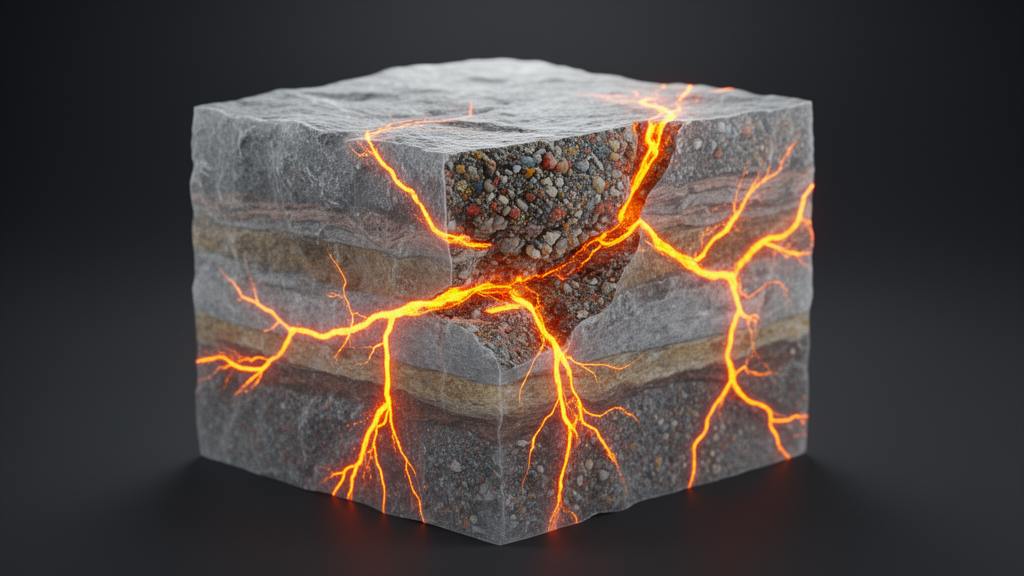
Hydraulic fracturing underpins the development of unconventional oil and gas resources, yet how fracture networks evolve inside strongly heterogeneous reservoirs has remained poorly understood. A new numerical study tackles that gap by building a two-dimensional fluid–solid coupling model based on the finite-discrete element method, published as an open-access paper in Geomechanics and Geophysics for Geo-Energy and Geo-Resources.
The model, developed by Zhi Huang, Dengke Li, Xuelin Liang and colleagues, uses a Weibull distribution with a fixed random seed approach to assign rock parameters randomly across the simulated domain, capturing heterogeneity in a controlled way. Pipe-flow elements are coupled into the framework to represent fluid transport, allowing the team to simulate the dynamic propagation of hydraulic fractures as pressurized fluid interacts with deforming rock.
The central finding concerns how the degree of heterogeneity changes the failure mode of the rock. According to the results, strong heterogeneity drives a transition from tensile failure toward shear and mixed failure, which in turn complicates the resulting fracture network. Where rock properties vary strongly from point to point, fractures no longer simply open in response to fluid pressure but also shear and deflect along local weaknesses.
That local shear deflection has a knock-on effect on the stress field around the growing fracture. The simulations indicate that deflection induced by strong heterogeneity disperses fluid pressure and weakens the energy accumulation effect of a high in-situ stress difference, the condition that normally keeps fractures straight and simple. This mechanism also diminishes the fluid-accumulation advantage of particular natural fracture orientations, such as angles of 30 and 90 degrees, causing the maximum fracture-aperture evolution to converge across different orientations.
The wellbore azimuth still determines the macroscopic fracture strike, the study finds, but conditions with a large deflection angle increase friction along the propagation path and restrict the aperture of the main fracture. In other words, the large-scale stress field sets the overall direction of growth, while mesoscale heterogeneity competes with it and reshapes the details of how wide and how branched the fractures become.
One of the study’s practical conclusions concerns which reservoirs make the best targets. Medium to strongly heterogeneous reservoirs can balance the development of secondary fracture networks against the conductivity of the main fracture, and the authors identify these conditions as favorable sweet spots for executing volume fracturing, where the goal is to stimulate a dense network rather than a single planar crack.
The work is presented as establishing a fluid-solid coupling fracture propagation model based on the finite-discrete element method, revealing what the authors describe as a cross-scale mechanical competition between macroscopic stress and mesoscopic heterogeneity. Alongside the sweet-spot identification, the paper proposes targeted stimulation strategies for the deployment of fan-shaped well networks.
As a numerical modeling study, the results provide a theoretical basis for fracturing design and for optimizing conductivity in fan-shaped well networks rather than direct field measurements. The published version is shared early as peer-reviewed, accepted research carrying a permanent DOI, subject to further edits before the final version of record. The findings suggest that accounting for rock heterogeneity, rather than treating reservoirs as uniform, could change how engineers plan fracture treatments and well placement in unconventional plays.
Subject of Research: Numerical simulation of hydraulic fracture propagation in heterogeneous reservoirs using the finite-discrete element method
Article Title: Numerical simulation of hydraulic fracture propagation in heterogeneous reservoirs based on the finite-discrete element method
Article References: Huang, Z., Li, D., Liang, X., Shen, S., Su, C., Hou, B., Ren, Z., & Gao, Y. (2026). Numerical simulation of hydraulic fracture propagation in heterogeneous reservoirs based on the finite-discrete element method. Geomechanics and Geophysics for Geo-Energy and Geo-Resources. https://doi.org/10.1007/s40948-026-01258-9
Image Credits: AI Generated
DOI: 10.1007/s40948-026-01258-9
Keywords: hydraulic fracturing, heterogeneous reservoirs, finite-discrete element method, fluid-solid coupling, fracture networks, shear failure, in-situ stress, fracture aperture, volume fracturing, unconventional oil and gas, wellbore azimuth, numerical simulation
Cite Scienmag News
Denise Maddox. (October 28, 2026). Simulations Show Rock Heterogeneity Reshapes Hydraulic Fracture Networks. Scienmag. https://scienmag.com/simulations-show-rock-heterogeneity-reshapes-hydraulic-fracture-networks/
Denise Maddox. "Simulations Show Rock Heterogeneity Reshapes Hydraulic Fracture Networks." Scienmag, 28 October 2026, https://scienmag.com/simulations-show-rock-heterogeneity-reshapes-hydraulic-fracture-networks/. Accessed 28 October 2026.
Denise Maddox. "Simulations Show Rock Heterogeneity Reshapes Hydraulic Fracture Networks." Scienmag. October 28, 2026. https://scienmag.com/simulations-show-rock-heterogeneity-reshapes-hydraulic-fracture-networks/