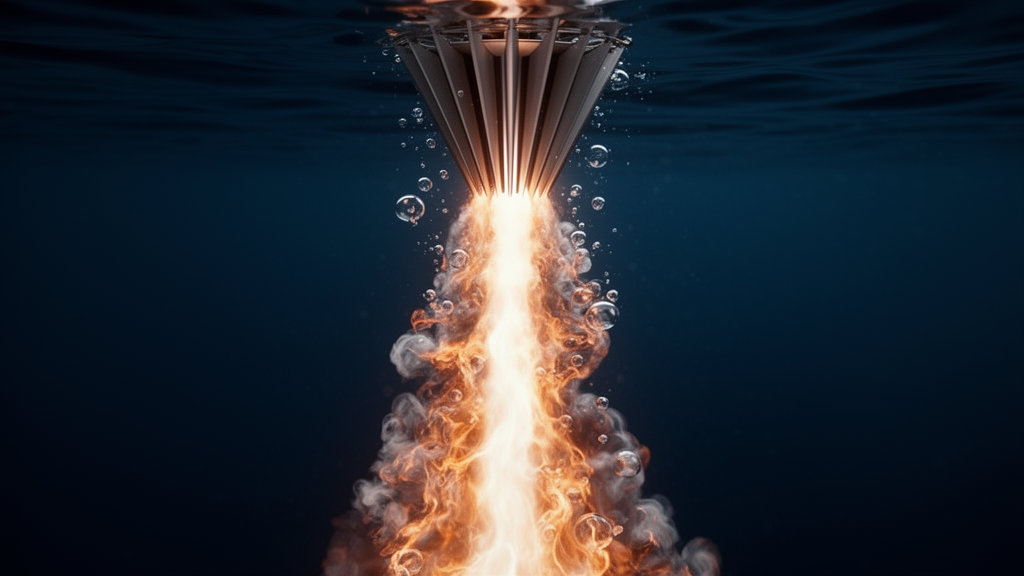
When a solid rocket motor fires underwater, its exhaust does not behave like the clean, predictable plume seen in atmospheric tests. A new numerical study published in Advances in Aerodynamics examines what happens when the exhaust of an annular conical aerospike nozzle is ignited at depths ranging from 10 to 60 meters, and the results show a jet that bulges, necks, fractures, and even turns back on the engine itself, with the violence of those effects growing steadily with depth.
The research, led by Xiwen Wang, Ranhui Liang, and Zhitan Zhou, builds a three-dimensional computational model of the underwater ignition transient of a solid rocket engine fitted with an annular throat aerospike nozzle. The team used the Volume of Fluid method to track the gas–water interface and the shear stress transport k-ω turbulence model to close the governing equations, solving the multiphase flow with a finite-volume scheme and a time step of one microsecond. The mesh contained 2.26 million hexahedral cells, with local refinement around the nozzle, the plug cone surface, and the jet core to capture the shock structures that dominate the over-expanded flow.
Validation was a central concern. The authors reproduced the underwater jet experiments of an earlier study, comparing simulated bubble morphology, jet development length, and jet width against measured data. The average error in jet development length was 6 percent, with a maximum error of 9.57 percent, and the average error in jet width was below 10 percent. Crucially, the characteristic phenomena of underwater supersonic jets—necking, bulging, and back-attack—appeared at the same locations in both experiment and simulation, giving the authors confidence that the model captures the physics of the gas–water interaction rather than merely producing plausible pictures.
The aerospike nozzle at the heart of the study is not an arbitrary choice. Unlike a conventional bell nozzle, whose expansion ratio is fixed at manufacture, the annular throat aerospike forms a semi-confined jet bounded by the plug cone on one side and open to ambient pressure on the other. That open aerodynamic boundary lets the jet adapt continuously to changes in ambient pressure, which is why aerospike engines are described as altitude-compensating. For submarine-launched systems, the same principle applies in reverse: as operating depth increases, so does ambient pressure, and a depth-compensating nozzle should, in principle, maintain thrust where a fixed-geometry bell nozzle would suffer severe over-expansion and flow separation.
The simulations make clear that underwater operation is fundamentally different from firing in air. At two milliseconds after ignition, the jet in air develops a complete Mach wave ring and expands to a larger radius, and it propagates markedly faster than its underwater counterpart. Underwater, the gas–water interface behaves like a wall, confining the supersonic gas and shaping the wave train formed outside the plug cone together with the cone surface itself. The structure of the separated flow field on the plug cone is therefore determined by the combination of the solid wall and the moving, deformable liquid boundary—a situation with no analogue in atmospheric testing.
Depth leaves a strong fingerprint on the jet’s evolution. At 10 meters, the jet’s transverse expansion exceeds the diameter of the projectile body; at 30 meters it is comparable; at 50 and 60 meters it is significantly smaller. As depth increases, ambient pressure rises, the water squeezes the jet harder, and the gas bubble volume shrinks. The 50 and 60 meter jets show apparent fracture by 13 milliseconds, the 30 meter jet begins to neck upstream, and the 10 meter jet shows no obvious bulging at that stage. The authors attribute the destabilization to coupled Kelvin–Helmholtz and Rayleigh–Taylor instability mechanisms: the velocity discontinuity at the gas–liquid interface grows unstably, shock-induced gas compression generates high-amplitude pressure pulsations, and the boundary oscillates violently before fragmenting.
Velocity fields tell the same story from another angle. The peak flow-field velocity is largest at 10 meters and decreases progressively through 30, 50, and 60 meters, because the deeper the engine operates, the stronger the confinement exerted at the gas–water interface and the slower the jet develops. Cross-sections taken 20 milliseconds after ignition show that at 10 meters the jet retains a ring of independent, sharply defined jets with a sunflower-shaped high-temperature core, while at greater depths the independent jet morphology disappears, the jet energy spreads outward rather than concentrating on the axis, and the high-temperature aggregation region at the jet’s end both cools and migrates closer to the nozzle outlet wall.
Pressure on the plug cone surface responds dramatically to depth. Five monitoring points recorded pressure–time histories at each depth, and the pattern was consistent: pressure rises, then falls, holds a period of relative stability corresponding to the jet’s bulging phase, and then oscillates as the jet breaks and attacks back. At 10 meters the pressure at the first monitoring point settles into steady-state oscillation, but at 60 meters the oscillation is the most intense, with 50 and 30 meters in between. When stabilized, the pressure on the plug cone surface is roughly 4 times ambient at 10 meters, 2 times at 30 meters, 1.5 times at 50 meters, and 1.1 times at 60 meters. The instant of violent pressure oscillation also advances with increasing ignition depth, and the initial pressure peak at the nozzle tail wall grows with depth as pressure waves from the ignition shock reflect and superimpose on the tail wall region.
Thrust follows a striking trajectory. The engine produces a large initial thrust peak at ignition, and the deeper the water, the larger that peak, because the jet’s impact on the external water is reversed onto the tail wall as an additional force. Thrust then falls rapidly as the initialized 2 MPa nozzle outlet pressure decays, rises again as the inlet pressure ramps to 12 MPa over the first 10 milliseconds, and finally increases once the outlet conditions stabilize. With increasing depth, the moment at which thrust begins to oscillate arrives earlier and the oscillation amplitude grows, mirroring the earlier fracture and back-attack of the deeper jets. The 60 meter jet breaks first, and its thrust is the first to oscillate.
The authors conclude that the oscillation of the underwater separation flow field of an aerospike nozzle is governed mainly by the jet oscillation process induced by gas–water two-phase interaction, rather than by the mechanisms familiar from air. They also note a practical limitation of the field: because underwater jet calculations are computationally expensive, most prior numerical work has used two-dimensional axisymmetric models, three-dimensional models are rare and mostly concern conventional bell nozzles, and research on underwater aerospike nozzle jets has been largely absent. By extending the aerospike concept to underwater solid rocket motors and quantifying jet morphology, plug cone pressure, and thrust across a 10 to 60 meter depth envelope, the study offers a theoretical basis for designing engines whose thrust compensation works as well beneath the sea as it does in the sky. The team also points toward a future combination of aerospike nozzles with supercavitation technology, in which a fully formed cavity around a projectile would reduce underwater drag while the nozzle continuously compensates thrust across the entire sailing envelope.
Subject of Research: Numerical simulation of underwater jet flow and thrust characteristics of an annular conical aerospike nozzle at different water depths
Article Title: Numerical study of underwater jet characteristics of an annular conical aerospike nozzle
Article References: Wang, X., Liang, R., & Zhou, Z. (2026). Numerical study of underwater jet characteristics of an annular conical aerospike nozzle. Advances in Aerodynamics, 8(1), Article 27. https://doi.org/10.1186/s42774-025-00229-0
Image Credits: AI Generated
DOI: 10.1186/s42774-025-00229-0
Keywords: aerospike nozzle, underwater jet, solid rocket engine, gas-water two-phase flow, Volume of Fluid method, flow separation, thrust oscillation, plug cone pressure, Kelvin-Helmholtz instability, back-attack, depth compensation, numerical simulation
Cite Scienmag News
Denise Maddox. (October 28, 2026). Simulations Reveal How Deep Water Squeezes and Destabilizes Aerospike Rocket Jets. Scienmag. https://scienmag.com/simulations-reveal-how-deep-water-squeezes-and-destabilizes-aerospike-rocket-jets/
Denise Maddox. "Simulations Reveal How Deep Water Squeezes and Destabilizes Aerospike Rocket Jets." Scienmag, 28 October 2026, https://scienmag.com/simulations-reveal-how-deep-water-squeezes-and-destabilizes-aerospike-rocket-jets/. Accessed 28 October 2026.
Denise Maddox. "Simulations Reveal How Deep Water Squeezes and Destabilizes Aerospike Rocket Jets." Scienmag. October 28, 2026. https://scienmag.com/simulations-reveal-how-deep-water-squeezes-and-destabilizes-aerospike-rocket-jets/