


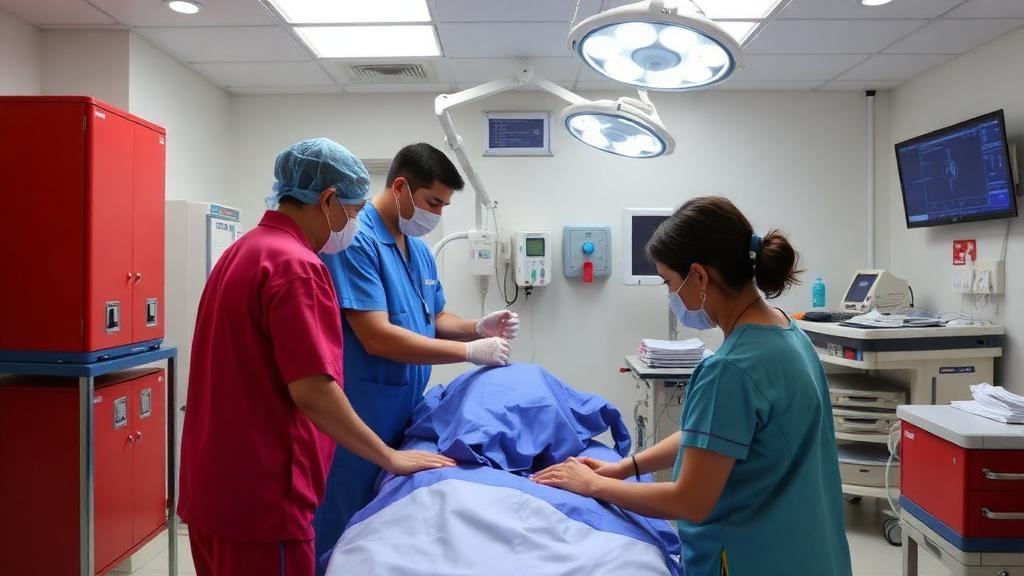
Emergency medicine is a specialty where minutes matter and mistakes can cost lives, which is precisely why the way doctors in training learn to handle cardiac arrests, multi-casualty traumas, and blocked airways has become one of the most closely watched questions in modern medical education. A new multicentre survey from Malaysia now offers one of the clearest national pictures yet of how simulation-based education is actually being delivered inside university teaching hospitals, and the findings reveal both remarkable enthusiasm and stubborn structural obstacles. The study, published in BMC Medical Education, was conducted by researchers from the Department of Emergency Medicine at Universiti Kebangsaan Malaysia and surveyed emergency physicians, programme coordinators, and postgraduate trainees across four university hospitals: Hospital Canselor Tuanku Muhriz, Pusat Perubatan Universiti Malaya, Hospital Universiti Sains Malaysia, and Hospital Al-Sultan Abdullah of Universiti Teknologi MARA.
The research team designed a cross-sectional survey using two structured questionnaires, one aimed at postgraduate emergency medicine trainees and the other at the emergency physicians and programme coordinators who run the training. The questionnaires probed how often simulation sessions were held, which simulation modalities were used, which clinical scenarios trainees were exposed to, whether resources were adequate, what barriers stood in the way of implementation, and how stakeholders perceived the future role of simulation alongside advanced technologies such as virtual reality and augmented reality. Statistical analysis was deliberately straightforward and transparent: descriptive statistics summarised the findings, exact 95 percent confidence intervals were calculated for selected proportions, and the Kruskal-Wallis test was used to explore differences in scenario frequency across the participating institutions.
Participation was strong. Of the 140 people invited, 98 completed the survey, an overall response rate of 70.0 percent. Trainees were particularly well represented, with 71 of 88 postgraduate emergency medicine trainees responding, a response rate of 80.7 percent, while 27 of 52 emergency physicians and programme coordinators took part, a response rate of 51.9 percent. This distribution matters because trainees and faculty experience simulation from opposite ends of the same process, and the survey captured both perspectives, allowing the researchers to compare how the people who design simulation programmes and the people who sit through them view the same enterprise.
The headline finding on delivery was that monthly simulation sessions are the norm rather than the exception. Among programme coordinators, 7 of 12 responses indicated monthly sessions, representing 58.3 percent with a 95 percent confidence interval of 32.0 to 80.7 percent. That wide interval reflects the modest number of coordinators surveyed, but the central message is consistent: simulation is not an occasional luxury in Malaysian university-based emergency medicine training, it is a scheduled, recurring component of the curriculum. When it comes to the tools of the trade, partial-task trainers dominated, with 99 percent of trainees reporting them as the most frequently used modality. These are the models that allow learners to rehearse a single skill, such as intubation on an airway trainer or chest tube insertion on a torso manikin, repeatedly and safely before ever touching a patient.
Scenario exposure followed a clear hierarchy that mirrors the epidemiology of emergency care itself. High-frequency exposure, with median scores of 4 or above on the survey’s ordinal scale, was reported for cardiac emergencies, trauma resuscitation, and airway management, the three domains where rapid, rehearsed teamwork most directly determines survival. At the other end of the spectrum, obstetric emergencies and disaster simulations were conducted far less often, with median scores of only 2 to 3. The gap is clinically significant. An emergency physician may encounter a pregnant patient in cardiac arrest or a mass casualty incident rarely, but when those events occur, the stakes are enormous and the opportunity for on-the-job learning is minimal. Simulation is precisely the tool designed to fill such low-frequency, high-stakes gaps, and the survey shows Malaysian programmes have not yet closed that gap.
The barriers section of the survey reads like a checklist of the challenges facing simulation-based education in many resource-conscious health systems. Insufficient trained facilitators topped the list, cited by 81.5 percent of respondents, followed closely by lack of time at 74.1 percent, limited equipment at 70.4 percent, and cost constraints, also at 70.4 percent. The facilitator shortage is arguably the most consequential of these, because high-fidelity simulation depends on skilled debriefing, the structured post-scenario conversation where most of the learning actually happens. Manikins and task trainers can be purchased, but faculty who can run realistic scenarios and then extract lessons from a stressed, error-prone team are scarcer and take years to develop. Time pressure compounds the problem in emergency departments, where clinical demand competes directly with protected teaching hours.
What makes the survey’s conclusion striking is that these barriers have not dampened belief in the method. Both faculty and trainees strongly endorsed the future expansion of simulation-based education and the integration of advanced simulation technologies into postgraduate emergency medicine training. That alignment between the people who deliver the education and the people who receive it is a powerful signal for policymakers and hospital administrators. The appetite for immersive, technology-enhanced learning, including virtual reality and augmented reality approaches, exists on the ground; what is missing is the institutional scaffolding, in the form of funded faculty development, protected time, and equipment budgets, needed to convert enthusiasm into expanded capacity.
The researchers frame their findings as a set of priorities rather than a verdict. Faculty development emerges as the first-order need, since trained facilitators unlock nearly every other element of a simulation programme. Institutional support follows, addressing the equipment and cost constraints that nearly three quarters of respondents identified. Curriculum planning is the third pillar, specifically to broaden scenario diversity so that obstetric emergencies and disaster medicine receive the same rehearsal attention as cardiac arrests and trauma. Finally, the authors point to collaborative resource sharing between institutions as a pragmatic strategy, allowing the four university hospitals and their counterparts to pool expensive simulators, share facilitator expertise, and standardise scenario libraries rather than duplicating investment at each site.
The study also carries an important scientific caveat that the authors state plainly: further outcome-based research is needed to evaluate the effects of simulation-based education on trainee performance and clinical practice. The current survey describes practices, perceptions, and barriers with commendable precision, but it cannot demonstrate that simulation improves patient outcomes or even measurable clinical competence in this setting. That question, which has occupied simulation researchers worldwide for decades, now needs to be answered in the Malaysian context, ideally through studies that track trainees from the simulation laboratory into the resuscitation bay and measure whether rehearsed skills translate into faster, safer, more accurate care.
For a country of Malaysia’s size and ambition, the implications extend beyond emergency medicine. The survey provides a template for how other specialties and other nations in the region can audit their own simulation infrastructure with the same methodological clarity, combining trainee and faculty perspectives, quantifying scenario exposure, and naming barriers in terms that administrators can act upon. The picture that emerges from these four university hospitals is of an educational system that has embraced the principle of learning by doing in a safe environment, delivers it on a regular monthly rhythm, and knows exactly what is holding it back. With facilitator training, protected time, targeted investment, and inter-institutional cooperation, the gap between what Malaysian emergency medicine trainees rehearse and what they will one day face in the emergency department could narrow considerably, and the patients they treat will be the ultimate beneficiaries.
Subject of Research: Simulation-based education in postgraduate emergency medicine training in Malaysia
Article Title: Simulation-based education in university-based postgraduate emergency medicine training in Malaysia: a multicentre survey of practices, barriers, and stakeholder perspectives
Article References: Jamal Abidi, A. S., Saiboon, I. M., Jaafar, M. J., Abd Samat, A. H., & Isa, M. H. (2026). Simulation-based education in university-based postgraduate emergency medicine training in Malaysia: a multicentre survey of practices, barriers, and stakeholder perspectives. BMC Medical Education. https://doi.org/10.1186/s12909-026-10564-5
Image Credits: AI Generated
DOI: 10.1186/s12909-026-10564-5
Keywords: simulation-based education, emergency medicine, postgraduate medical education, medical simulation, Malaysia, faculty development, virtual reality, augmented reality, trauma resuscitation, airway management, medical training, cross-sectional survey
Cite Scienmag News
Courtney Benton. (October 10, 2026). Simulation Training Transforms Emergency Medicine Education in Malaysia, Survey Reveals. Scienmag. https://scienmag.com/simulation-training-transforms-emergency-medicine-education-in-malaysia-survey-reveals/
Courtney Benton. "Simulation Training Transforms Emergency Medicine Education in Malaysia, Survey Reveals." Scienmag, 10 October 2026, https://scienmag.com/simulation-training-transforms-emergency-medicine-education-in-malaysia-survey-reveals/. Accessed 10 October 2026.
Courtney Benton. "Simulation Training Transforms Emergency Medicine Education in Malaysia, Survey Reveals." Scienmag. October 10, 2026. https://scienmag.com/simulation-training-transforms-emergency-medicine-education-in-malaysia-survey-reveals/


