


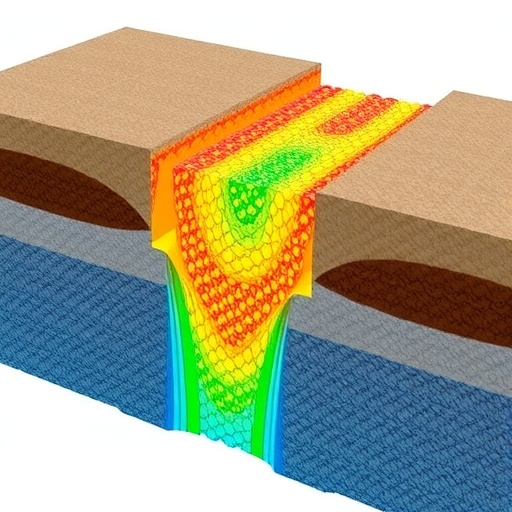
In the ever-evolving realm of petroleum engineering and geomechanics, the intricate processes governing hydraulic fracturing have long been subjects of intense scientific scrutiny. A groundbreaking study recently published in Scientific Reports by Xiao, Yuan, Wang, and colleagues offers a monumental leap forward in our understanding of proppant transport dynamics within hydraulic fractures, specifically addressing the impact of length-dependent variable aperture on these processes. This innovative research harnesses advanced numerical simulation techniques to capture the nuances of proppant movement, presenting findings that promise to reshape how engineers optimize hydraulic fracturing for enhanced resource recovery.
Hydraulic fracturing, widely known as “fracking,” is indispensable for extracting oil and natural gas from unconventional reservoirs. Central to the success of this method is the effective placement of proppant—solid particulate matter such as sand or ceramic beads—into the created fractures. Proppants serve the critical function of preventing fracture closure, thereby maintaining permeability and facilitating hydrocarbon flow. Yet, the complex interplay between fluid dynamics, proppant transport, and fracture geometry remains a formidable challenge that limits the efficiency of current fracturing operations. The team’s focus on variable fracture aperture, particularly one that changes along the fracture length, emerges as a vital factor in decoding proppant placement behavior.
Traditional models of hydraulic fractures often assume a uniform aperture size, overlooking spatial variability induced by mechanical heterogeneities and fluid-rock interactions. This new study confronts this simplification head-on by incorporating a fracture aperture that varies with fracture length, reflecting the true physical conditions observed in field operations. This variable aperture model is significant because it accounts for changes in flow velocity profiles, shear forces, and sedimentation effects, which are crucial for predicting where proppant settles within the fracture system.
Using high-fidelity numerical simulations, the research team investigated how fracture aperture variability influences proppant transport dynamics, employing a coupled fluid-solid interaction framework. This approach integrates Navier-Stokes equations for fluid flow with sedimentation and particle-transport models, calibrated against fracture mechanics principles. The simulations revealed that regions of narrower aperture accelerate fluid velocity, which in turn affects proppant transport trajectories by enhancing suspension in some areas while promoting sedimentation in others. The interplay between these mechanisms leads to heterogeneous proppant distribution, challenging previously held assumptions of homogenous proppant placement.
Moreover, the simulations highlighted the nonlinear relationship between fracture aperture variation and proppant transport efficiency. Specifically, the researchers demonstrated that even subtle aperture changes could induce marked disparities in proppant layering and vertical distribution within the fracture. This phenomenon underscores the importance of accurately characterizing fracture geometry in operational settings to avoid proppant clustering or settling that impedes effective fracture conductivity.
The implications of this research extend far beyond theoretical considerations. From a practical standpoint, understanding how fracture aperture variability governs proppant placement enables engineers to design pumping schedules and fluid viscosities tailored to site-specific geological conditions. This tailored approach could mitigate premature proppant settling, minimize nonproductive fracture regions, and ultimately enhance hydrocarbon recovery rates. Furthermore, the insights obtained may inform the development of novel proppant materials engineered to synergize with variable-aperture fracture environments.
One of the pivotal technical breakthroughs of this study is the integration of fracture aperture length dependency into the simulation framework, which required innovative numerical methods to reconcile the scale disparities between fluid flow turbulence, particle sedimentation, and fracture mechanics. The team employed adaptive mesh refinement techniques to capture fine-scale heterogeneities along the fracture path, allowing unprecedented resolution of flow patterns and particle dynamics. Such methodological sophistication positions this research at the cutting edge of computational geomechanics and hydraulic fracture modeling.
Another noteworthy aspect is the study’s validation strategy. The researchers cross-referenced their simulation outputs with laboratory experiments mimicking variable aperture fractures and proppant transport under controlled flow conditions. The close agreement between simulated and experimental results lends robust credibility to their numerical model while opening avenues for further empirical calibration in more complex real-world scenarios.
Beyond its immediate engineering applications, this study also contributes fundamentally to the science of multiphase flow in porous media and fractured systems. By elucidating the coupling between hydrodynamic forces and solid particle transport in geometrically heterogeneous fractures, the work offers insights applicable to a broad spectrum of fields including environmental remediation, geothermal energy extraction, and subsurface waste management where proppant or particle transport phenomena are relevant.
Intriguingly, the authors discuss the potential for incorporating their model into real-time field monitoring technologies. By integrating sensors measuring fracture aperture changes during fracturing operations with predictive algorithms based on their numerical model, operators could dynamically adjust treatment parameters to optimize proppant distribution on the fly. This prospect signals a step towards smarter, more adaptive hydraulic fracturing techniques made possible through digital twins of subsurface fracture networks.
As energy production faces mounting environmental and economic pressures, innovations that improve resource extraction efficiency while reducing operational footprint are urgently needed. The insights from this study provide a critical foundation for such innovations by delivering a more realistic and predictive understanding of fracture behavior during stimulation. This enables more environmentally conscientious fracturing fluid design, reduced chemical waste, and minimized subsurface damage.
The research also charts new territory for academia-industry collaboration. By bridging theoretical fracture mechanics with actionable engineering designs, the presented proppant transport simulation framework stands as an archetype of how interdisciplinary teamwork drives tangible technological progress. It is anticipated that oil and gas operators will rapidly adopt and refine these modeling techniques to enhance reservoir performance, especially in challenging reservoirs characterized by complex fracture geometries.
Importantly, this work catalyzes a paradigm shift from static fracture design towards dynamic, geometry-aware fracturing strategies. The concept of length-dependent variable aperture fractures is not just a numerical curiosity but a reflection of real geological complexities that must be embraced to unlock the full potential of hydraulic fracturing. Recognition of such complexity transforms how engineers conceive fracture stimulation, mandating more sophisticated modeling and monitoring frameworks.
The study’s comprehensive treatment of fracture aperture variability also complements emerging trends in proppant technology, such as degradable and ultra-lightweight proppants. Understanding how these materials behave in variable aperture settings can drive next-generation material innovation, fostering smart proppants tailored for site-specific fracture profiles and flow conditions.
Looking ahead, Xiao et al. envision extending their model to three-dimensional fracture networks to incorporate multiple interacting fractures—a scenario typical in advanced multistage fracturing operations. Such expansion would further enhance the predictive power of their simulations and support increasingly intricate reservoir stimulation designs. Moreover, coupling chemical-fluid interactions with proppant transport in variable aperture fractures promises to unlock new mechanistic understandings relevant to hydraulic fracturing fluid chemistries.
In sum, this landmark study unveils the critical role of length-dependent variable fracture aperture in governing proppant transport, providing a highly detailed numerical tool that significantly advances hydraulic fracturing science. By bridging complex fracture geometry with quantifiable proppant transport dynamics, it sets a new benchmark for realistic simulation in unconventional reservoir engineering. The work stands to not only optimize current operations but also inspire innovative approaches to fracture stimulation that harmonize technical efficiency with environmental stewardship.
Cite Scienmag News
Denise Maddox. (June 9, 2026). Simulating Proppant Transport in Variable-Length Hydraulic Fractures. Scienmag. https://scienmag.com/simulating-proppant-transport-in-variable-length-hydraulic-fractures/
Denise Maddox. "Simulating Proppant Transport in Variable-Length Hydraulic Fractures." Scienmag, 9 June 2026, https://scienmag.com/simulating-proppant-transport-in-variable-length-hydraulic-fractures/. Accessed 3 September 2026.
Denise Maddox. "Simulating Proppant Transport in Variable-Length Hydraulic Fractures." Scienmag. June 9, 2026. https://scienmag.com/simulating-proppant-transport-in-variable-length-hydraulic-fractures/


