


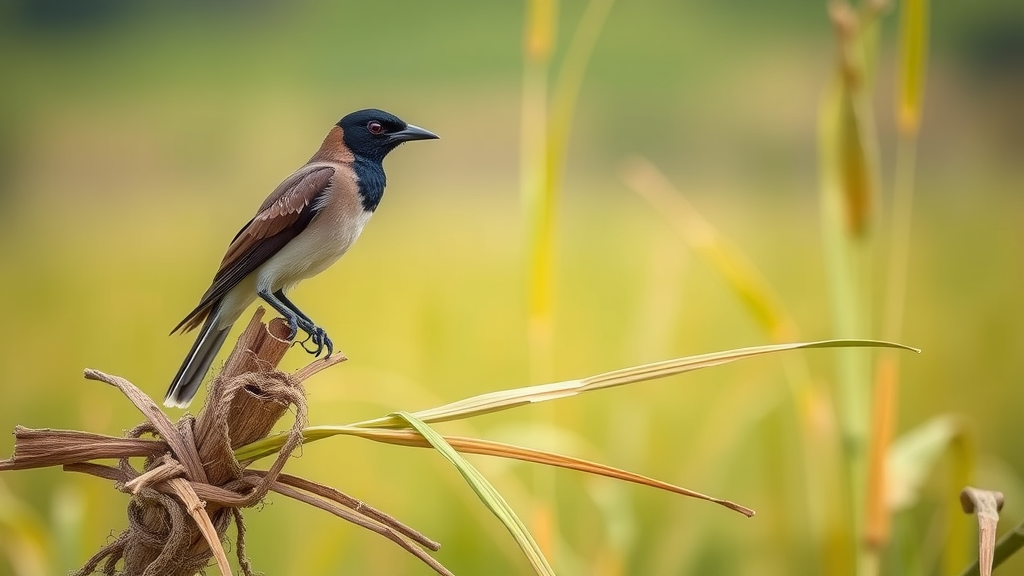
It sounds almost too simple: stick a pole in a flooded rice field, and a hawk will do the pest control for you. Yet a new study from the rice-growing lowlands of Daule, Ecuador, published in Discover Ecology, shows that the humble perch may be one of the most elegant tools yet devised against one of the world’s most destructive invasive crop pests. Snail kites, raptors that feed almost exclusively on freshwater apple snails, devoured roughly five to six times more snails in field plots equipped with perches than in open plots without them, and researchers say the finding could reshape how farmers manage an invader that costs rice producers millions each year.
The channeled apple snail, Pomacea canaliculata, is native to southern South America but has spread to rice regions around the world over the past few decades, reaching Ecuador in 2005. In flooded paddies the snails graze voraciously on newly transplanted rice seedlings, and in natural wetlands they strip away aquatic vegetation and reroute nutrient flows. Because the snails often arrive without their natural predators, populations can explode, leaving farmers reliant on repeated applications of molluscicides. Those chemical campaigns kill snails effectively, but they are expensive, environmentally damaging, and must be endlessly repeated because snails surviving in unplanted ditches and borders simply recolonize treated fields.
Enter the snail kite, Rostrhamus sociabilis, a hawk with a deeply curved bill exquisitely adapted for one job: extracting the soft body of a Pomacea snail from its shell. The kites cannot eat in flight. Instead they snatch a snail from the water, carry it to a perch, and use their bill to sever the columellar muscle anchoring the animal to its shell, leaving behind a structurally intact, unpunctured shell that accumulates in telltale piles beneath favored feeding posts. That distinctive signature allowed the research team, led by Denis Mosquera of the Universidad Veracruzana in Mexico together with colleagues including Robert J. Fletcher Jr. of the University of Cambridge, to attribute consumed shells unambiguously to kites rather than to limpkins, the only other known snail predator, which puncture shells while foraging at ground level.
Between March 2024 and February 2025, the team set up seventeen experimental blocks in flooded rice fields, each containing three 20 by 20 meter plots: one with natural perches such as earthen field borders, dead snags, and trees; one with a single artificial perch built from inexpensive materials, a small metal mesh platform on a pole standing about 1.5 meters above the water; and one control plot with no perches at all. They then tracked predation two ways, counting and measuring the empty shells accumulating beneath perches each month, and directly observing hunting kites from a distance with binoculars and a telescope.
The results were striking. During the first monthly count, artificial perches accumulated an average of about 626 empty shells per square meter of perch base, dwarfing the roughly 3 shells per square meter found at earthen borders. Capture rates told the same story from the other direction: kites hunting in plots with natural perches caught snails at 4.8 snails per minute and those using artificial perches at 3.9 per minute, compared with just 0.7 per minute in open plots. Search times collapsed wherever perches existed, averaging about 24 seconds with natural perches and 22 seconds with artificial ones, versus a punishing 109 seconds of hovering over open water before a capture.
Hunting distance revealed the underlying mechanics. Kites using perches struck from an average of only 22 meters for natural perches and about 10 meters for artificial ones, always flying directly from the perch to the prey. In perchless plots, kites had to engage in prolonged hovering flights averaging 109 meters, an energetically costly strategy that apparently limits how much effort they will invest. Perch availability, in other words, transforms the rice field from marginal habitat into prime hunting ground for a specialist predator, echoing previous work in Florida wetlands that first suggested artificial perches could help kites handle exotic apple snails.
One detail carries particular biological weight: the snails eaten at artificial perches were significantly larger than those taken at natural perches overall. Because female channeled apple snails are larger and more fecund than males, kites feeding at artificial perches are likely removing the most reproductively valuable individuals from the population. In a single month, kites consumed more than 1,300 snails at artificial perch plots and more than 2,800 at natural perch plots after the researchers cleared away old shells, hinting at predation pressure capable of meaningfully suppressing snail numbers at the landscape scale.
Equally telling was what happened in the control plots. Without perches, predation was so inefficient that these areas effectively became refuges where snails experienced little to no predation pressure, potentially seeding reinvasion of surrounding fields. The researchers draw a direct parallel to the well-documented pattern in which pesticide-induced pest resurgence follows the killing of natural enemies in rice systems. Chemical fumigation wipes out snails temporarily, but perchless refuges and surviving border populations guarantee the pest’s return, while the farmer’s costs, and the ecological toll, keep climbing.
The study is not without caveats. The authors note high variation among plots, and because trees were concentrated in only two of the seventeen blocks, the observed size differences in snails consumed at trees could reflect spatial variation in snail availability rather than perch effects alone. Still, the core conclusion stands on strong statistical footing, with perch type explaining most of the variance in shell density in their mixed models, and significant differences persisting across pairwise comparisons corrected for multiple testing.
The practical appeal is hard to overstate. The artificial perches cost almost nothing, use locally available materials, and require minimal installation effort, making the technique accessible to small-scale farmers across the tropics. Strategically placed perches in perch-limited corners of the rice landscape could eliminate snail refuges, reduce agrochemical dependence, and bolster populations of a charismatic specialized raptor at the same time. In a field where biological control of invasive prey often fails because habitat structure constrains the predator, this study offers a rare, deceptively simple prescription: give the hunter a place to land, and let evolution’s most specialized snail-eater go to work.
Subject of Research: Biological control of the invasive channeled apple snail by snail kites in rice fields, and the effect of natural and artificial perches on kite foraging efficiency.
Article Title: Snail kite (Rostrhamus sociabilis) feeding efficiency on pest channeled apple snails (Pomacea canaliculata) increases in rice fields with ‘natural’ and artificial perches
Article References: Mosquera, D., Ruelas Inzunza, E., Fletcher, R. J., Jr., Galindo-González, J., Noa-Carrazana, J. C., & Pérez-Staples, D. (2026). Snail kite (Rostrhamus sociabilis) feeding efficiency on pest channeled apple snails (Pomacea canaliculata) increases in rice fields with ‘natural’ and artificial perches. Discover Ecology, 2(1), Article 15. https://doi.org/10.1007/s44396-026-00033-0
Image Credits: AI Generated
DOI: 10.1007/s44396-026-00033-0
Keywords: snail kite, channeled apple snail, biological control, rice fields, invasive species, artificial perches, foraging efficiency, pest management, Ecuador, Pomacea canaliculata, Rostrhamus sociabilis, sustainable agriculture
Cite Scienmag News
Alan Morgan. (September 12, 2026). Simple Wooden Perches Turn Snail Kites Into Powerful Allies Against Rice Pest. Scienmag. https://scienmag.com/simple-wooden-perches-turn-snail-kites-into-powerful-allies-against-rice-pest/
Alan Morgan. "Simple Wooden Perches Turn Snail Kites Into Powerful Allies Against Rice Pest." Scienmag, 12 September 2026, https://scienmag.com/simple-wooden-perches-turn-snail-kites-into-powerful-allies-against-rice-pest/. Accessed 4 October 2026.
Alan Morgan. "Simple Wooden Perches Turn Snail Kites Into Powerful Allies Against Rice Pest." Scienmag. September 12, 2026. https://scienmag.com/simple-wooden-perches-turn-snail-kites-into-powerful-allies-against-rice-pest/


