


In the deserts of the United Arab Emirates, one of the toughest barriers to restoring native vegetation is not the scorching sun or the salty soil, but something much smaller: the seed coat. Many arid-zone plants armor their seeds with hard, water-impermeable coatings that keep them dormant until conditions are right. This physical dormancy is a brilliant survival strategy, preventing seeds from sprouting during a dry spell that would kill a young seedling. But for ecologists trying to reforest degraded desert land or produce native plants for agriculture and landscaping, that same armor becomes an obstacle. A new study from researchers at United Arab Emirates University puts hard numbers on how best to break it, and the verdict is strikingly low-tech: a pair of nail clippers.
The research, published in Innovations in Agriculture, tested four seed pretreatments across nine flowering species native to the UAE, a lineup that includes some of the country’s most ecologically and culturally important plants. Among them are the iconic Ghaf tree (Prosopis cineraria), the national tree of the UAE and a symbol of desert resilience; the Umbrella Thorn Acacia (Acacia tortilis), whose canopy shape anchors agroforestry systems across the Middle East and Africa; and several Senna species prized in traditional medicine as natural laxatives. The roster also included Sudan grass (Sorghum sudanense), a drought-tolerant forage crop, the nitrogen-fixing shrubs Tephrosia nubica and Crotalaria persica, the medicinal velvetleaf abutilon (Abutilon pannosum), and coffee senna (Senna occidentalis), a plant with known insecticidal properties.
The team, led by Nour Debouza with experimental design by Taoufik Ksiksi and contributions from Sunil Mundra and Iltaf Shah, collected seeds from four sites around Al-Ain City, including the university campus, Al-Ain Zoo, the Local Plants Park Asharij, and the Mazyad district. Back in the laboratory, they ran a carefully controlled germination trial. For each species and each treatment, 100 seeds were used across five replicates, with 20 seeds per replicate. The seeds were first surface-sterilized in a 5 percent bleach solution for 15 minutes, then placed in petri dishes lined with filter paper and held in an incubator at a constant 24 degrees Celsius in continuous darkness for 14 days. Germination was checked every afternoon, and on the ninth day the dishes were cleaned and the filter papers replaced to ward off bacterial and fungal contamination.
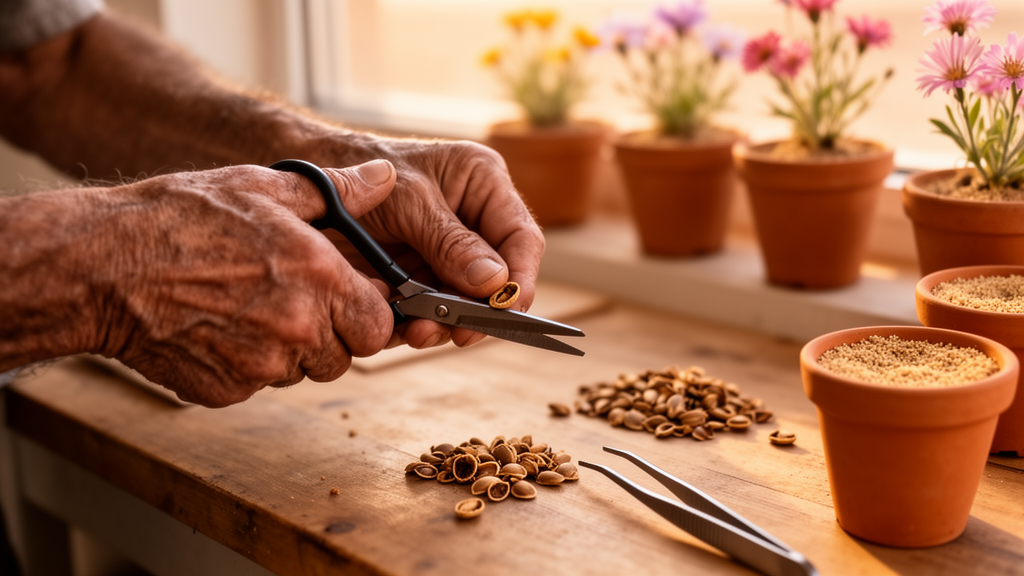
The four pretreatments were chosen to mimic and accelerate processes that seeds experience in nature. Mechanical scarification, abbreviated MChip in the study, involved manually chipping each seed across its coat with nail clippers, replicating the abrasion seeds suffer against sand and rocks, or the digestive grinding they endure inside the guts of birds and camels. Chemical scarification used 96 percent sulfuric acid for either 15 or 30 minutes (SAcid15 and SAcid30), a laboratory proxy for the slow chemical weathering that seeds might experience in soil. The final treatment was a simple 24-hour soak in tap water, imitating the flash-flood conditions that periodically drench desert soils. A control group, sterilized but otherwise untreated, completed the design.
Rather than relying on a single metric, the researchers evaluated six germination parameters: final germination percentage, mean germination time, mean germination rate, coefficient of velocity of germination, mean daily germination percentage, and germination index. Together these measures capture not only how many seeds sprouted but how quickly and uniformly they did so, giving a far richer picture of treatment effects. One-way ANOVA with Dunnett’s post hoc corrections, run in RStudio, compared each treatment against the control for every species.
The headline result concerns final germination percentage, which improved significantly (P < 0.001) in seven of the nine species after mechanical chipping. Senna italica reached a perfect 100 percent germination, while Sorghum sudanense hit 98 percent, Tephrosia nubica 97 percent, Senna angustifolia 99 percent, Acacia tortilis 98 percent, Prosopis cineraria 99 percent, and Crotalaria persica 93 percent. The 30-minute sulfuric acid treatment matched that level of improvement across the same seven species, while the shorter 15-minute acid bath worked for three species and the water soak for only two, Tephrosia nubica and Acacia tortilis, and only modestly. In practical terms, this means a grower armed with nothing more than clippers and patience can coax nearly every viable seed of these desert natives into a seedling.
The finer-grained timing metrics told a more nuanced story. Mean germination rate improved significantly in seven species under the 30-minute acid treatment, with values ranging up to 0.972 days for the Ghaf tree, while mechanical chipping significantly boosted that parameter in just one species, Senna angustifolia. Mean germination time responded most strongly to the 30-minute acid exposure, improving in seven species, whereas the coefficients of velocity and the germination index showed substantial gains under both acid durations and, to a lesser degree, chipping. Mean daily germination percentage improved in six species under both mechanical chipping and the longer acid soak, with Umbrella Thorn Acacia posting the largest gain at 34.061 percent. Soaking, by contrast, lagged across nearly every metric, confirming that plain water is rarely enough to penetrate these desert-grade seed coats.
Not every species cooperated. Senna occidentalis was the sole holdout, showing no statistically significant change in any germination parameter under any of the four treatments. That anomaly is itself scientifically interesting, suggesting that this species’ dormancy operates through mechanisms other than a simple physical barrier, perhaps requiring different cues such as temperature fluctuations or chemical signals to trigger sprouting. The finding is a useful reminder that dormancy is not a one-size-fits-all phenomenon; its strength and nature vary with both genotype and the environmental conditions under which the seeds formed, as earlier studies have documented.
Why does the ranking of treatments matter beyond the laboratory? The Ghaf tree illustrates the stakes. Previous work had shown sulfuric acid could raise its germination by up to 75 percent, and the new study confirms acid’s power, with a 30-minute exposure lifting germination to 99 percent. But sulfuric acid is dangerous to handle, requires protective equipment, and generates hazardous waste, which limits its use in community-based planting programs and remote nurseries. Mechanical scarification, though labor-intensive when applied to thousands of seeds, is safe, cheap, and requires no special infrastructure. The authors conclude that it is the safest and most effective pretreatment overall, benefiting eight of the nine species studied, with acid scarification as the second-choice option best reserved for situations where large seed volumes must be processed quickly.
The implications stretch from restoration ecology to food security. The nine species span forage grasses, nitrogen-fixing green manures, medicinal shrubs, and keystone desert trees, so reliable germination protocols feed directly into reforestation campaigns, soil stabilization projects, and efforts to combat desertification. The study’s authors frame their work as practical guidance for sustainable agriculture and biodiversity conservation, helping conservationists reduce extinction risk for native flora while giving farmers and land managers a reproducible recipe for seedling production. As climate change intensifies pressure on arid ecosystems, the humble act of clipping a seed coat, mirroring the abrasion of wind-blown sand and a camel’s gut, may prove to be one of the simplest and most powerful tools for keeping the UAE’s desert flora alive.
Subject of Research: Effects of mechanical and chemical scarification on seed germination in nine flowering species of the United Arab Emirates
Article Title: Mechanical scarification: The key to optimal germination parameters in nine flowering species of the United Arab Emirates
Article References: Debouza, N. E. H., Mundra, S., Shah, I., & Ksiksi, T. (2024). Mechanical scarification: The key to optimal germination parameters in nine flowering species of the United Arab Emirates. Innovations in Agriculture, 7, 1-10. https://doi.org/10.3897/ia.2024.124153
Image Credits: AI Generated
Keywords: seed germination, mechanical scarification, seed dormancy, sulfuric acid scarification, United Arab Emirates, Prosopis cineraria, Acacia tortilis, desert restoration, plant physiology, reforestation, arid agriculture, germination parameters
Cite Scienmag News
Alan Morgan. (October 18, 2026). Simple Seed-Cutting Trick Unlocks Germination in Nine Desert Flowers of the UAE. Scienmag. https://scienmag.com/simple-seed-cutting-trick-unlocks-germination-in-nine-desert-flowers-of-the-uae/
Alan Morgan. "Simple Seed-Cutting Trick Unlocks Germination in Nine Desert Flowers of the UAE." Scienmag, 18 October 2026, https://scienmag.com/simple-seed-cutting-trick-unlocks-germination-in-nine-desert-flowers-of-the-uae/. Accessed 18 October 2026.
Alan Morgan. "Simple Seed-Cutting Trick Unlocks Germination in Nine Desert Flowers of the UAE." Scienmag. October 18, 2026. https://scienmag.com/simple-seed-cutting-trick-unlocks-germination-in-nine-desert-flowers-of-the-uae/


