


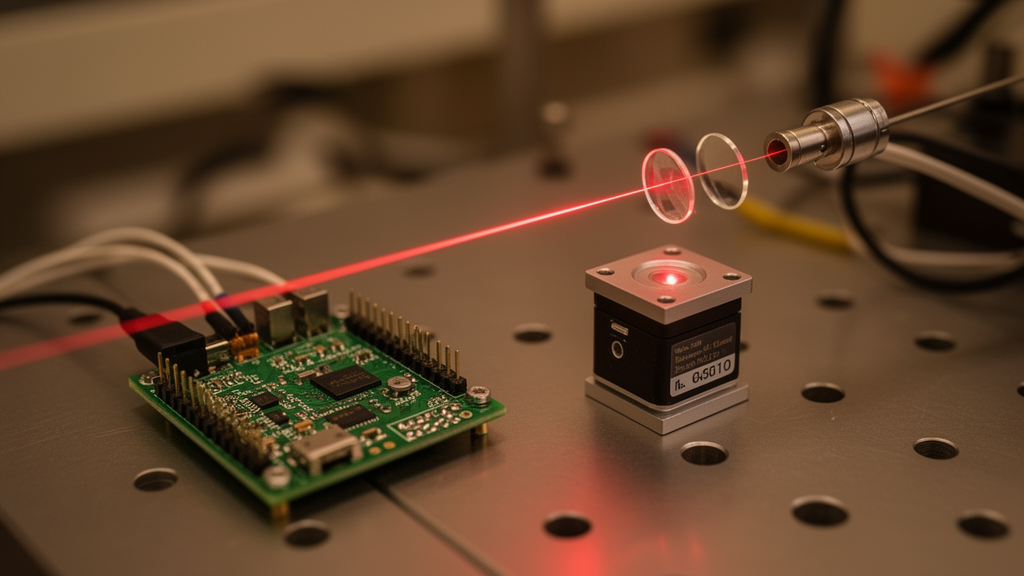
Laser systems that need both high power and a single, spectrally pure frequency face a stubborn problem: the semiconductor laser diodes that can deliver hundreds of milliwatts usually refuse to stay locked to a clean, narrow-line mode for very long. A team of physicists led by Florian Kiesel, Kirill Karpov, Alexandre De Martino, Jonas Auch and Christian Gross has now demonstrated a remarkably simple fix. Instead of surrounding the laser with elaborate optical and electronic stabilization hardware, they let a low-cost microcontroller periodically re-tune the laser diode’s current, keeping the light injection locked in a quasi-continuous manner over timescales of hours. The work was published on 10 January 2025 in EPJ Techniques and Instrumentation as an open access research article.
The technique addresses a long-standing bottleneck in atomic, molecular and optical physics. Experiments in this field often require several narrow-line laser beams with output powers in the 100 milliwatt range. Tapered amplifiers offer a scalable solution in the red and near-infrared, but they are not available at shorter wavelengths, where the rising popularity of alkaline-earth and alkaline-earth-like atoms for quantum technologies has made narrow-line laser amplification increasingly important. Injection locking of high-power laser diodes is a commonly used and cost-effective technique for this purpose, yet for many diodes it is very challenging to achieve stable operation of the locked state because of a complex interplay of non-linearities and thermal effects.
Injection locking itself is conceptually straightforward. Seed light from a spectrally pure master laser is injected into a more powerful slave laser diode, forcing the slave to emit at the seed’s frequency. When the slave’s cavity becomes resonant with the seed, injection locking forces it to lase at the seed frequency, and its spectral purity rises until it matches the seed’s spectrum. The difficulty is that successful locking requires the slave laser’s parameters, such as temperature and current, to be set precisely so that the cavity matches the incoming seed light. Existing stabilization schemes, whether active or passive, exploit properties such as polarization purity, Fabry-Pérot signals, atomic vapor cell spectroscopy, interference filter transmission, intensity noise or beam shape. All of these rely on a non-negligible amount of overhead equipment and depend at least partly on the specific diode, which hinders scalability and general applicability.
The new method strips the problem down to its essentials. The only hardware required is a microcontroller, in this case an Arduino Due, which reads the slave laser diode’s internal photo diode and controls the set point of the slave laser current through the external modulation input of the current controller. The photo diode’s current is converted to a voltage with a standard transimpedance-amplifier circuit. The key insight is that the photo diode signal, plotted as a function of the slave diode’s current, changes characteristically when the seed light is present. Sweeping the current while monitoring this signal reveals a resonance feature with a sharp, asymmetric jump on the low-current side, and this jump marks the optimal operating current for the locked state.
The asymmetry and hysteresis of the signal arise from cavity expansion caused by Joule heating and by heating from the resonant seed light. When the current is swept from high to low, the jump occurs at smaller currents than when sweeping upward, and the downward sweep produces a much more prominent peak. Ramping the current down and stopping just before the abrupt jump yields a more stable and spectrally purer injection; some diodes also show a small plateau just before the jump. The researchers exploited this structure in a three-step Injection Lock optimization Algorithm: sweep the current up with the resonance jump in the middle of the ramp, sweep down over the same interval while recording the photo diode signal and computing its numerical derivative to locate the jump point, then sweep up again and back down to an optimal current offset from the detected jump, which must be fine-tuned for each diode and working point. Each step in the discrete ramps is held for about 0.1 milliseconds, and the whole algorithm takes about 0.4 seconds, after which the laser current is held constant. The optimization can be triggered externally and synchronized to an experimental cycle, for example during a phase of an ultracold-gas experiment when no laser light is needed, so it does not affect the cycle time.
Thermalization turned out to be central to making the scheme reliable. The position of the jump point depends strongly on the history of the system: starting from an initially unlocked laser, it drifts to lower currents under continuous application of the triangular current ramps and converges to a constant value after about 10 iterations. The team therefore implemented a cold start option in which the trigger is held to run about 15 ramp-cycles before releasing the algorithm to find the optimal current reliably. Once thermalized, brief lock losses of tens of seconds leave the jump point essentially unchanged between consecutive iterations.
To quantify performance, the researchers characterized a slave diode at 671 nanometers, a Ushio HL67001DG used for laser cooling of lithium, whose cooling performance serves as an independent check of the generated light’s spectral quality. They defined spectral purity by comparing the integrated spectral power of the injection locked and free-running diode, measured with a HighFinesse laser spectrum analyzer. The free-running diode lases over a spectrum about 2 nanometers wide around 674 nanometers at 22 degrees Celsius, well separated from the seed at 671 nanometers. With a seed power of 3.2 milliwatts and a driver set point of 204 milliamperes delivering 180 milliwatts of optical power, reliable locking was obtained for current offsets from the jump point between 1.9 and 3.6 milliamperes. Smaller offsets lose the fully injected state after a short time, larger offsets reduce the spectral purity, and below about 2 milliwatts of seed power the stable interval essentially vanishes and a fully injected state can no longer be achieved. The width of the stable region decreases non-linearly with seed power, a typical signature of mode competition in a lasing system.
The long-term test is the headline result. With a seed power of 3.2 milliwatts and an offset of 2.7 milliamperes, the algorithm was run once per minute for six hours, a total of 360 repetitions. It never failed to bring the system to a fully injection locked state. The measured spectral impurity stayed at the detection limit, below 6 per mille, with a mean of 1.18 per mille; detection noise explains some negative values in the data. The current set point stayed within a range of plus or minus 0.4 milliamperes for the whole measurement, and although a drift appeared after about 3 hours, shifting the average set point of the final iterations by 0.18 milliamperes, the spectral impurity was unaffected. The team also confirmed the spectral measurements through long-time monitoring of the entire laser cooling system, where the detected atom number, which is highly sensitive to spectral purity, remained stable within a detection noise of a few percent.
Generality and scalability were demonstrated as well. The method worked for slave diodes at 401 nanometers (a Nichia NDV4B16 used for cooling erbium), 461 nanometers (Nichia NDB4916) and 689 nanometers (Ushio HL69001DG) for cooling strontium, with reliable locking obtained for all tested diodes after parameter optimization. Blue diodes show notably stronger thermal responses, so slower ramps may be needed; without optimizing for speed, the algorithm took at most 1 second to finish. The researchers also operated six slave diodes in two-stage serial configuration with output powers between 100 and 190 milliwatts, and verified that applying the algorithm sequentially to two chained injection locks, in which one amplified slave seeds a second, assured reliable locking of the entire system for lithium laser cooling.
The practical implications extend beyond a single lab trick. Because the scheme requires only a microcontroller and the diode’s own internal photo diode, it can be replicated cheaply across many laser channels, enabling distributed amplification of single-frequency light and multi-beam power delivery in setups that would otherwise drown in stabilization hardware. The authors note that the algorithm only fails without chance of recovery if the optimal current set point drifts outside the ramp interval, which can be chosen several tens of milliamperes wide and is unlikely even at the scale of months. For experiments demanding narrow linewidth laser light with hundreds of milliwatts delivered along several beam paths, a periodic half-second relock may prove to be all the stabilization a laser system needs.
Subject of Research: A periodically applied microcontroller-based relocking scheme that maintains stable, spectrally pure injection locking of high-power laser diodes for quasi-continuous-wave applications.
Article Title: Long-term stable laser injection locking for quasi-CW applications
Article References: Kiesel, F., Karpov, K., De Martino, A., Auch, J., & Gross, C. (2025). Long-term stable laser injection locking for quasi-CW applications. EPJ Techniques and Instrumentation, 12(1), Article 1. https://doi.org/10.1140/epjti/s40485-024-00113-z
Image Credits: AI Generated
DOI: 10.1140/epjti/s40485-024-00113-z
Keywords: injection locking, laser diodes, microcontroller, spectral purity, quasi-CW lasers, laser cooling, thermalization, Arduino, narrow linewidth, atomic physics, laser stabilization, distributed amplification
Cite Scienmag News
Katie Riggs. (October 29, 2026). Simple Microcontroller Trick Keeps Injection-Locked Lasers Stable for Hours. Scienmag. https://scienmag.com/simple-microcontroller-trick-keeps-injection-locked-lasers-stable-for-hours/
Katie Riggs. "Simple Microcontroller Trick Keeps Injection-Locked Lasers Stable for Hours." Scienmag, 29 October 2026, https://scienmag.com/simple-microcontroller-trick-keeps-injection-locked-lasers-stable-for-hours/. Accessed 2 November 2026.
Katie Riggs. "Simple Microcontroller Trick Keeps Injection-Locked Lasers Stable for Hours." Scienmag. October 29, 2026. https://scienmag.com/simple-microcontroller-trick-keeps-injection-locked-lasers-stable-for-hours/









