


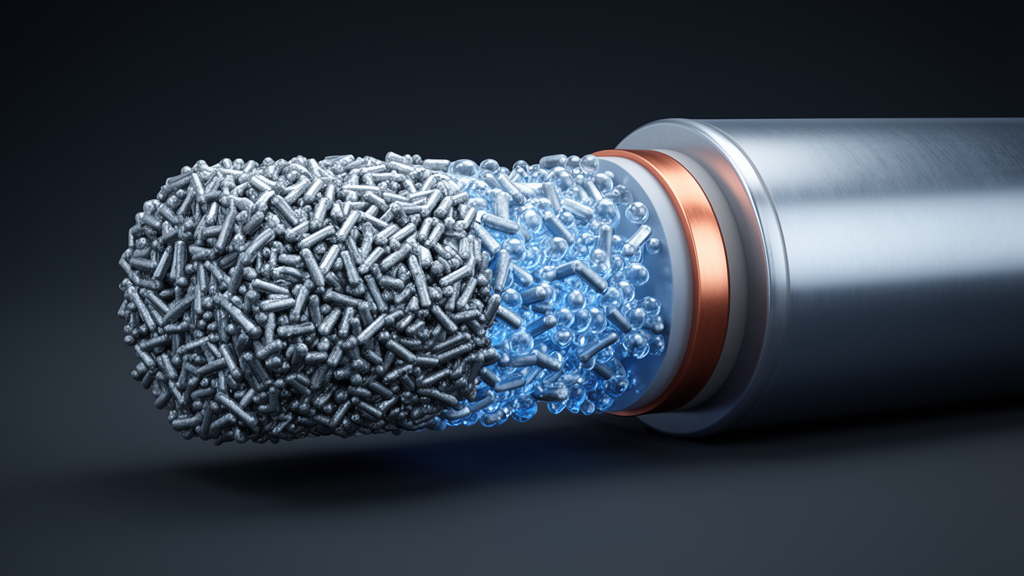
Silicon has long been the dream anode material for lithium-ion batteries. It can theoretically store more than 3,600 milliampere-hours per gram, nearly ten times the capacity of the graphite that dominates commercial cells today. Yet despite two decades of breakthroughs at the material level, silicon anodes still struggle to make the leap from laboratory bench to factory floor. Now, a team of battery researchers at Gachon University in South Korea argues that the missing piece is not a better silicon particle, but a fundamentally different way of thinking about the entire electrode.
In a Perspective published in Frontiers in Batteries and Electrochemistry, Minseok Kim, Jungmin Lee, and colleagues under the supervision of Dongsoo Lee and Junghyun Choi lay out a co-design strategy that connects silicon materials, electrode architecture, interfacial chemistry, and processing technology into a single integrated framework. Their central claim is provocative: the challenges that plague silicon anodes cannot be solved by optimizing the active material alone. Instead, practical, high-energy-density silicon anodes will require holistic electrode engineering in which every component, from binders to electrolyte additives, is treated as an active design parameter.
The scale of the silicon problem is easy to underestimate. When silicon absorbs lithium ions during charging, it swells by up to 300 percent in volume. That mechanical breathing cycle pulverizes particles, breaks electrical contacts, and repeatedly ruptures and reforms the solid electrolyte interphase, the thin protective layer that forms on the anode surface. Each rupture consumes fresh lithium and electrolyte, driving rapid capacity decay and eventual cell failure. Graphite, by contrast, swells only modestly and stores just 372 milliampere-hours per gram, which is why it has remained the commercial standard despite its fundamental capacity ceiling.
Over the past decade, researchers have made remarkable progress at the material level through nanostructuring, alloying, and composite design, including silicon oxide and silicon-carbon composites. Cui and coworkers demonstrated that well-ordered graphene coatings on silicon particles, engineered through thermal oxidation followed by chemical vapor deposition, preserve structural integrity far better than disordered carbon coatings. Cho’s group has pushed scalable implementations further, engineering sub-nanometer silicon anodes through a crystal growth inhibition mechanism and demonstrating structural stability in practical prototype battery packs. The Gachon team’s own contributions include graphene nanoribbon-based conductive networks that enhance microstructural homogeneity and mechanical robustness in silicon-carbon composite anodes, as well as 2D structured graphite frameworks that accommodate the anisotropic swelling of silicon domains while maintaining inter-particle connectivity.
But here is where the lab-to-factory gap becomes apparent. Most laboratory demonstrations of nanostructured silicon rely on low areal loadings below 1 milliampere-hour per square centimeter and flooded electrolyte conditions that do not reflect real cell constraints. Many nanostructuring approaches, such as templated synthesis of porous silicon or chemical vapor deposition of conformal carbon coatings, face significant barriers in scalability and cost-effectiveness. The Gachon researchers argue that this discrepancy between laboratory performance and industrial feasibility demands a co-design philosophy that bridges material innovations with scalable electrode engineering from the outset, rather than treating manufacturing as an afterthought.
At the electrode level, the team highlights how conductive agents and binders have evolved from passive components into active structural elements. Polyanion-assisted ionic-electronic conductive agents developed for high-density silicon-based anodes can preserve electrical percolation pathways even under severe electrode breathing while facilitating electrolyte penetration throughout the electrode. Binders, once mere adhesives, must now accommodate significant mechanical stress and preserve electrode integrity through repetitive volume fluctuations. Systems such as pulley and self-healing binders have been introduced to address electrode cracking, and the Gachon group proposes multifunctional network binders featuring mechanically robust crosslinked frameworks that substantially enhance structural stability. This design concept becomes even more critical in all-solid-state batteries, where interfacially reinforced crosslinked binders can alleviate severe contact-loss issues at solid-solid interfaces.
Processing technology represents another frontier. Because silicon anodes are typically commercialized in blended configurations with graphite, thick-film electrodes are essential for maximizing practical capacity and energy density. Dry electrode processing has emerged as a promising manufacturing route because it mitigates solvent-induced binder migration, a major bottleneck of conventional wet-based processing for high-loading anodes. However, dry-processed anodes present unique interfacial challenges, particularly those associated with binder decomposition. Tailored electrolyte additive designs are vital for suppressing initial irreversibility in dry-processed electrode matrices, significantly enhancing electrochemical stability in full-cell configurations. Chemical modifiers such as carboxy silanes can direct robust solid electrolyte interphase formation and ensure stable operation even under high areal capacity conditions of 3.5 milliampere-hours per square centimeter.
Overcoming the inherently low initial Coulombic efficiency of silicon anodes, which largely originates from extensive solid electrolyte interphase formation, requires electrode-level prelithiation engineering. The Gachon team’s earlier work showed that incorporating silicon-stabilized lithium metal powder composites enables controlled in situ prelithiation. More recently, they extended this concept to scalable fully dry manufacturing with a lithium-metal-underlayer-based Li/Cu prelithiation strategy. In this simple one-step dry process, the lithium underlayer compensates for initial lithium loss in thick-film anodes while promoting the bottom-up formation of a uniform fluorine-rich solid electrolyte interphase.
The co-design philosophy extends to interfacial chemistry as well. Mechanochemically activated additives strengthen interactions within silicon-carbon composite electrodes, enabling uniform dispersion, a robust matrix that tolerates severe volumetric stress, and improved solid electrolyte interphase stability during cycling. Building on this concept, interface-stabilizing anion-anchoring additives were developed to address non-uniform lithium-ion flux and localized overpotentials arising from tortuous transport pathways. Through sulfonate-driven electrostatic stabilization and interfacial anion anchoring, these additives create a lithium-ion-enriched interfacial environment that homogenizes flux and directs solid electrolyte interphase evolution toward a thin, robust, lithium-fluoride-rich inorganic interphase. Surface-engineering strategies that induce lithium-fluoride-rich interphases, including a synergistic hybrid interlayer termed Anode SHIELD, enhance interfacial stability by mechanically isolating the active surface while increasing the lithium-ion transference number and promoting facile transport. These protective interlayers can also mitigate dendrite growth and short-circuit risks under abnormal cell behavior, and the strategy extends beyond conventional lithium-ion batteries to pure silicon anodes in high-power lithium-ion capacitors.
Looking ahead, the Gachon researchers outline a quantitative roadmap for the next stage of silicon-anode development. Future research should prioritize high-loading, thick-film electrodes above 5.0 milliampere-hours per square centimeter specifically optimized for extreme fast charging, targeting 80 percent state-of-charge in under 15 minutes while addressing localized polarization and lithium-plating risks. Interfacial engineering must extend to solid-state battery configurations, where the primary challenge shifts to maintaining chemo-mechanical contact through breathable interfaces that accommodate silicon expansion without delaminating from solid electrolytes. Scalable processing routes, particularly dry manufacturing and integrated prelithiation strategies, should be refined to ensure uniform prelithiation and binder distribution at industrial scale, targeting production throughput comparable to current graphite-based lines. To satisfy the demanding performance requirements of electric vehicles, robotics, and urban air mobility, the field must establish a quantitative roadmap targeting at least 1,000 end-of-life cycles and energy densities exceeding 400 watt-hours per kilogram and 800 watt-hours per liter at the cell level. The future of silicon anodes, the team concludes, will depend not simply on discovering better silicon materials, but on establishing a holistic design philosophy that unifies material innovation, electrode engineering, and scalable manufacturing into a tightly integrated electrode system.
Subject of Research: Bridging silicon materials and electrode engineering for high energy density lithium ion battery anodes
Article Title: Bridging silicon materials and electrode engineering for high energy density lithium ion battery anodes
Article References: Kim, M., Lee, J., Lee, C., Kim, J., Jo, W., Lee, D., & Choi, J. (2026). Bridging silicon materials and electrode engineering for high energy density lithium ion battery anodes. Frontiers in Batteries and Electrochemistry, 5, Article 1848415. https://doi.org/10.3389/fbael.2026.1848415
Image Credits: AI Generated
DOI: 10.3389/fbael.2026.1848415
Keywords: Bridging, silicon, materials, electrode, engineering, high, energy, density, lithium, battery, anodes, scientific research
Cite Scienmag News
Denise Maddox. (October 17, 2026). Silicon Anodes Need Full Electrode Co-Design, Not Just Better Materials, to Power Next-Gen Batteries. Scienmag. https://scienmag.com/silicon-anodes-need-full-electrode-co-design-not-just-better-materials-to-power-next-gen-batteries/
Denise Maddox. "Silicon Anodes Need Full Electrode Co-Design, Not Just Better Materials, to Power Next-Gen Batteries." Scienmag, 17 October 2026, https://scienmag.com/silicon-anodes-need-full-electrode-co-design-not-just-better-materials-to-power-next-gen-batteries/. Accessed 17 October 2026.
Denise Maddox. "Silicon Anodes Need Full Electrode Co-Design, Not Just Better Materials, to Power Next-Gen Batteries." Scienmag. October 17, 2026. https://scienmag.com/silicon-anodes-need-full-electrode-co-design-not-just-better-materials-to-power-next-gen-batteries/


