


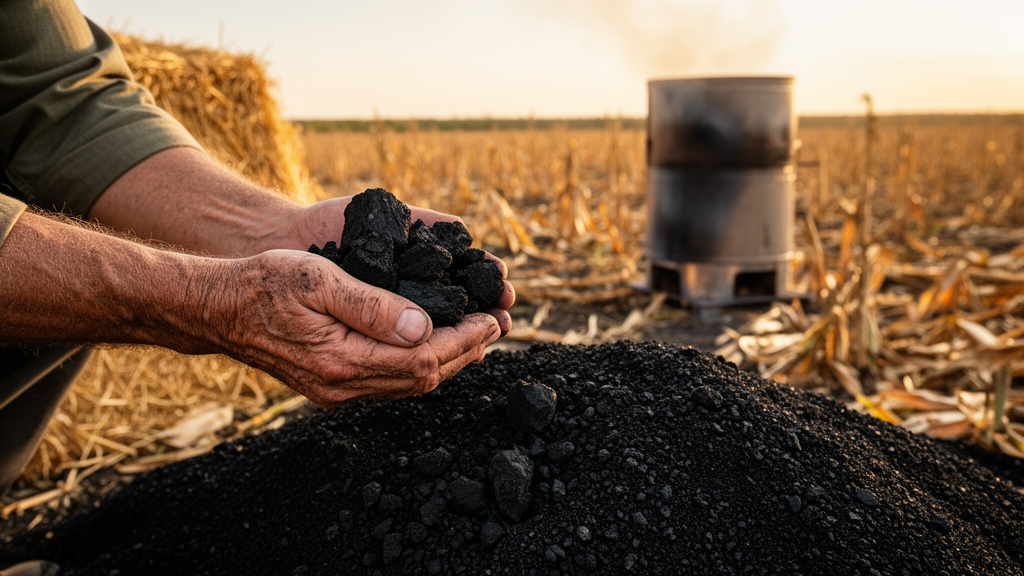
Every year, humanity discards billions of tonnes of organic material—rice husks, wheat straw, sawdust, fruit peels, spent coffee grounds, animal manure, sewage sludge—that rots in landfills or goes up in smoke. Nearly one-third of all food produced for human consumption is never eaten, amounting to roughly 1.6 billion tonnes annually and causing economic losses of about USD 1.2 trillion. Agriculture alone contributes nearly 10 percent of global greenhouse gas emissions, while landfilling and open burning release methane, toxic pollutants, and harmful leachates that accelerate climate change and degrade ecosystems. A comprehensive review published in Frontiers in Environmental Engineering argues that this mounting waste crisis may hold the seed of its own solution: biochar, a carbon-rich porous material produced by heating biomass under oxygen-limited conditions, could transform discarded organic matter into a versatile tool for soil restoration, water purification, and long-term carbon removal.
Biochar is not a new idea. Its origins trace back to the ancient Amazonian Terra Preta soils, where indigenous populations deliberately incorporated charred organic matter into infertile ground to boost fertility and agricultural productivity. Those soils contained stable carbon compounds and showed remarkable nutrient retention and microbial activity compared with surrounding earth, demonstrating centuries ago what modern science now confirms: carbonized biomass can persist in soil for decades to centuries while continuously improving its properties. Today, researchers at institutions including Ganpat University in India are systematically cataloging how this ancient practice can be scaled into industrial climate technology, examining everything from feedstock chemistry to reactor design and carbon market economics.
The technical appeal of biochar lies in its structure. Produced mainly through pyrolysis—the thermochemical decomposition of biomass at temperatures between 300 and 700 degrees Celsius in the absence of oxygen—biochar develops a highly porous architecture with extensive surface area and abundant surface functional groups, including hydroxyl, carboxyl, ketonic carbon, and phenolic groups. These features give the material exceptional adsorption capacity, high cation exchange ability, and prolonged carbon storage. Certain biochars can absorb water up to 400 percent of their own weight thanks to hydrophilic pore networks and irregular particle structures. The three main components of plant biomass—cellulose, hemicellulose, and lignin—each decompose at different temperature ranges during pyrolysis, and their proportions in the feedstock strongly govern the porosity, aromaticity, and stability of the resulting char. Lignin-rich woody biomass, for example, produces biochar with higher fixed carbon content and superior thermal stability because its cross-linked aromatic structure resists microbial degradation and oxidation.
Pyrolysis itself has evolved into a family of technologies, each with distinct trade-offs. Slow pyrolysis, operating between 300 and 550 degrees Celsius with heating rates of just 0.1 to 1 degree Celsius per second and residence times of minutes to hours, maximizes biochar yield at 30 to 50 percent by weight, making it the preferred route for carbon sequestration. Fast pyrolysis, by contrast, uses very high heating rates and vapor residence times under five seconds at 400 to 600 degrees Celsius to produce 50 to 75 percent bio-oil, the renewable liquid fuel, with only 10 to 20 percent char. Flash pyrolysis pushes temperatures to 600 to 1,400 degrees Celsius with heating rates exceeding 1,000 degrees per second, while microwave-assisted pyrolysis generates heat directly within the biomass through electromagnetic interaction with molecular dipoles, enabling uniform volumetric heating that can handle wet feedstocks without extensive pre-drying. Microwave-derived biochars have achieved surface areas of 450 to 800 square meters per gram, rivaling commercial activated carbons. Vacuum pyrolysis, carried out under reduced pressure, suppresses oxidation and secondary cracking to yield bio-oil with heating values between 22.4 and 40 megajoules per kilogram alongside carbon-rich char.
Feedstock selection is equally decisive. Agricultural residues such as rice husk, wheat straw, and corn stover are inexpensive and abundant but carry moderate to high ash content—rice husk is particularly rich in silica, which can block active surface sites and reduce adsorption efficiency. Forestry biomass like sawdust, bark, and wood chips contains high lignin and fixed carbon, producing low-ash, carbon-dense biochar with excellent stability, though collection and transportation from dispersed forest regions raise operational costs. Food and kitchen waste, including fruit peels and spent coffee grounds, offers continuous availability at very low cost but requires pre-drying because of high moisture content. Animal-derived wastes such as poultry litter, cow dung, and pig manure are rich in nitrogen, phosphorus, and minerals, yielding nutrient-enriched biochar valuable for phosphorus recovery, but they also generate high ash levels and may contain antibiotics, pathogens, and heavy metals that demand careful quality monitoring before land application.
The climate mathematics are striking. Large-scale studies on olive tree pruning residues in Spain demonstrated that an optimized pyrolysis plant processing 6.5 tonnes of biomass per hour was energy self-sufficient and capable of permanently removing around 2.68 tonnes of carbon dioxide equivalent per tonne of biochar produced, with annual carbon removal potential reaching approximately 24,450 tonnes. Country-level assessments in China showed that more than 920 kilograms of carbon dioxide equivalent could be sequestered from every tonne of crop residue converted to biochar, with national sequestration potential estimated at 0.50 petagrams of carbon dioxide equivalent annually. Potassium-enriched biochar has been shown to increase carbon storage potential by up to 45 percent. Field experiments applying biochar at rates around 30 tonnes per hectare significantly lowered carbon dioxide, methane, and nitrous oxide emissions while enhancing soil carbon sequestration and corn yields. The mechanism is elegant: pyrolysis converts labile biomass carbon into highly stable polyaromatic carbon networks with low hydrogen-to-carbon and oxygen-to-carbon ratios that resist microbial decomposition for decades to centuries.
Biochar also acts on greenhouse gases through soil microbial pathways. Meta-analytical evidence from studies conducted between 2000 and 2024 shows that biochar application increases the abundance of amoA and nosZ functional genes while reducing nirS gene abundance, producing a notable decline in nitrous oxide emissions. Improved soil aeration and oxygen diffusion suppress the anaerobic conditions that favor methane-producing methanogenic microorganisms, while biochar surfaces provide habitats for methane-oxidizing bacteria. Biochar raises soil pH and stimulates microorganisms carrying the nosZ gene, enhancing the conversion of nitrous oxide to harmless nitrogen gas during denitrification. It further adsorbs ammonium and nitrate ions, reducing nitrogen losses and limiting substrates available for nitrous oxide formation. Emission reductions were particularly effective when biochar and nitrogen fertilizer were applied at moderate rates, with stronger methane mitigation observed in warmer southern paddy systems and greater nitrous oxide reduction in cooler northern regions affected by freeze-thaw cycles.
Beyond agriculture, biochar is emerging as a low-cost adsorbent for wastewater treatment. Sewage-sludge biochar produced through pyrolysis demonstrated a DNA adsorption capacity of 1 milligram per gram, five times higher than iron-oxide-coated sand, with removal efficiencies of 85 percent for antibiotic resistance genes and 97 percent for total environmental DNA. Date palm biochar prepared at 600 degrees Celsius achieved 64 percent phenol removal with an adsorption capacity of 15.93 milligrams per gram. The material removes contaminants through adsorption, ion exchange, pore filling, electrostatic attraction, surface complexation, and precipitation, with oxygen-containing functional groups forming complexes with heavy metal ions including lead, cadmium, copper, and chromium. Modified biochars containing iron oxides, magnetic nanoparticles, or nitrogen functional groups exhibit improved adsorption capacity through additional catalytic and redox reactions, and the material also serves as a support matrix for biofilm development that enhances microbial degradation of organic pollutants.
The review is candid about risks. Biochar produced from contaminated feedstocks such as sewage sludge, animal manure, and municipal biosolids may concentrate heavy metals including cadmium, lead, chromium, nickel, copper, zinc, and arsenic during pyrolysis, because organic matter is volatilized while inorganic elements remain in the solid fraction. Low-temperature or incomplete pyrolysis can increase the formation and retention of polycyclic aromatic hydrocarbons, dioxins, and pharmaceutical residues, while manure-derived biochar may contain veterinary antibiotics and high salt levels that harm soil microorganisms if applied excessively. High levels of toxic PAHs are mainly associated with poor reactor design, uneven heating, and vapor condensation rather than feedstock type alone, meaning proper process control can significantly reduce contamination. The review proposes a comprehensive quality framework spanning feedstock characterization, pretreatment, pyrolysis process control, leaching tests, ecotoxicological evaluation, certification against international biochar standards, and long-term field monitoring before large-scale deployment.
Looking ahead, the review envisions future biochar systems integrating artificial intelligence, machine learning, and Internet of Things technologies to optimize process control and industrial scalability, alongside co-pyrolysis, microwave-assisted modification, life cycle assessment, and techno-economic analysis to improve efficiency and sustainability. Economic opportunities through carbon trading systems, subsidies, and reduced dependence on fertilizers and irrigation inputs may further encourage large-scale adoption. The authors caution that biochar is not a universal solution—its effectiveness is highly site-specific, influenced by feedstock composition, pyrolysis conditions, aging behavior, and soil interactions, and adverse effects on soil microorganisms, earthworms, and crop growth have been reported under certain conditions. Greater collaboration among researchers, policymakers, industries, and farmers will be essential to establish transparent carbon policies and strengthen international cooperation. If those challenges can be met, the ancient practice of burying charred biomass in soil may become one of the most scalable carbon-negative technologies available, transforming the world’s waste streams into valuable resources while accelerating global climate neutrality goals.
Subject of Research: From biowaste to biochar: sustainable pathways for waste valorization, environmental benefits, and practical uses
Article Title: From biowaste to biochar: sustainable pathways for waste valorization, environmental benefits, and practical uses
Article References: Kumar, Y. (2026). From biowaste to biochar: sustainable pathways for waste valorization, environmental benefits, and practical uses. Frontiers in Environmental Engineering, 5, Article 1890725. https://doi.org/10.3389/fenve.2026.1890725
Image Credits: AI Generated
DOI: 10.3389/fenve.2026.1890725
Keywords: biowaste, biochar, sustainable, pathways, waste, valorization, environmental, benefits, practical, uses, scientific research
Cite Scienmag News
Denise Maddox. (October 17, 2026). Biochar: The Carbon-Rich Material Turning Global Waste Into a Climate Solution. Scienmag. https://scienmag.com/biochar-the-carbon-rich-material-turning-global-waste-into-a-climate-solution/
Denise Maddox. "Biochar: The Carbon-Rich Material Turning Global Waste Into a Climate Solution." Scienmag, 17 October 2026, https://scienmag.com/biochar-the-carbon-rich-material-turning-global-waste-into-a-climate-solution/. Accessed 17 October 2026.
Denise Maddox. "Biochar: The Carbon-Rich Material Turning Global Waste Into a Climate Solution." Scienmag. October 17, 2026. https://scienmag.com/biochar-the-carbon-rich-material-turning-global-waste-into-a-climate-solution/


