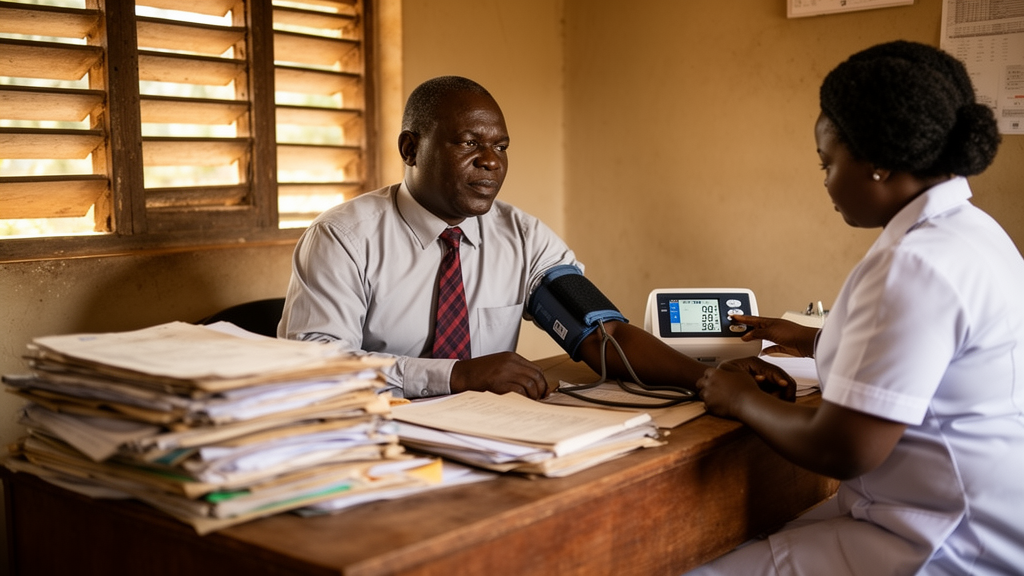
In the highland districts of Kigezi, in rural southwestern Uganda, a quiet health crisis is unfolding inside government offices. A new cross-sectional survey led by Herbert Izo Ninsiima of Kabale University School of Medicine and colleagues, published in BMC Public Health, has found strikingly high rates of hypertension, diabetes, and obesity among civil servants working in four rural districts of the sub-region. The findings challenge a persistent assumption in global health: that non-communicable diseases, or NCDs, are primarily problems of wealthy, urbanized societies. Here, in one of the least-developed corners of the world, nearly two in every five surveyed office workers had elevated blood pressure, one in ten had diabetes, and almost two in three met the clinical definition of obesity.
The study set out to fill a well-documented gap. While research from high-income countries has repeatedly warned that NCDs are rising steeply in less-developed nations, the prevalence of these conditions and their risk factors remain poorly characterized in the published literature, particularly for specific occupational groups. Most available studies from low-income settings have focused on the general population, leaving special groups such as civil servants largely unstudied. Yet civil servants occupy a distinctive position: they are sedentary office workers embedded in rural communities, often serving as both breadwinners and health role models for the people around them. Understanding their disease burden, the researchers argue, offers a window into how the epidemiological transition is playing out in rural Africa.
To capture that picture, the team conducted a cross-sectional survey among civil servants aged 28 to 68 years across four districts of the Kigezi sub-region. They used a modified version of the World Health Organization’s STEPs survey instrument, the standardized protocol WHO developed for surveillance of chronic disease risk factors in resource-limited settings. The instrument allowed the researchers to assess behavioral and metabolic risk factors including age, sex, lifestyle, physical activity, body mass index, and dietary habits, while hypertension and diabetes were assessed through anthropometric measurements and blood glucose testing. The approach follows the WHO STEPwise logic of building a layered profile of each participant, moving from questionnaire data to physical measurements to biochemical tests.
The definitions used in the analysis were clinically standard. Hypertension was defined as a systolic blood pressure of 140 mmHg or higher and/or a diastolic blood pressure of 90 mmHg or higher. Diabetes was defined as a fasting blood glucose concentration of 7.0 mmol/L or above, the conventional diagnostic threshold for type 2 diabetes. Obesity was classified as a body mass index of 30 kg/m² or greater. Logistic regression models were then used to identify the factors statistically associated with these conditions, producing adjusted odds ratios that quantify how strongly each factor predicts disease after accounting for other variables.
The headline numbers are sobering. Among the analyzed sample, the prevalence of hypertension was 40.0 percent, with a 95 percent confidence interval spanning 32.0 to 48.5 percent. Diabetes prevalence stood at 10.7 percent (95 percent CI: 6.2 to 17.2 percent), and obesity reached 65.0 percent (95 percent CI: 56.6 to 72.6 percent). In plain terms, if the confidence intervals are taken at face value, somewhere between a third and nearly half of the civil servants studied had high blood pressure, and the true burden of obesity could plausibly range from well over half to nearly three-quarters of the workforce. For a rural setting, these figures rival or exceed those reported in many urban populations elsewhere in sub-Saharan Africa.
Underlying these disease rates was a landscape of pervasive behavioral risk. Physical inactivity was reported by 91.4 percent of participants, meaning that more than nine in ten civil servants failed to meet recommended activity levels. Inadequate fruit consumption affected 49.3 percent, and 48.6 percent reported alcohol consumption. These three factors, sedentary behavior, poor diet, and alcohol use, are the classic engines of the metabolic syndrome, and their co-occurrence in a single occupational group helps explain why hypertension and obesity cluster so heavily in this population. Desk-based government work, combined with dietary patterns low in fresh produce and regular alcohol intake, appears to be manufacturing chronic disease at remarkable speed.
The regression analysis added mechanistic texture to these associations. Age and hypertension were both linked to diabetes: hypertension carried an adjusted odds ratio of 4.89 (95 percent CI: 1.43 to 16.67), meaning that civil servants with high blood pressure had nearly five times the odds of also having diabetes compared with those whose blood pressure was normal. Age showed an adjusted odds ratio of 2.12 (95 percent CI: 0.70 to 6.37), an association whose confidence interval crosses one, indicating statistical uncertainty, though the underlying pattern of increasing age and blood pressure being associated with the development of type 2 diabetes mellitus was consistent in the data. Conversely, the study identified a striking protective factor: walking or cycling to work was associated with markedly lower odds of hypertension, with an adjusted odds ratio of 0.25 (95 percent CI: 0.10 to 0.63). In other words, civil servants who commuted under their own power had about a quarter of the odds of hypertension compared with those who did not, a finding with obvious and inexpensive policy implications.
The study also found that increased fasting blood sugar and increased body weight were associated with hypertension, while increasing age and blood pressure were associated with the development of type 2 diabetes. This bidirectional web, in which weight drives blood pressure, blood pressure tracks with blood sugar, and age amplifies both, reflects the physiology of the metabolic syndrome. Excess adiposity, particularly in sedentary individuals, promotes insulin resistance, which in turn is linked to sympathetic nervous system activation and vascular changes that raise blood pressure. The Kigezi data capture this cascade in a real, rural African workforce, demonstrating that the same pathological pathways documented in clinic-based studies elsewhere operate with full force even where healthcare resources are scarce.
There is an important caveat that the authors themselves acknowledge: of the 296 civil servants originally assessed, only 140, or 47.3 percent, had complete data and were included in the final analysis. The remaining 156 were excluded because of incomplete data resulting from COVID-19 restrictions and missing questionnaires. The analyzed sample was evenly balanced by sex, with 70 males and 70 females and a mean age of 42 years. While the even sex split and the use of standardized WHO instruments strengthen the study, the substantial proportion of excluded participants means the estimates should be interpreted with appropriate caution, and the wide confidence intervals around several of the odds ratios reflect the modest sample size. Even so, the consistency of the prevalence estimates with broader concerns about NCDs in least-developed countries lends the findings credibility.
The implications reach well beyond the Kigezi highlands. Least-developed countries face a double burden, contending with acute infectious diseases and rising chronic disease simultaneously, all amidst scarce resources. When nearly two-thirds of a rural workforce shows obesity and 40 percent shows hypertension, the downstream costs, in stroke, kidney disease, heart failure, and diabetic complications, threaten to overwhelm health systems that are already stretched. The researchers recommend preventive interventions focused on NCDs, including regular sensitization campaigns and health checkups, alongside diet and lifestyle modification. The protective signal from active commuting offers a concrete starting point: encouraging walking or cycling to work is a low-cost measure that could be embedded in public sector employment policy. The work was supported by the Fogarty International Center of the U.S. National Institutes of Health, the U.S. Department of State’s Office of the U.S. Global AIDS Coordinator and Health Diplomacy, and PEPFAR under Award Number 1R25TW011213. As the global health community confronts the accelerating shift of chronic disease into the world’s poorest regions, this study of rural Ugandan civil servants delivers a clear message: the metabolic epidemic has arrived, and the window for cheap, effective prevention, starting with a bicycle and a piece of fruit, is open now.
Subject of Research: Prevalence and determinants of hypertension, diabetes, and obesity among civil servants in rural southwestern Uganda
Article Title: Prevalence and determinants of hypertension, diabetes, and obesity among civil servants in rural Southwestern Uganda: a cross-sectional survey
Article References: Prevalence and determinants of hypertension, diabetes, and obesity among civil servants in rural Southwestern Uganda: a cross-sectional survey. (n.d.). https://doi.org/10.1186/s12889-026-29653-7
Image Credits: AI Generated
DOI: 10.1186/s12889-026-29653-7
Keywords: hypertension, diabetes, obesity, non-communicable diseases, civil servants, Uganda, WHO STEPs survey, physical inactivity, risk factors, public health, type 2 diabetes, rural health
Cite Scienmag News
Daisy Hatcher. (October 15, 2026). Silent Epidemic: Hypertension, Diabetes and Obesity Surge Among Rural Ugandan Civil Servants. Scienmag. https://scienmag.com/silent-epidemic-hypertension-diabetes-and-obesity-surge-among-rural-ugandan-civil-servants/
Daisy Hatcher. "Silent Epidemic: Hypertension, Diabetes and Obesity Surge Among Rural Ugandan Civil Servants." Scienmag, 15 October 2026, https://scienmag.com/silent-epidemic-hypertension-diabetes-and-obesity-surge-among-rural-ugandan-civil-servants/. Accessed 15 October 2026.
Daisy Hatcher. "Silent Epidemic: Hypertension, Diabetes and Obesity Surge Among Rural Ugandan Civil Servants." Scienmag. October 15, 2026. https://scienmag.com/silent-epidemic-hypertension-diabetes-and-obesity-surge-among-rural-ugandan-civil-servants/