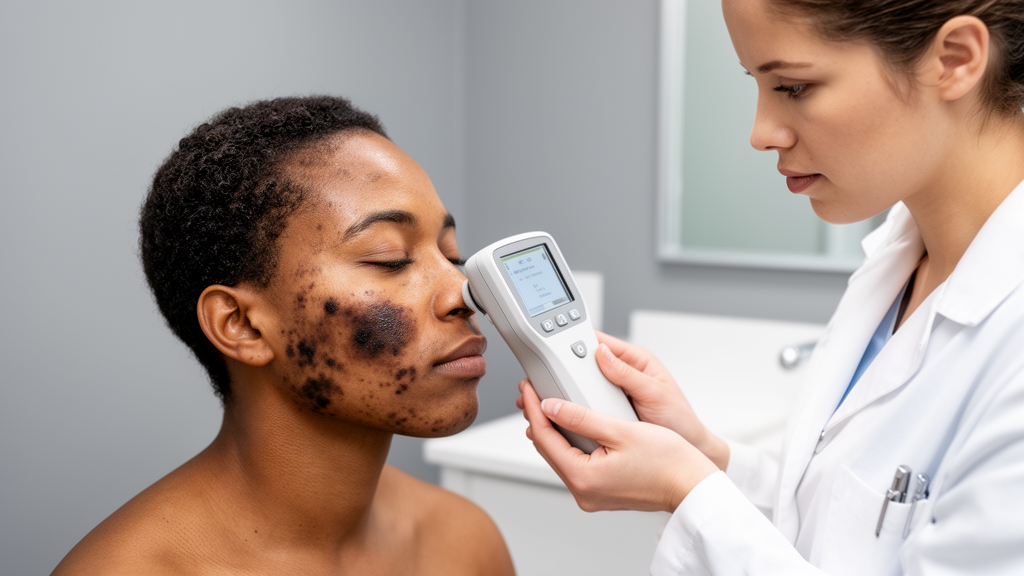
Post-inflammatory hyperpigmentation, or PIH, is one of the most common pigmentary complaints that dermatologists encounter, yet it remains one of the least standardized. The condition arises when inflammation or external injury to the skin triggers an overproduction or uneven distribution of melanin, leaving behind dark patches that can persist for months or even years. It is particularly prevalent among individuals with naturally darker Fitzpatrick skin types, and its impact extends well beyond the surface of the skin, often affecting quality of life in ways that are difficult to quantify. A new research letter published in the Archives of Dermatological Research argues that the field has outgrown its reliance on the naked eye, and that a well-established optical technique called colorimetry could provide the foundation for a proper clinical scale for PIH.
The core problem, according to the authors, is that assessment of PIH severity currently depends exclusively on visual inspection and patient self-reporting. Both approaches are vulnerable to perception bias, and both can be strongly influenced by ambient lighting conditions, which vary enormously between examination rooms, clinics, and research settings. Unlike many other dermatologic disorders, PIH lacks a standardized clinical scale for assessment, and this absence creates inconsistencies in evaluating disease progression and treatment outcomes. Two clinicians looking at the same lesion may disagree on whether it has lightened, and a patient’s own sense of improvement may not align with what a physician observes. In clinical trials, this subjectivity can blur the signal that researchers are trying to detect, making it harder to demonstrate whether an experimental therapy actually works.
The diagnostic challenges associated with pigmentary disorders more broadly highlight the limitations of subjective visual assessment and support the development of standardized, quantitative methods. Standardized quantitative measurements for PIH would ensure accurate, reproducible, and unbiased assessments regardless of external influences such as lighting or observer expectation. The authors emphasize that objective assessment is particularly important for monitoring therapeutic response over time and for improving the consistency of outcomes in clinical trials evaluating PIH interventions. There is also a counseling dimension: measurable, objective evidence of pigmentary improvement would allow clinicians to give patients concrete feedback, enabling direct and accurate measurement of patient outcomes rather than vague reassurances that a lesion is fading.
Other objective tools do exist. Reflectance confocal microscopy can image pigment at the cellular level, dermoscopy magnifies surface structures, and spectrophotometry can decompose reflected light into its spectral components. Each of these techniques provides valuable pigmentary or structural information. Yet the research letter argues that colorimetry is especially well suited for PIH assessment because it is noninvasive, practical, reproducible, and capable of providing quantitative measurements of pigmentation that can be easily tracked longitudinally. In other words, it occupies a practical middle ground: more objective than the eye, but far simpler and cheaper to deploy in routine practice than advanced imaging platforms.
Colorimetry works by measuring the intensity of light reflectance from the skin, converting what the eye perceives as color into objective numerical data on pigmentation and erythema. The technique has a long pedigree in skin color metrics. It expresses color in three values, corresponding to lightness on a white-to-black axis, a red-to-green axis, and a yellow-to-blue axis, within a three-dimensional color space. This tristimulus representation allows any skin color to be plotted as a point in a defined coordinate system, so that changes over time can be expressed as precise numerical shifts rather than subjective impressions. A fading brown patch, for example, would show a measurable increase in the lightness value, and the magnitude of that shift can be compared across patients, visits, and studies.
The track record of colorimetry in pigmentary research is substantial. It has been used to measure pigmentary involvement in PIH treatment studies, including a landmark trial of topical tretinoin for hyperpigmented lesions caused by cutaneous inflammation in Black patients, published in the New England Journal of Medicine in the 1990s. It has also featured in PIH models that assessed histologic, clinical, spectroscopic, and colorimetric traits in parallel, allowing researchers to correlate what the device measured with what was happening in the skin itself. Beyond PIH, colorimetry has been applied to broader pigmentary disorders, including melasma and vitiligo, where it has been used to track skin lightening and repigmentation over time. The authors argue that this history of successful application in related conditions further supports its utility as a standardized tool for monitoring pigmentary changes longitudinally in PIH specifically.
The vision implicit in the research letter is a clinical scale for PIH anchored in colorimetric values rather than photographic comparisons or ordinal grading by eye. Such a scale would transform how the severity of the condition is communicated and studied. Instead of describing a lesion as mild, moderate, or severe, clinicians could report a lightness value and its deviation from the patient’s baseline skin color, with defined thresholds separating grades of severity. Treatment response could be expressed as the rate of change in those values, giving trials a continuous, statistically powerful endpoint. Because the measurements are numerical, they could be pooled across centers and populations, something that subjective grading has never reliably achieved.
The authors are candid about the hurdles that stand between this vision and routine practice. The cost and availability of colorimetric instruments remain barriers, particularly in resource-limited settings, and operator training is required to obtain consistent readings. Integrating these measurements into established clinical workflows is another practical challenge, since clinic visits are already time-pressured. More fundamentally, colorimetric measurements may be influenced by baseline pigmentation, melanin content, and device-specific calibration, all of which can affect measurement accuracy across varying skin tones and ethnic populations. A device calibrated against one reference population may not perform identically on another, and the very patients who stand to benefit most from objective PIH assessment, those with darker skin types, are the ones for whom calibration issues could be most consequential.
For these reasons, the research letter calls for future studies to validate colorimetric measurements in diverse populations and to assess whether reference ranges are needed. Establishing normative values across the full spectrum of skin tones would be a prerequisite for any scale that aspires to universal use. The authors, a team of dermatology researchers and clinicians affiliated with Texas Tech University Health Sciences Center, Texas Tech Health Sciences Center El Paso, and the Westlake Dermatology Clinical Research Center, report no funding source and no conflicts of interest, and the study received an ethics exemption as a research letter that generated no new datasets.
The significance of the argument extends beyond a single condition. PIH is a frequent sequela of acne, eczema, infections, cosmetic procedures, and injuries, and it disproportionately affects people of color, a population that has historically been underrepresented in dermatologic research. A validated, objective scale would not only improve individual patient care but also raise the methodological quality of the trials that test new treatments, potentially accelerating the development of therapies for a condition that currently has no standardized way to measure its own severity. Colorimetry is not a new technology, but applying it systematically to PIH could be the step that turns a stubbornly subjective clinical problem into a quantitatively tractable one. As the authors suggest, the tools already exist; what is needed now is the validation work to build a scale that clinicians and regulators can trust.
Subject of Research: Using colorimetry to develop an objective clinical scale for post-inflammatory hyperpigmentation
Article Title: The potential of colorimetry in developing a clinical scale for post-inflammatory hyperpigmentation
Article References: Verma, K. K., Goldstein, D. R., Friedmann, D. P., & Tarbox, M. B. (2026). The potential of colorimetry in developing a clinical scale for post-inflammatory hyperpigmentation. Archives of Dermatological Research, 318(1), Article 403. https://doi.org/10.1007/s00403-026-04935-7
Image Credits: AI Generated
DOI: 10.1007/s00403-026-04935-7
Keywords: post-inflammatory hyperpigmentation, colorimetry, dermatology, skin pigmentation, clinical scale, melanin, spectrophotometry, Fitzpatrick skin type, treatment outcome, quantitative assessment, melasma, vitiligo
Cite Scienmag News
Ophelia Keating. (October 15, 2026). Colorimetry Could Bring Objective Numbers to Post-Inflammatory Hyperpigmentation Care. Scienmag. https://scienmag.com/colorimetry-could-bring-objective-numbers-to-post-inflammatory-hyperpigmentation-care/
Ophelia Keating. "Colorimetry Could Bring Objective Numbers to Post-Inflammatory Hyperpigmentation Care." Scienmag, 15 October 2026, https://scienmag.com/colorimetry-could-bring-objective-numbers-to-post-inflammatory-hyperpigmentation-care/. Accessed 15 October 2026.
Ophelia Keating. "Colorimetry Could Bring Objective Numbers to Post-Inflammatory Hyperpigmentation Care." Scienmag. October 15, 2026. https://scienmag.com/colorimetry-could-bring-objective-numbers-to-post-inflammatory-hyperpigmentation-care/