


…
…
The description of Scincella verecunda adds a notable chapter to what has become one of the most active fronts in skink taxonomy. The genus Scincella, established by Mittleman in 1950, belongs to the sphenomorphine group of skinks, a lineage characterized by small, elongate bodies, smooth overlapping scales, and a largely terrestrial lifestyle. Members of the genus are often referred to as ground skinks or litter skinks because of their habit of moving through leaf litter and surface soil layers, where their cryptic coloration and secretive behavior make them easy to overlook during field surveys. This elusiveness is one reason why the true diversity of the genus has been so difficult to estimate, and why new species continue to emerge from regions that have already received considerable herpetological attention.
The species epithet verecunda, derived from the Latin word meaning shy or modest, reflects the retiring nature of the animal itself. This naming convention follows a long tradition in herpetology of using Latin and Latinized adjectives to convey behavioral or ecological traits observed by the describers. Such names often prove durable and informative for field biologists, since they encode an observation about the organism directly into its scientific designation. In the case of S. verecunda, the name is fitting for a lizard that inhabits dense montane coniferous forests and is presumably active in the litter layer, where visibility to human observers is limited and encounters are infrequent.
The type locality lies in Linxiang District, Lincang City, in the western part of Yunnan Province. This region sits within the mountainous belt that connects the Hengduan Mountains to the Indo-Burmese biodiversity hotspot, an area widely recognized as one of the most biologically rich and topographically complex landscapes on Earth. Elevation in the type locality ranges from 2,113 to 2,358 meters above sea level, placing the species firmly within the high-elevation coniferous forest zone. Such forests, dominated by pines and other conifers, create a distinctive microclimate characterized by cooler temperatures, higher humidity, and thick accumulations of needle litter on the forest floor. These conditions are favorable for small terrestrial squamates that rely on litter cover for thermoregulation, foraging, and predator avoidance, and they may explain why the species has gone unnoticed until now.
The discovery also illustrates the continuing value of museum-based and field-based integrative taxonomy in regions where the fauna is still incompletely documented. Yunnan Province, in particular, has been the source of a remarkable number of new reptile and amphibian descriptions over the past two decades, driven by a combination of expanded field surveys, improved molecular methods, and renewed taxonomic attention to groups previously considered well known. The genus Scincella exemplifies this trend. Within the past few years, multiple new species have been described from southern and southwestern China, and the pace of discovery shows no sign of slowing. Each new species not only adds to the known diversity but also refines our understanding of how these skinks have diversified across the complex topography of the region.
From a phylogenetic standpoint, the placement of S. verecunda within a clade that also includes S. ouboteri, S. ochracea, and S. reevesii is informative. These relatives are distributed across Southeast Asia and southern China, and their association with the new species suggests a broader evolutionary radiation within the genus that spans a considerable geographic range. The mitochondrial markers used in the study, namely 12S ribosomal RNA, 16S ribosomal RNA, and cytochrome c oxidase subunit I, are standard tools in reptile systematics. The 12S and 16S genes are slowly evolving ribosomal RNA genes that provide reliable signal for deeper phylogenetic relationships, while CO1, a protein-coding gene, evolves more rapidly and is particularly useful for distinguishing closely related species. The combination of these three markers in a concatenated dataset of 1,548 base pairs provides a reasonable balance between phylogenetic depth and species-level resolution.
The magnitude of genetic divergence reported between S. verecunda and its closest relatives is striking. A minimum uncorrected pairwise distance of 6.3 percent in the 16S gene and 16.6 percent in CO1 far exceeds the thresholds typically used to delimit species in squamate taxonomy. In many reptile groups, CO1 divergences of even 2 to 4 percent are considered sufficient to suggest species-level distinctness, particularly when corroborated by morphological differences. The values reported here therefore indicate a deep evolutionary separation, consistent with a long period of independent evolution, likely shaped by geographic isolation in the fragmented montane landscapes of southwestern China.
The morphological diagnosis of S. verecunda rests on a combination of characters rather than any single autapomorphy, which is common in skink taxonomy where individual traits often vary within and among species. The absence of a palpebral disc on the lower eyelid is particularly noteworthy. In most Scincella species, the lower eyelid bears a transparent window, or palpebral disc, that allows the animal to see even when the eyelid is closed. This feature has traditionally been treated as a diagnostic character of the genus. The discovery that S. verecunda lacks this structure challenges that assumption and suggests that eyelid morphology within Scincella may be more evolutionarily labile than previously appreciated. The authors of the study interpret this as evidence of homoplasy, meaning that the trait may have been gained or lost independently in different lineages rather than being inherited from a single common ancestor.
Homoplasy in eyelid morphology has broader implications for skink systematics. The presence or absence of a transparent window in the lower eyelid has been used extensively in classifying sphenomorphine skinks, and if this character is unreliable as a synapomorphy, then the morphological boundaries of Scincella and allied genera may need to be redrawn. This is not an isolated concern. Across squamate taxonomy, morphological characters once considered robust indicators of evolutionary relationships have repeatedly been shown to be convergent or reversive when examined in the light of molecular phylogenies. The case of S. verecunda reinforces the principle that integrative approaches, combining molecular and morphological evidence, are essential for arriving at stable and biologically meaningful classifications.
The small number of specimens available for the description, six individuals, is not unusual for newly discovered reptile species, particularly those from remote or difficult-to-access habitats. However, it does mean that certain aspects of the species’ biology, such as sexual dimorphism, ontogenetic variation, and intrapopulational variability in scalation, remain poorly characterized. The maximum snout-vent length recorded for adult females is 48.7 millimeters, which places S. verecunda among the smaller members of the genus. Body size in Scincella varies considerably across species, and the ecological correlates of this variation, such as prey size, habitat structure, and predation pressure, remain largely unexplored for most members of the genus.
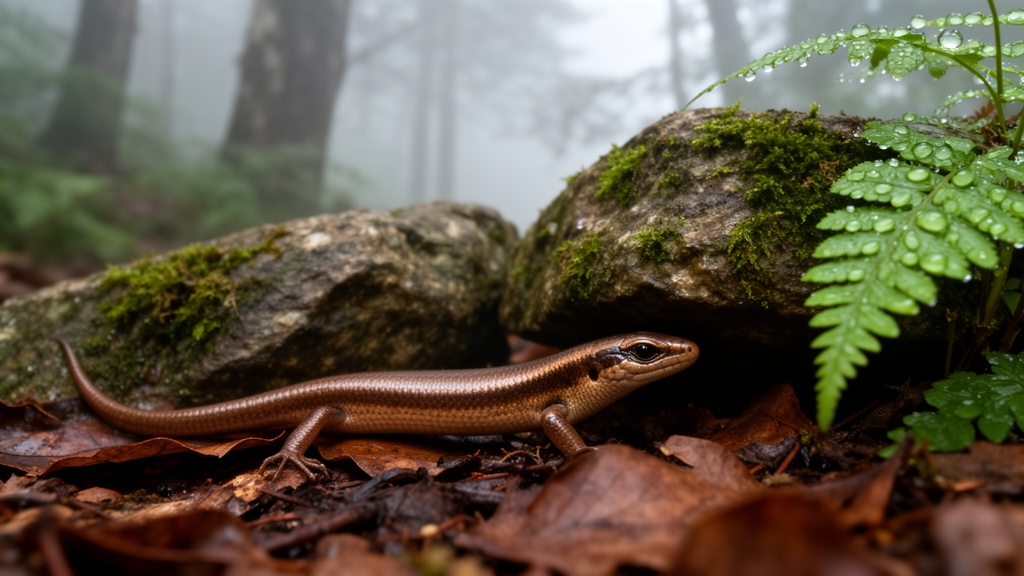
The coloration described for the living animal, with a brown dorsum scattered with small dark spots and golden-yellow lateral surfaces bearing numerous distinct dark spots that sometimes coalesce into vermiform markings, is a pattern that likely serves a camouflage function in the dappled light of the coniferous forest floor. The irregular dark dorsolateral stripes further contribute to this cryptic appearance. Such patterns are common among litter-dwelling skinks and are thought to disrupt the animal’s outline against the heterogeneous background of needles, twigs, and soil. The observation that the toes do not contact the fingers when the limbs are adpressed is a morphological detail that helps distinguish this species from certain congeners in which the limbs overlap more extensively.
The methodology employed in the study reflects current best practices in integrative taxonomy. The use of maximum likelihood and Bayesian inference frameworks, with nodal support evaluated through multiple complementary metrics, provides a robust basis for phylogenetic conclusions. The inclusion of 106 sequences from 59 individuals representing 32 nominal Scincella species gives the analysis a breadth of taxonomic sampling that strengthens confidence in the placement of the new species. The choice of Tropidophorus species as the outgroup follows precedent from earlier studies of the group and provides an appropriate comparative framework for rooting the phylogeny.
The deposition of specimens in the herpetological collection of Qinghai University and the publication of genetic sequences in GenBank ensure that the data underlying the species description are accessible to future researchers. This is an important consideration in modern taxonomy, where reproducibility and data availability are increasingly recognized as essential components of rigorous species delimitation. The compliance with Chinese wildlife protection regulations and institutional ethical review also reflects the growing emphasis on responsible and legally sound research practices in biodiversity science.
From a conservation perspective, the restricted known distribution of S. verecunda, currently limited to high-elevation coniferous forest in a single district of Lincang City, warrants attention. Montane forests in southwestern China face ongoing pressures from logging, agricultural expansion, infrastructure development, and climate change. Species with narrow elevational ranges and limited dispersal ability, as is typical of small terrestrial skinks, may be particularly vulnerable to habitat modification. The fact that the species was discovered at elevations above 2,100 meters suggests that it may be adapted to relatively cool and stable climatic conditions, which could make it sensitive to warming temperatures that shift suitable habitat zones upslope. Further surveys in adjacent mountain ranges and within the broader Lincang region are needed to determine whether the species occurs more widely and to assess its conservation status more accurately.
The broader biogeographic context of the discovery is also significant. The mountainous terrain of southwestern China, shaped by the uplift of the Tibetan Plateau and the complex geological history of the region, has created a mosaic of isolated habitats that promote allopatric speciation. Deep river valleys, ridgelines, and elevational gradients act as barriers to dispersal for small terrestrial reptiles, allowing populations to diverge in isolation over evolutionary timescales. The pattern of repeated discovery of new montane species in this region, including multiple Scincella in recent years, is consistent with this model of topographically driven diversification. As survey effort continues to expand into less accessible high-elevation areas, additional undescribed lineages are likely to be revealed.
The finding that not all Scincella species necessarily bear a palpebral disc also has implications for field identification and survey work. Researchers relying solely on external morphology to identify specimens in the field or in museum collections may misassign individuals to the wrong genus if they assume that the presence of a transparent lower eyelid is obligatory for Scincella. This underscores the importance of molecular verification, particularly for specimens collected at the edges of known species ranges or in poorly surveyed areas. As the genus continues to grow in species number, the development of reliable identification tools, including photographic guides and molecular keys, will become increasingly important for both taxonomists and conservation practitioners working in the region.
In summary, the description of Scincella verecunda contributes not only a new species to science but also new insight into the morphological evolution and biogeography of a widespread skink lineage. It demonstrates that even in regions with a long history of herpetological research, significant discoveries remain to be made, particularly in montane ecosystems that combine high habitat heterogeneity with limited survey coverage. The integrative approach used in the study, combining mitochondrial phylogenetics with detailed morphological comparison, provides a model for future taxonomic work on Scincella and other morphologically conservative squamate groups. As more species are described and phylogenetic sampling improves, a clearer picture will emerge of how this diverse genus has diversified across the varied landscapes of Asia and Central America, and how best to conserve the unique evolutionary lineages it contains.
Subject of Research: …
Article Title: Shy highlander: a new species of the genus Scincella Mittleman, 1950 ( Squamata , Scincidae ) from montane forests of Yunnan Province, China
Article References: Xu, Y., Nguyen, T. V., Deng, J., Zhang, T., Sun, F., Liu, J., Poyarkov, N. A., & Peng, L. (2026). Shy highlander: a new species of the genus Scincella Mittleman, 1950 (Squamata, Scincidae) from montane forests of Yunnan Province, China. Herpetozoa, 39, 127-143. https://doi.org/10.3897/herpetozoa.39.e188979
Image Credits: AI Generated
DOI: 10.3897/herpetozoa.39.e188979
Keywords: herpetology, taxonomy, new species, skinks, China, Yunnan, Scincella, integrative taxonomy, highlander, species, genus, Mittleman
Cite Scienmag News
Drew Townsend. (October 17, 2026). Shy highlander: new skink species discovered in Yunnan’s montane forests. Scienmag. https://scienmag.com/shy-highlander-new-skink-species-discovered-in-yunnans-montane-forests/
Drew Townsend. "Shy highlander: new skink species discovered in Yunnan’s montane forests." Scienmag, 17 October 2026, https://scienmag.com/shy-highlander-new-skink-species-discovered-in-yunnans-montane-forests/. Accessed 17 October 2026.
Drew Townsend. "Shy highlander: new skink species discovered in Yunnan’s montane forests." Scienmag. October 17, 2026. https://scienmag.com/shy-highlander-new-skink-species-discovered-in-yunnans-montane-forests/


