


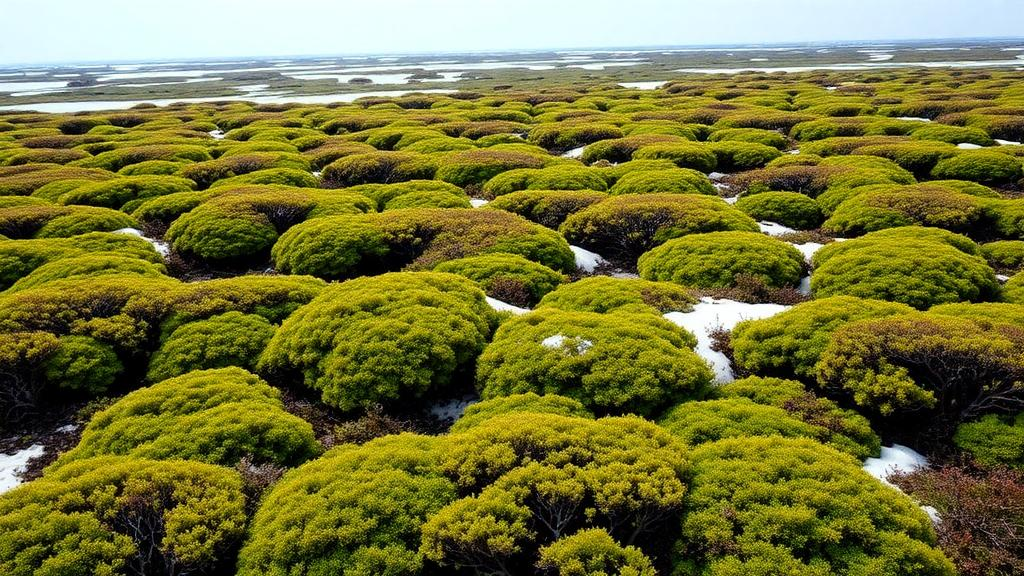
Across the far north, a quiet botanical invasion is underway. As Arctic and boreal climates warm, woody shrubs are creeping into landscapes that were once dominated by mosses, sedges and other low-growing herbaceous plants. In permafrost peatlands—waterlogged, frozen-ground ecosystems that hold roughly one-third of the world’s soil organic carbon—this shift in vegetation is more than a change in scenery. A new study published in the journal Plant and Soil suggests that when shrubs take over, they fundamentally rewire the microbial machinery that decides whether carbon in these soils stays buried or escapes into the atmosphere.
The research, led by Xiaoyu Long and Changchun Song of the Northeast Institute of Geography and Agroecology at the Chinese Academy of Sciences, together with colleagues, focused on peatlands in the Greater Khingan Mountains of northeastern China. Using a space-for-time approach—a technique in which sites representing different stages of shrub dominance are compared as a proxy for change over time—the team surveyed a gradient running from herbaceous dominance to full shrub dominance. At each site, they measured soil carbon fractions, microbial necromass, community composition, extracellular enzyme activities and microbial carbon use efficiency, building one of the most complete pictures to date of how vegetation change cascades down into the dark, cold layers of permafrost soil.
The first surprise lies in how thoroughly shrubs transform the physical and chemical environment of the peat. Where shrubs established, the team found soils with higher pH, lower moisture and eased nutrient limitations. That combination matters because peatland carbon storage has historically depended on the opposite conditions: cold, acidic, waterlogged and nutrient-poor ground that slows decomposition to a crawl. Shrubs effectively open a window for microbial activity, aerating and chemically ameliorating soils that have been preserving plant remains for millennia. In effect, the woody plants act as ecosystem engineers whose presence changes the rules of the carbon game.
Beneath the shrubs, the microbial communities reorganized in strikingly divergent ways. Bacterial communities shifted toward K-selected taxa—slower-growing, more competitive organisms that thrive in stable, resource-limited environments—while fungal communities became enriched in r-selected groups, fast-growing opportunists that rapidly exploit available resources. This split in life-history strategies, the authors report, was accompanied by increased complexity in microbial interaction networks, suggesting a denser web of ecological relationships underground. More connections among microbes can mean more efficient transfer of carbon through the food web, with consequences for how much of that carbon ends up locked in stable forms.
The enzyme data tell a parallel story. Hydrolytic enzyme activity—the chemical toolkit microbes use to break down complex organic molecules such as cellulose and chitin—was enhanced in shrub-dominated soils. At the same time, microbial carbon use efficiency, a measure of how much consumed carbon microbes convert into their own biomass rather than respiring as carbon dioxide, declined. Lower carbon use efficiency means that a larger share of the carbon flowing through the microbial community is released back to the atmosphere, while a smaller share is built into microbial cells. Together with the elevated enzyme activity, this points to accelerated decomposition in shrub-expanded peatlands.
The consequences for carbon stocks are double-edged. On one hand, the team measured lower stocks of particulate organic carbon—partially decomposed plant fragments that are physically protected but chemically vulnerable—in shrub-dominated communities. This is a warning sign: particulate organic carbon in cold regions is a dominant form of soil carbon storage, and its loss suggests that shrub expansion is accelerating net carbon release from these peatlands. On the other hand, the researchers found higher accumulation of microbial necromass—the residual cell walls and biomolecules of dead microorganisms—and a greater proportion of mineral-associated organic carbon, the fraction of soil carbon that is chemically bound to mineral surfaces and can persist for decades to centuries.
This dual outcome reframes how scientists think about carbon stabilization in a warming Arctic. For decades, soil carbon models have treated plant litter as the primary feedstock for long-term carbon storage. But a growing body of work, including the microbial efficiency–matrix stabilization framework that this study builds upon, argues that living microbes are the gatekeepers: they consume plant carbon, incorporate part of it into their biomass, and upon death leave behind necromass that binds to minerals. The new findings suggest that shrub expansion is shifting permafrost peatlands from a regime where carbon persists as intact plant debris to one where carbon persists as microbially processed, mineral-bound material. The carbon is not simply vanishing—it is changing form, and the new form may be more durable.
Why does this matter for the global climate? Permafrost peatlands contain an enormous reservoir of carbon accumulated over thousands of years, and the fate of even a small fraction of it could influence the pace of climate change. If shrub expansion accelerates the decomposition of vulnerable particulate carbon while simultaneously promoting the formation of stable necromass-derived carbon, the net climate feedback will depend on the balance between these two opposing processes—and on how quickly mineral surfaces in these organic-rich soils can actually bind the new carbon. Peatlands are typically low in mineral content, so the capacity for mineral association may be limited, a caveat the authors’ findings implicitly raise for long-term projections.
The study also highlights the power of linking microbial functional traits directly to measured carbon dynamics, rather than inferring carbon fate from vegetation cover alone. By connecting community composition, enzyme activities and carbon use efficiency to direct measurements of carbon fractions and necromass, the researchers traced a complete causal chain from plant shift to soil outcome. This trait-based approach is increasingly seen as essential for improving Earth system models, which have historically represented soil carbon as a single homogeneous pool and are now being rebuilt around physically distinct fractions with different vulnerabilities.
As shrubs continue their northward march, the underground world of permafrost peatlands is being reorganized from the bottom up. The new research indicates that the transition is not a simple story of carbon loss or carbon gain, but a transformation in the very pathways by which carbon is stabilized—away from the preservation of plant-derived particles and toward microbial necromass accumulation and mineral association. Understanding and monitoring that transformation, the authors argue, will be critical for predicting how one of the planet’s largest carbon reservoirs will respond as the climate continues to warm.
Subject of Research: Microbial mechanisms of soil carbon stabilization under shrub expansion in permafrost peatlands
Article Title: Shrub expansion alters soil carbon stabilization via microbial necromass accumulation in permafrost peatlands
Article References: Long, X., Song, C., Song, Y., Wang, N., Long, S., & Sun, Z. (2026). Shrub expansion alters soil carbon stabilization via microbial necromass accumulation in permafrost peatlands. Plant and Soil. https://doi.org/10.1007/s11104-026-09132-z
Image Credits: AI Generated
DOI: 10.1007/s11104-026-09132-z
Keywords: permafrost peatland, shrub expansion, soil organic carbon, microbial necromass, carbon use efficiency, particulate organic carbon, mineral-associated organic carbon, microbial communities, extracellular enzymes, life-history strategies, climate change, Greater Khingan Mountains
Cite Scienmag News
Alan Morgan. (October 2, 2026). Shrubs Are Rewriting How Permafrost Peatlands Lock Away Carbon. Scienmag. https://scienmag.com/shrubs-are-rewriting-how-permafrost-peatlands-lock-away-carbon/
Alan Morgan. "Shrubs Are Rewriting How Permafrost Peatlands Lock Away Carbon." Scienmag, 2 October 2026, https://scienmag.com/shrubs-are-rewriting-how-permafrost-peatlands-lock-away-carbon/. Accessed 4 October 2026.
Alan Morgan. "Shrubs Are Rewriting How Permafrost Peatlands Lock Away Carbon." Scienmag. October 2, 2026. https://scienmag.com/shrubs-are-rewriting-how-permafrost-peatlands-lock-away-carbon/


