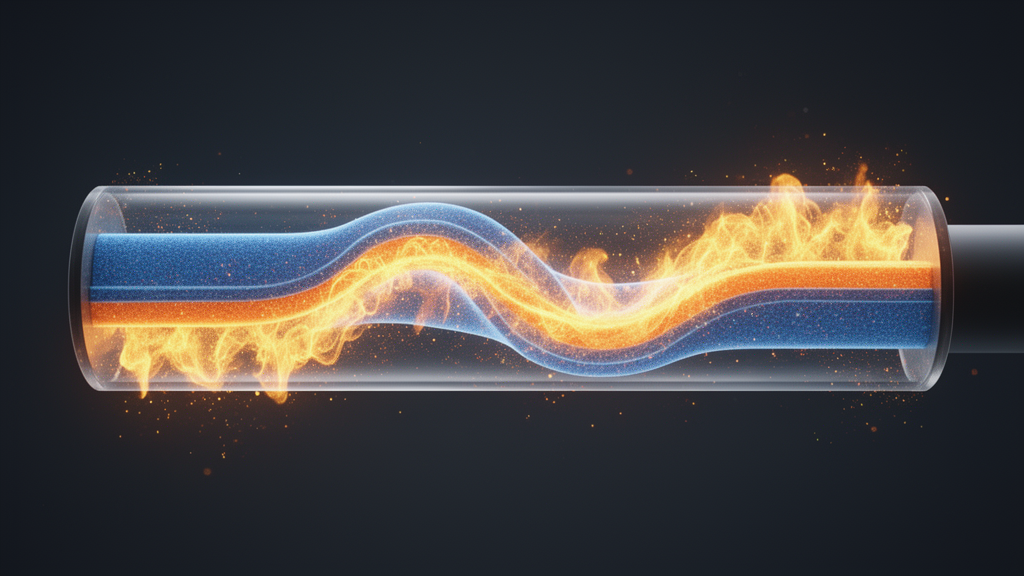
When a shock wave slams into a wavy boundary between hydrogen and air, the outcome depends dramatically on how hard the shock hits. A new numerical study published in Advances in Aerodynamics maps out this interaction in detail, identifying two fundamentally different ignition regimes and showing that, in most cases, the resulting combustion barely disturbs the hydrodynamic instability that shapes the interface. The work, led by Jianwen Liu and colleagues including Pengfei Yang, Wan Cheng, Juchun Ding and Xisheng Luo, uses an enhanced version of the detonationFoam solver built on the OpenFOAM framework, equipped with a detailed nine-species, twenty-one-step hydrogen-oxygen chemical mechanism and adaptive mesh refinement to resolve both shocks and flames.
The physical setting is the Richtmyer-Meshkov instability, the growth of wrinkles on an interface between fluids of different densities after a shock passes through it. Baroclinic vorticity, generated where the shock’s pressure gradient misaligns with the interface’s density gradient, drives the perturbation through an initial startup phase, linear growth, nonlinear deformation into bubbles and spikes, and eventual turbulent mixing. In supersonic combustion engines, this instability is a friend rather than a nuisance: it stirs fuel and air together, and mixing largely controls how efficiently the engine burns. But when the interface separates fuel from oxidizer rather than carrying a premixed flame, the coupling between instability and chemistry remains poorly understood, particularly the formation of hot spots that can trigger ignition.
The team simulated a sinusoidal hydrogen-air interface struck by shocks with Mach numbers between 2.0 and 2.7, replicating the thermochemical environment of a scramjet combustor with air preheated to 600 kelvin and fuel injected at 300 kelvin. Each reactive case was paired with an inert twin in which the chemical source terms were switched off, allowing a direct comparison of what combustion does and does not change. A grid independence study with five mesh configurations settled on a 50-micrometer baseline resolution with two levels of adaptive refinement.
The first major finding concerns ignition mode. At Mach 2.0, the shock itself does not ignite the mixture. Instead, the curved transmitted and reflected shocks spawn a pattern of transverse waves that sweep across the interface, creating localized pockets of elevated pressure and temperature near the spike and bubble tips. These pockets reach ignition conditions first, and localized burning appears about 68 microseconds after shock impact before spreading along the entire interface. The researchers quantify the regime with a modified Damköhler number comparing a flow time scale to the local ignition delay: at Mach 2.0 the ratio is roughly 0.05, meaning the interface deforms substantially before any combustion begins.
At Mach 2.7 the picture inverts. Intense shock compression raises post-shock temperature and pressure enough to ignite the interface almost immediately, with water appearing as early as 9 microseconds after impact, well before any complex transverse wave structure forms. Here the Damköhler number rises to about 4.7, and combustion is dominated by spontaneous self-ignition driven by the abrupt thermal jump. The early, intense heat release even accelerates both the transmitted and reflected shocks relative to the inert case, showing that in this strong-ignition regime chemistry does leave a visible imprint on the wave dynamics, even though the large-scale deformation of the interface remains essentially unchanged.
That last point is the study’s most striking quantitative result. Across all three Mach numbers examined, the amplitude growth of reactive interfaces collapsed onto that of their inert counterparts, and when plotted in dimensionless form the results for different shock strengths fell onto a single curve regardless of whether reactions were active. Classical inert instability models, notably that of Dimonte and Ramaprabhu, predicted the growth closely. The reason, the authors explain, is that for a sharp initial interface the total fuel mass in the mixing layer is small, so heat release is weak and the pressure waves it generates are too feeble to distort the interface. Interface thickening observed in the reactive cases stems mainly from thermal expansion and late-stage diffusion after the primary vorticity deposition, not from altered growth rates.
Large-amplitude interfaces complicate the story. When the initial perturbation is large, the transmitted shock curves more strongly, and interactions between transverse waves and the shock produce triple points, Mach stems and slip lines, forging an intricate post-shock pressure landscape. This complexity ignites the mixture at multiple sites along the interface rather than only at spike and bubble tips, although overall ignition onset is actually delayed relative to the small-amplitude case at the same shock strength. To capture the growth rate, the team modified the VMG model of Vandenboomgaerde and colleagues with a reduction factor of roughly 0.3, interpolated from experiments that account for how large amplitudes attenuate vorticity deposition. The modified model successfully predicted the linear growth rate, reinforcing the conclusion that hydrodynamics dominates even amid multi-site ignition.
Interface thickness proved to be the parameter with the most surprising chemistry-dependent behavior. For weak ignition at Mach 2.0, the effect is non-monotonic: moderate thickening of the diffusion layer advances ignition, because a thinner mixture-fraction gradient lowers the scalar dissipation rate at the stoichiometric surface and gives radicals a larger reaction zone to accumulate in, while excessive thickening delays ignition because the shock loses strength as it traverses the diffuse layer, weakening the pressure and temperature peaks that drive ignition. The authors conclude that an optimal diffusion thickness should exist for earliest ignition under weak-shock conditions. At Mach 2.7 the behavior reverses cleanly: thickening consistently delays ignition, because abrupt shock compression dominates and any diffuse layer merely softens the thermal jump. Sufficiently thick interfaces may even shift the system from strong to weak ignition.
Vorticity analysis explains why thick interfaces behave differently at high Mach numbers. At Mach 2.0, spatially integrated vorticity near the interface shows little dependence on thickness, consistent with combustion’s weak influence. At Mach 2.7, thicker interfaces produce markedly higher integrated vorticity throughout the evolution: stronger heat release intensifies dilatational vorticity through thermal expansion, and the wrinkled flame structure amplifies the misalignment of density and pressure gradients, enhancing baroclinic deposition. Because viscosity rises with temperature, it more than doubles in the late stage of every case, and viscous vorticity generation becomes substantial, particularly in reactive strong-shock cases. The authors note that such strong viscous effects may delay the transition to turbulence, and that evolution at thick interfaces under strong shocks is jointly governed by baroclinic and viscous vorticity production.
The heat release rate ties the whole picture together. After ignition it climbs to a peak and then decays toward nearly zero as mixing becomes too slow to sustain combustion, meaning strong coupling between burning and instability exists only in a brief early window. This transient explains the limited overall influence of combustion on instability growth in non-premixed configurations. The researchers caution that their idealized single-mode interface does not replicate the full complexity of a practical scramjet combustor; it isolates the fundamental feature of separate fuel and air injection with mixing-controlled combustion. Even so, the identification of two ignition modes with opposite responses to interface thickness offers concrete guidance for supersonic propulsion, where controlling ignition timing and mixing efficiency is central to engine performance.
Subject of Research: Numerical study of reactive Richtmyer-Meshkov instability at shock-driven sinusoidal hydrogen-air interfaces
Article Title: Interaction of shock wave with sinusoidal fuel-air interface
Article References: Liu, J., Yang, P., Cheng, W., Ding, J., & Luo, X. (2026). Interaction of shock wave with sinusoidal fuel-air interface. Advances in Aerodynamics, 8(1), Article 22. https://doi.org/10.1186/s42774-026-00266-3
Image Credits: AI Generated
DOI: 10.1186/s42774-026-00266-3
Keywords: Richtmyer-Meshkov instability, shock wave, hydrogen-air interface, scramjet combustion, ignition regimes, detonationFoam, baroclinic vorticity, non-premixed combustion, interface thickness, Mach number, adaptive mesh refinement, chemical kinetics
Cite Scienmag News
Denise Maddox. (October 29, 2026). Shock Waves Ignite Fuel-Air Interfaces in Two Distinct Ways, Simulations Show. Scienmag. https://scienmag.com/shock-waves-ignite-fuel-air-interfaces-in-two-distinct-ways-simulations-show/
Denise Maddox. "Shock Waves Ignite Fuel-Air Interfaces in Two Distinct Ways, Simulations Show." Scienmag, 29 October 2026, https://scienmag.com/shock-waves-ignite-fuel-air-interfaces-in-two-distinct-ways-simulations-show/. Accessed 29 October 2026.
Denise Maddox. "Shock Waves Ignite Fuel-Air Interfaces in Two Distinct Ways, Simulations Show." Scienmag. October 29, 2026. https://scienmag.com/shock-waves-ignite-fuel-air-interfaces-in-two-distinct-ways-simulations-show/