


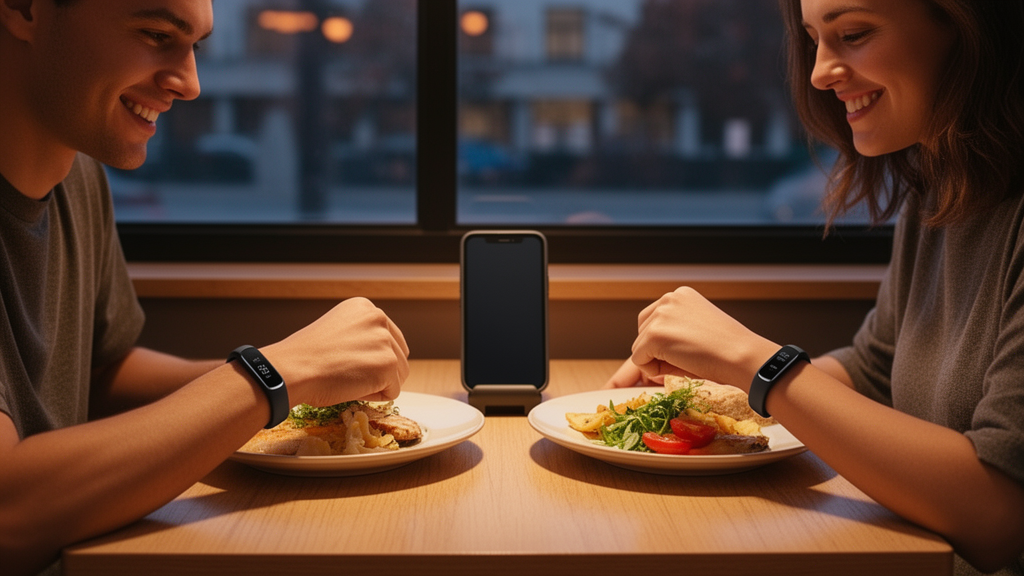
Eating a meal together over a video call has become an ordinary ritual for millions of people who live apart from family, friends and colleagues. A team of Japanese researchers has now tested whether a small technological addition to those virtual dinners—letting each diner see a visualization of the interaction between them—can change the way their bodies and minds respond to the shared meal. The answer from their randomized, open-label, controlled preliminary study in healthy adults is largely no, at least for the outcomes the trial was designed to detect, though the data hint at one intriguing physiological pattern during the earliest minutes of eating.
The study, published in BioPsychoSocial Medicine and registered with the University Hospital Medical Information Network Clinical Trials Registry as UMIN000051250 on June 3, 2023, grew out of two strands of earlier work. Prior studies had suggested that sharing biosignals may enhance social presence and connectedness, and that online shared eating may influence heart rate variability, dyadic physiological covariation, loneliness and mood. What remained insufficiently examined, the authors wrote, was the effect of biosignal-sharing feedback during online commensality—the practice of eating together, in person or remotely, as a social act.
To fill that gap, the researchers built an intervention they call interaction-visualizing feedback. Participants ate together online in dyads, and in the intervention group the system shared the members’ physiological information and visualized their interpersonal interactions in real time, using heart rate variability as the underlying signal. The control group instead saw only constant illumination, with no biosignal feedback. The design was open-label, meaning participants knew which condition they were in, and randomized, meaning allocation to the two conditions was assigned by chance.
The primary outcome was a change in the standard deviation of normal-to-normal intervals, or SDNN, a standard heart rate variability metric that captures overall beat-to-beat variability over a measurement window. The researchers calculated ΔSDNN, the change in SDNN from a pre-meal resting phase to each subsequent experimental phase. Secondary outcomes included exploratory within-dyad correlation coefficients of ΔSDNN between dyad members—asking whether two people eating together online show similar shifts in their autonomic activity—and pre-to-post changes on two psychological instruments: the Three-Item Loneliness Scale, or TILS, and the UWIST Mood Adjective Checklist, or UMACL, which measures energetic arousal and tense arousal.
Because people eating together are not independent observations, the analysis had to respect the structure of the data. Linear mixed models accounted for repeated measurements within each participant and for dependency within each dyad. This statistical approach is essential in dyadic designs, where two members of a pair share a meal, a conversation and a video link, and where treating them as unrelated individuals would inflate the apparent strength of any finding.
Thirty dyads were enrolled. One control dyad was excluded because of insufficient HRV data acquisition, leaving 29 dyads for the analysis. The headline result was negative: the group-by-phase interaction for ΔSDNN was not statistically significant, with F(2, 96.5) = 0.102 and p = .903. In plain terms, the trajectory of heart rate variability change across the experimental phases did not differ between the group that saw interaction-visualizing feedback and the group that saw constant illumination.
The psychological outcomes followed the same pattern. Group-by-time interactions were not statistically significant for the Three-Item Loneliness Scale, with p = .556, for UMACL energetic arousal, with p = .953, or for UMACL tense arousal, with p = .197. Seeing a visualization of the interaction between themselves and their meal partner, in other words, did not measurably shift loneliness or the two arousal dimensions of mood over the course of the session, at least with the sample size and measures used in this preliminary trial.
The exploratory dyad-level analyses told a more nuanced story. During the first half of the meal, a significant positive within-dyad correlation in ΔSDNN was observed in the intervention group, with Spearman’s ρ = 0.525 and p = .045, but not in the control group, where ρ was −0.169 and p = .563. The between-member absolute difference in ΔSDNN during the first half of the meal was also smaller in the intervention group than in the control group, with a Mann–Whitney U of 45.0 and p = .008. Together, these findings suggest that when partners could see the interaction visualized, their early-meal changes in SDNN moved in similar directions and magnitudes more often than when they could not.
The authors were careful about what these exploratory results do and do not show. Their conclusion states that interaction-visualizing feedback did not significantly affect ΔSDNN or psychological outcomes during online shared eating sessions, and that the exploratory dyad-level findings suggested possible early phase within-dyad similarity in SDNN change. Because the trial was preliminary, open-label and small, with 29 dyads analyzed, these correlation and difference findings cannot be taken as proof that biosignal sharing causes physiological synchrony, and the psychological measures showed no group differences at all.
Still, the study adds a concrete data point to a growing area of research on remote commensality and biosignal sharing. As video-call meals become a fixture of modern social life, the question of whether technology can make them feel more genuinely shared—physiologically as well as socially—remains open. This trial suggests that visualizing interpersonal interaction during an online meal does not reliably reshape heart rate variability or mood in healthy adults, but it leaves open the possibility that the earliest minutes of a shared virtual meal hold a subtle, measurable signature of connection worth investigating in larger, more definitive studies.
Subject of Research: A randomized, open-label, controlled preliminary trial testing whether interaction-visualizing feedback during online shared eating affects heart rate variability, dyadic physiological covariation, loneliness and mood in healthy adults.
Article Title: Effects of interaction-visualizing feedback on heart rate variability and psychological outcomes during online shared eating: a randomized, open-label, controlled preliminary study in healthy adults
Article References: Shimazu, M., Hasuo, H., Sakuma, H., Fujii, R., Kitada, E., Goto, A., Tomoda, S., Kanbara, K., Araki, H., & Kusaka, N. (2026). Effects of interaction-visualizing feedback on heart rate variability and psychological outcomes during online shared eating: a randomized, open-label, controlled preliminary study in healthy adults. BioPsychoSocial Medicine. https://doi.org/10.1186/s13030-026-00369-9
Image Credits: AI Generated
DOI: 10.1186/s13030-026-00369-9
Keywords: heart rate variability, online shared eating, interaction-visualizing feedback, SDNN, dyadic physiological covariation, loneliness, mood, randomized controlled trial, healthy adults, commensality, biosignal sharing, autonomic nervous system
Cite Scienmag News
Glenn Wilkins. (October 28, 2026). Sharing heart-rate feedback online may sync meal partners’ heart rhythms, small trial finds. Scienmag. https://scienmag.com/sharing-heart-rate-feedback-online-may-sync-meal-partners-heart-rhythms-small-trial-finds/
Glenn Wilkins. "Sharing heart-rate feedback online may sync meal partners’ heart rhythms, small trial finds." Scienmag, 28 October 2026, https://scienmag.com/sharing-heart-rate-feedback-online-may-sync-meal-partners-heart-rhythms-small-trial-finds/. Accessed 4 November 2026.
Glenn Wilkins. "Sharing heart-rate feedback online may sync meal partners’ heart rhythms, small trial finds." Scienmag. October 28, 2026. https://scienmag.com/sharing-heart-rate-feedback-online-may-sync-meal-partners-heart-rhythms-small-trial-finds/




