


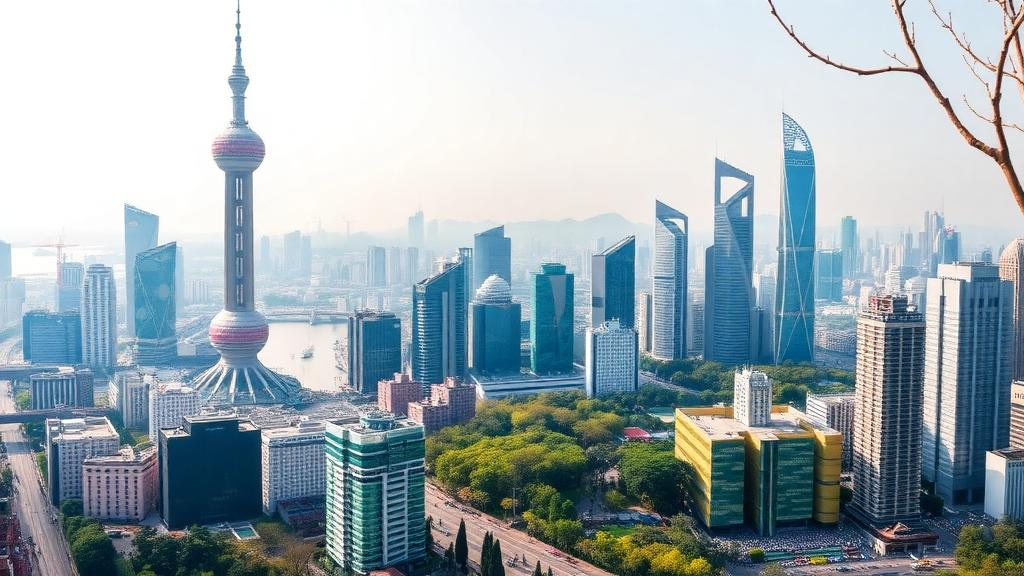
Shanghai’s master plans never once use the term ecosystem services, yet a systematic analysis of the city’s official planning documents shows the concept is woven into them anyway, implicitly and unevenly. Researchers examined the Shanghai Master Plan 2017-2035 together with the master plans of all nine suburban districts it names, searching 802 relevant text passages for explicit and implicit references to ecosystem services and green infrastructure. The finding, published in the journal One Ecosystem, reveals a striking knowledge and implementation gap at the science-policy interface: the scientific vocabulary has not reached the planning documents, but the underlying ideas have partially arrived, filtered through Chinese planning traditions and the national strategy of ecological civilization.
The research team applied linguistic preprocessing to the official documents, systematically searching for the exact term ecosystem services and its Chinese equivalent shengtai xitong fuwu, as well as for green infrastructure and its Chinese counterpart luse jichu sheshi. To be sensitive to possible loss of information through translation, they also identified additional Chinese keywords showing terminological proximity to the concepts, consulting experts from Tongji University in Shanghai for reliable translations. The machine translation of the Chinese documents into English, combined with postediting and native-speaker consultations, is an accepted resource-efficient method for cross-language research. Each passage was then interpreted according to its context-specific appearance and rated on a score system from 0 to 3, reflecting whether a service was merely mentioned, linked to a problem or aim, tied to an action, or accompanied by concrete goals and assessments.
The result is unambiguous on one point: the term ecosystem services did not appear in any of the ten documents, neither in the municipal master plan nor in the district plans for Baoshan, Chongming, Fengxian, Jiading, Jinshan, Minhang, Pudong, Qingpu and Songjiang. Instead, the researchers found similar terms used 33 times across the documents. The most frequent, appearing twelve times, was ecological benefits, shengtai xiaoyi, which surfaced in all master plans at least once except Baoshan and Songjiang, often directly related to specific ecosystems such as farmland, forests or water. Another closely related term, ecological service, shengtai fuwu, differs from the original only by dropping the two characters for system and appeared in Fengxian, Jiading, Songjiang and the Shanghai master plan. Ecological service function and, in a single exceptional Minhang passage, ecological landscape service rounded out the terminology. None of the plans specified or elaborated on what ecological benefits actually entail, which complicates judging whether this reflects deliberate adoption of the international concept or coincidental linguistic similarity.
Despite the missing vocabulary, individual ecosystem services are referenced throughout the plans with varying importance. Cultural services dominate, accounting for roughly half of all mentioned services, with the districts of Fengxian and Songjiang exceeding even that average. The uptake is most significant for recreation and mental and physical health, for which all plans contain specific targets. This appreciation is hardly surprising given that the Chinese garden tradition has long emphasized aesthetics and harmony between humans and nature, and it contrasts with the underrepresentation of cultural services in international scientific discourse. Provisioning services, particularly food supply tied to farmland protection and water supply, form the second pillar, covering between fifteen and twenty-eight percent of named services depending on the district. The plans even name specific local products, from grain and vegetables to the Baihe strawberry of Qingpu.
Regulating services present the most diverse and weakest integration. Although they include the largest number of individual services, ten in total, they cover only between eight percent in Songjiang and twenty-six percent in Jinshan of all references. Water-related regulating services, including wastewater treatment, runoff mitigation and moderation of extreme events such as flood protection, were consistently well covered in Jiading and Jinshan and relatively well in Shanghai and Minhang, but neglected or mentioned only as problems in most other plans. The researchers attribute the relative importance of water-related services to Shanghai’s coastal location and to pressing water pollution and flood risks in the Yangtze River Basin. An illustrative example is the Sponge City idea introduced in the Shanghai master plan, which addresses urban water management through nature-based approaches.
More striking is what the plans omit. Air quality regulation, noise reduction and local climate regulation are highly relevant urban ecosystem services and known environmental problems in Shanghai, yet they are insufficiently covered even though the problems themselves are addressed. In Minhang and Pudong, only indistinct references to pollution barrier forests were found, and only in Jinshan is the relationship between vegetation and air pollution reduction expressed clearly. Carbon sequestration and storage is selectively referenced, while biological control and noise reduction were hardly considered at all. Pollination and raw material supply are absent from every plan. Disservices, such as insecurity in the night, shading of farmland and pollution by volatile organic compounds, appear in a few plans but are rarely acknowledged as such and never linked to goals or actions. The researchers warn that a too severe focus on only a few services risks undermining the integrated character of the ecosystem services approach.
Green infrastructure shows a similar pattern of partial uptake. Nearly all master plans mention natural elements, and the network characteristics of green infrastructure, meaning connectivity between individual green spaces planned as a coherent system, are evident for roughly fifty to seventy-five percent of all references. The city-wide ecological network consists of green belts, ecological corridors, green wedges, parks at multiple scales, ecological reserves and water bodies, further linked to a greenway system that combines ecological objectives with human usage. The multiscale approach appears in 28.6 percent of green infrastructure references in the Shanghai master plan and up to 47.9 percent in Minhang. Yet the researchers found deficits in a majority of plans because at least one core aspect of the concept, whether network connectivity, multiple benefits or the strategic planning idea, is usually missing. In Baoshan only one passage, 2.6 percent, demonstrates all aspects, while Fengxian manages at least twelve comprehensive passages. Minhang and Chongming have precisely adopted the concept, which the researchers view as a promising starting point for deeper planning considerations.
The analysis also reveals a spatial logic: the district master plans reflect the land use proportions within their administrative areas. Districts bordering the inner city have large shares of built-up land and correspondingly emphasize cultural services. The southern districts of Jinshan and Fengxian are dominated by cropland, so their plans frequently address provisioning services. Chongming and Qingpu are characterized by extensive water bodies and marshes, areas with potential for supporting and habitat-related services, and these receive more than average attention there. The researchers calculated descriptive Pearson correlation coefficients between land use categories and service mentions, finding that districts with high degrees of water bodies and marshes give supporting and habitat services more attention, whereas highly urbanized districts rarely mention them. This implicit prioritizing means the plans mirror the natural landscape characteristics of each district, even without a consistent conceptual framework.
One policy stands out as a direct, if invisible, integration of ecosystem services: the ecological protection red line. In areas delineated by a red line, construction is prohibited to protect important services. The scientific process behind suggesting the red lines for the Shanghai master plan included assessing ecosystem services as a core element, limited to carbon sequestration and storage, water storage, water purification, soil conservation and biodiversity hotspots. The master plan itself never mentions this basis. The red line policy is the strongest and most consistent conservation action related to ecosystem services and green infrastructure within the plans, yet the underlying assessment remains unacknowledged in the planning documents, a curious case of science informing policy without the discourse following.
The Shanghai findings align with international research showing that explicit references to ecosystem services in urban plans are rare and the framework is seldom considered as a whole, consistent with studies from Europe, Australia and parts of the United States. Cultural services such as recreation and tourism dominate while pollination and biological control are neglected, mirroring patterns found in Italian, German and Polish contexts. Notably, the best example of integration was found in district master plans rather than the municipal one, contradicting findings from other studies that lower-level plans are generally weaker on environmental aspects. The researchers conclude that while ecological protection has been promoted and green infrastructure and ecosystem services are implicitly considered, a complete discursive shift towards a new ecological approach to urban planning has not yet been achieved. The implicit uptake provides an extendible basis for further integration, with the greatest need for improvement identified in Baoshan, Songjiang and Pudong, and positive examples set by Minhang, Fengxian and Jinshan. For a megacity that sees itself as a role model for urban planning well beyond China, closing the vocabulary gap may prove the decisive step toward fully exploiting the urban potential of ecosystem services.
Subject of Research: Ecosystem services and green infrastructure in Shanghai urban planning
Article Title: Ecosystem Services Concept and Terminology as reflected in Shanghai Urban District Master Planning
Article References: Knöll, V., Falke, M., Jing, G., Chen, Z., Dong, N., & Zepp, H. (2025). Ecosystem Services Concept and Terminology as reflected in Shanghai Urban District Master Planning. One Ecosystem, 10, Article e154549. https://doi.org/10.3897/oneeco.10.e154549
Image Credits: AI Generated
DOI: 10.3897/oneeco.10.e154549
Keywords: ecosystem services, green infrastructure, urban planning, Shanghai, master plans, ecological civilization, spatial planning, China, sustainability, science-policy interface, Ecosystem, Services
Cite Scienmag News
Gavin Prescott. (October 18, 2026). Shanghai’s Master Plans Never Say Ecosystem Services, Yet They Quietly Plan Around Them. Scienmag. https://scienmag.com/shanghais-master-plans-never-say-ecosystem-services-yet-they-quietly-plan-around-them/
Gavin Prescott. "Shanghai’s Master Plans Never Say Ecosystem Services, Yet They Quietly Plan Around Them." Scienmag, 18 October 2026, https://scienmag.com/shanghais-master-plans-never-say-ecosystem-services-yet-they-quietly-plan-around-them/. Accessed 18 October 2026.
Gavin Prescott. "Shanghai’s Master Plans Never Say Ecosystem Services, Yet They Quietly Plan Around Them." Scienmag. October 18, 2026. https://scienmag.com/shanghais-master-plans-never-say-ecosystem-services-yet-they-quietly-plan-around-them/


