


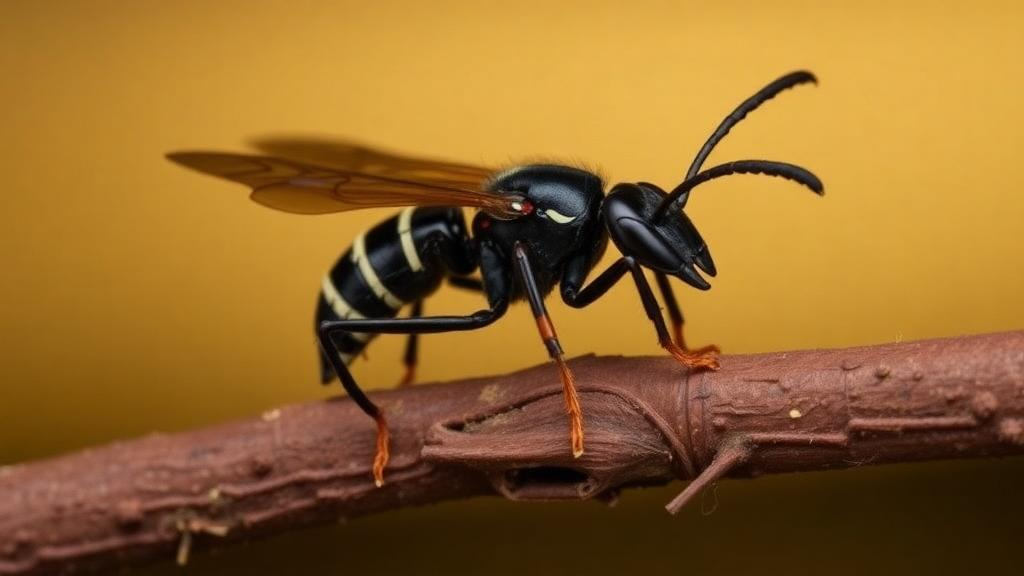
Deep in the rainforests of the Central African Republic, on the slopes of South Africa’s Gamkaberg, and in the canopy shadows of Uganda’s Kibale National Park, a group of tiny parasitic wasps has been hiding in plain sight for decades. Now, thanks to one of the most exhaustive insect sampling campaigns ever conducted on the African continent, four previously unknown species of Darwin wasps belonging to the genus Eusterinx have finally been formally described, doubling the number of these wasps known from the entire Afrotropical region in a single stroke.
The discovery, published in the Journal of Hymenoptera Research by Andrey Humala and Simon van Noort, reads like a detective story written in the language of taxonomy. The genus Eusterinx, a moderately large group of Darwin wasps in the subfamily Orthocentrinae, is known from every major biogeographic region of the world, with 58 described extant species before this study. Yet in Africa, the genus was so vanishingly rare that only a single specimen had ever been recorded across a previous study treating quite a large amount of material from South Africa, Ethiopia, Kenya and Uganda. The new paper changes that picture dramatically, describing Eusterinx dzanga from the Central African Republic, Eusterinx kirkwoodi and Eusterinx gamka from South Africa, and Eusterinx kibale from Uganda, all belonging to the subgenus Ischyracis.
What makes the rarity of these wasps so remarkable is the sheer scale of the sampling effort behind the discovery. The type specimens were extracted from the Iziko South African Museum collection, which houses the fruits of continuous invertebrate inventory surveys conducted by van Noort over the last 33 years across a range of habitats in South Africa and further afield in Africa. These surveys totaled 101,866 Malaise trap days, equivalent to 279 Malaise trap years, producing an estimated 57.15 million arthropod specimens, of which 5.9 million were Hymenoptera and 509,330 were Ichneumonidae. From this staggering abundance, only seven curated specimens of the subgenus Ischyracis were ever extracted and sorted, from among 770 specimens of Orthocentrinae that had been pulled from the bulk samples. The wasps are not just rare; they are statistical phantoms.
The seven specimens were determined by Gavin Broad in 2015 during a visit to the South African Museum, when he identified them from among the sorted Orthocentrinae material. It is this determination that set the stage for the current study, which treats the material housed in the Iziko collection and provides an illustrated identification key to the known Afrotropical Eusterinx species. Online Lucid identification keys and images of all the species treated in the paper are available at WaspWeb, a resource that makes the morphology of these minute wasps accessible to researchers worldwide.
Representatives of the subgenus Ischyracis are small to medium-sized ichneumonids, with body lengths ranging from 3.2 to 8.4 millimeters and forewing lengths from 2.5 to 6.5 millimeters. They are characterized by slender legs and body, enlarged eyes with inner orbits clearly convergent to the clypeus in females and to a lesser extent in males, strong notauli, and a propodeum bearing a pair of well-developed apophyses. Males have one concave tyloid on the sixth flagellomere. According to the studies of van Rossem, Eusterinx is divided into six subgenera: Dallatorrea, Eusterinx, Holomeristus, Ischyracis and Trestis, earlier considered as valid genera and synonymized by Townes in 1971, and Divinatrix van Rossem. The boundaries between some subgenera have not yet been well defined, and Dasch, in his monograph devoted to the Nearctic fauna, considered all existing subgenera of Eusterinx to be synonyms, recognizing species-groups instead.
The four new African species belong to the subgenus Ischyracis, which to date contains eleven known species worldwide. The subgenus Dallatorrea, with four known species from the Palaearctic and Nearctic regions, was recently synonymized under Ischyracis. Before this study, the only species of Eusterinx recorded from the Afrotropical region was Eusterinx africana, described last year from South Africa. The new paper brings the Afrotropical tally to five species, all in Ischyracis, and provides a key to distinguishing them based on characters such as the slenderness of the second metasomal tergite, the proportions of the first flagellomere, the presence or absence of a pale band on the flagellum, the length of the propodeal apophyses relative to hind coxal width, and the slenderness of the hind femur.
Eusterinx dzanga, the largest of the new species at 5.2 millimeters in body length with a forewing of 3.3 millimeters, was collected in the Parc National de Dzanga-Ndoki in the Prefecture Sangha-Mbaéré of the Central African Republic, in lowland rainforest using a Malaise trap. It is recognizable by a very slender second metasomal tergite, 2.15 times as long as its maximum width posteriorly, a first flagellomere 7.0 times as long as wide, a flagellum bearing a wide pale band on flagellomeres 7 to 14, propodeal apophyses nearly as long as hind coxal width, and a slender hind femur 6.3 times as long as wide. The species is named after the Dzanga-Ndoki National Park, and the male remains unknown.
Eusterinx kibale, from Kibale National Park in Uganda, was collected at the Makerere University Biological Field Station at 1495 meters in secondary mid-altitude rainforest using a Malaise trap. At 3.5 millimeters in body length with a forewing of 2.7 millimeters, it is characterized by a flagellum bearing a narrower pale band on flagellomeres 11 to 14, elongate propodeal apophyses with terminally rounded tips, and a second metasomal tergite 1.5 times as long as wide posteriorly. Eusterinx gamka, from the Gamkaberg Nature Reserve in the Western Cape of South Africa, was collected using a yellow pan trap in thicket vegetation. At 3.9 millimeters in body length with a forewing of 2.5 millimeters, it differs from its closest relatives by the proportions of the area superomedia on the propodeum, which is 1.6 times as long as its maximum width, a short malar space 1.2 times as long as the basal mandibular width, and a hind tarsus clearly longer than the hind tibia. The species name Gamkaberg means lion mountain in Khoisan.
Eusterinx kirkwoodi, from the Eastern Cape of South Africa, is known from two specimens, a holotype collected with a Malaise trap on Mannetjie Farm and a paratype collected with a yellow pan trap on Blauwe Krans Farm, both in Valley Bushveld habitat near the town of Kirkwood. At 4.4 millimeters in body length with a forewing of 3.0 millimeters, it is distinguished by an area superomedia 1.3 times as long as its maximum width, a longer malar space 1.75 times as long as the basal mandibular width, and a hind tarsus as long as the hind tibia. There is no variation between the two known specimens, and the paratype matches the holotype with respect to size and character states. The species is named after the closest town to the type localities of both specimens.
Beyond the four new species, the study also examined two unplaced males from the Central African Republic and Uganda, collected in the same rainforest localities as the female holotypes of Eusterinx dzanga and Eusterinx kibale respectively. The researchers were unable to match these males to their respective females, noting that they differ markedly from the associated females, particularly with respect to the presence or absence of banding on the antennae and the relative size of the propodeal apophyses, for both of which they are more typical of the South African species associated with arid habitats. Sexual dimorphism is clearly present in the genus, exacerbating reliable matching of the sexes, and a barcoding analysis will be required to resolve conspecifics across the sexes. There are also a few additional Ischyracis specimens from Cameroon, Uganda and Zimbabwe stored in the Natural History Museum in London, which will be dealt with in a follow-up paper.
The biology of Eusterinx remains poorly known, but a few species have been reported as koinobiont endoparasitoids of keroplatid gnats from the genera Orfelia and Cerotelion, in the fly family Keroplatidae. This suggests that the newly described African species may likewise be parasitoids of fungus gnats, playing a quiet but potentially significant role in regulating the populations of these dipterans in African forests and thickets. The possibility that further specimens of the subgenus Ischyracis reside in the many unsorted samples deposited in the South African Museum adds a tantalizing dimension to the story, hinting that the Afrotropical Eusterinx fauna may be richer still than the current study reveals.
The discovery of four new species in a genus previously represented by a single Afrotropical specimen underscores a broader truth about biodiversity science: even in well-sampled regions, the rarest members of an ecosystem can remain invisible for centuries. It takes not just the right tools, but the right patience, a 33-year campaign of continuous inventory surveys, hundreds of thousands of trap days, and millions of specimens, to coax the rarest wasps out of the statistical noise. The new species from the Central African Republic, South Africa and Uganda are a testament to that patience, and a reminder that the smallest animals often carry the biggest surprises.
Subject of Research: New records of the genus Eusterinx Förster (Hymenoptera: Ichneumonidae: Orthocentrinae) from the Afrotropical Region, with description of four new species from Central African Republic, South Africa and Uganda
Article Title: New records of the genus Eusterinx Förster ( Hymenoptera : Ichneumonidae : Orthocentrinae ) from the Afrotropical Region, with description of four new species from Central African Republic, South Africa and Uganda
Article References: Humala, A. E., & van Noort, S. (2025). New records of the genus Eusterinx Förster (Hymenoptera: Ichneumonidae: Orthocentrinae) from the Afrotropical Region, with description of four new species from Central African Republic, South Africa and Uganda. Journal of Hymenoptera Research, 98, 817-839. https://doi.org/10.3897/jhr.98.157523
Image Credits: AI Generated
Keywords: records, genus, Eusterinx, rster, Hymenoptera, Ichneumonidae, Orthocentrinae, Afrotropical, Region, description, four, species
Cite Scienmag News
Gavin Prescott. (October 18, 2026). New records of the genus Eusterinx Förster (Hymenoptera: Ichneumonidae: Orthocentrinae) from the Afrotropical Region, with description of four new species from Central African Republic, South Africa and Uganda. Scienmag. https://scienmag.com/new-records-of-the-genus-eusterinx-forster-hymenoptera-ichneumonidae-orthocentrinae-from-the-afrotropical-region-with-description-of-four-new-species-from-central-african-republic-south-africa-a/
Gavin Prescott. "New records of the genus Eusterinx Förster (Hymenoptera: Ichneumonidae: Orthocentrinae) from the Afrotropical Region, with description of four new species from Central African Republic, South Africa and Uganda." Scienmag, 18 October 2026, https://scienmag.com/new-records-of-the-genus-eusterinx-forster-hymenoptera-ichneumonidae-orthocentrinae-from-the-afrotropical-region-with-description-of-four-new-species-from-central-african-republic-south-africa-a/. Accessed 18 October 2026.
Gavin Prescott. "New records of the genus Eusterinx Förster (Hymenoptera: Ichneumonidae: Orthocentrinae) from the Afrotropical Region, with description of four new species from Central African Republic, South Africa and Uganda." Scienmag. October 18, 2026. https://scienmag.com/new-records-of-the-genus-eusterinx-forster-hymenoptera-ichneumonidae-orthocentrinae-from-the-afrotropical-region-with-description-of-four-new-species-from-central-african-republic-south-africa-a/


