


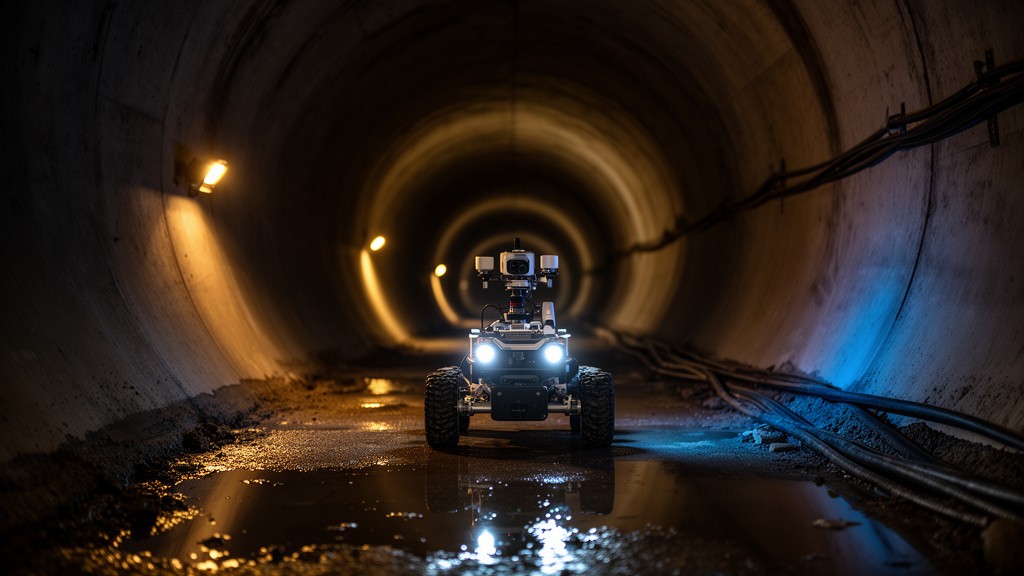
Deep beneath the streets, in the dark and damp of the world’s sewer networks, a quiet revolution is underway. Engineers at the University of Freiburg and the Fraunhofer Institute for Physical Measurement Techniques have taught a robot to know exactly where it is inside the labyrinth of pipes that keep our cities clean. The breakthrough, published in the International Journal of Intelligent Robotics and Applications, could finally allow autonomous machines to inspect the ageing arteries of urban infrastructure with centimetre-level precision — without the tethers, guesswork and manual labour that have defined sewer inspection for decades.
The problem the team tackled is deceptively simple to state but fiendishly hard to solve. When a robot crawls through a sewer, it must continuously answer two questions: where am I, and what does the pipe around me look like? The answers matter enormously. A crack, a displaced joint or a deformed section is only useful information if it can be pinned to a precise position along the pipe axis and around its circumference. Without that, inspection results from different years cannot be compared, defect progression cannot be tracked, and repair crews cannot find the damage they are meant to fix. In one common maintenance technique — plastic lining — house connections must be re-opened at their exact locations after a liner is installed, making accurate localisation a safety-critical requirement.
Today, the position of an inspection robot is usually determined by the length of unrolled tether cable connecting it to the surface. The approach is crude: it assumes the pipe between two manholes is a perfectly straight line, ignores any angular deviation, and measures only a one-dimensional distance. It requires continuous manual handling, the cable must remain under tension at all times, and driving backwards over long distances is particularly difficult. Wheel encoders and inertial measurement units offer a tetherless alternative, but they suffer from cumulative drift caused by wheel slip, vibrations and sensor noise — errors that grow relentlessly with distance travelled.
The obvious high-tech solution is simultaneous localisation and mapping, or SLAM: the family of algorithms that lets robots build maps while tracking their own position within them. SLAM has transformed indoor robotics, autonomous vehicles and even subterranean exploration. But when the Freiburg team deployed state-of-the-art SLAM systems — including LeGO-LOAM, LIO-SAM and Voxel-SLAM — inside sewer pipes, the algorithms collapsed. The reason lies in the peculiar geometry of sewers: smooth, curved, non-planar walls with repetitive cross-sections, few sharp edges and almost no planar surfaces. Standard feature detectors, which typically require at least 10 edge features and 100 surface features per frame for reliable scan registration, extracted on average just 4.1 edge features and 6.8 surface features per frame in sewer conditions. The algorithms were effectively blinded, reduced to little more than inertial dead reckoning.
The team’s solution is elegantly counterintuitive: instead of fighting the sewer’s monotony, embrace it. Sewers are built to strict regulations, and that standardisation becomes a powerful prior. Pipe segments are straight elements with known or bounded lengths, beginning and ending at well-defined joints. The new algorithm constrains the robot’s motion to the detected pipe-segment axis, reducing the localisation problem — for most of the trajectory — to a single degree of freedom: longitudinal motion along the pipe. Orientation changes are permitted only at detected connections between segments, which occur at discrete, predictable distances. This dramatically shrinks the state space the estimator must search.
To perceive its environment, the robot uses a 3D laser scanner mounted in an application-specific configuration, capturing 14 scan layers simultaneously with an asymmetrical opening angle biased toward the direction of travel. The adapted feature detector fits circles to the points in each scan layer, then applies linear regression to the circle centres to estimate the pipe axis. Connection features — the joints between pipe segments — are identified as sequences of fitted circles whose radii are significantly larger than the median, followed by a circle with a smaller radius. Because concrete and plastic pipes have different joint geometries, the thresholds are calibrated to the pipe material. The detector also adapts the classical planar feature to operate in polar coordinates, identifying surfaces that follow a cylindrical model rather than seeking flat patches in 3D space.
Perhaps the most ingenious component is the loop-closure strategy. In homogeneous environments, different locations can look nearly identical, and false loop closures — where the algorithm wrongly believes it has revisited a spot — can catastrophically distort the map. The new approach permits loop closure only at detected pipe connections and verifies revisits by comparing normalised connection point clouds using the symmetric Chamfer distance, a metric that averages the nearest-neighbour distances between two point sets in both directions. With a threshold of 5 millimetres, selected on an independent calibration subset, the system classified all 125 connection events across laboratory and field experiments perfectly: 100 per cent precision, 100 per cent recall, zero false positives. Thresholds of 2 millimetres missed revisits; 8 and 11 millimetres produced false loop closures. Five millimetres was the only value that achieved both.
The validation was rigorous. In the laboratory, a robot crawled through 48-centimetre-diameter plastic pipe segments while a total station tracked a prism mounted on top, providing continuous ground truth. The proposed method achieved a root-mean-square absolute trajectory error of 13.4 ± 4.1 millimetres — roughly three times better than IMU-encoder dead reckoning at 41.3 millimetres, and far superior to LIO-SAM and Voxel-SLAM, whose outputs in the sewer environment were dominated by inertial propagation. An ablation study confirmed that the pipe-axis constraint and the adapted feature extraction provided the largest improvements in local accuracy, while loop closure primarily corrected accumulated drift during repeated back-and-forth traversals and the self-centring controller improved heading stability.
Field trials in five operational rainwater sewer holdings, with lengths between 27.8 and 90.3 metres and diameters from 40 to 220 centimetres, confirmed the laboratory findings under real-world conditions of mud, water and imperfect pipe alignment. For the first holding, encoder-only localisation produced an endpoint error of 232.6 centimetres; IMU-only, 96.4 centimetres; IMU-encoder fusion, 64.7 centimetres. The proposed method reduced the error to 16.3 centimetres — 0.46 per cent of the holding length. Across all five holdings, relative endpoint errors ranged from 0.38 to 0.62 per cent, all below the one per cent benchmark. The complete SLAM pipeline processes each lidar frame in 35.9 milliseconds on an embedded NVIDIA Jetson AGX Orin platform — faster than the scan period, enabling genuine real-time operation.
The implications extend beyond inspection. The algorithm generates geometrically consistent 3D maps in which the angle at every pipe connection is known, allowing local low points where sediment accumulates to be identified more easily. Defects detected in camera images or lidar point clouds can be localised with a mean axial error of 6.2 millimetres and a mean circumferential error of 8.7 degrees. The authors caution that their validation covered only rainwater sewers with round cross-sections, and that mixed or wastewater sewers, heavy deposits, degraded pipes and non-circular profiles remain untested. But the core insight — that embedding strong domain-specific geometric priors into SLAM substantially improves performance in feature-poor environments — points toward a future where fleets of autonomous robots patrol the hidden infrastructure beneath our feet, performing large-scale condition assessment, targeted maintenance and long-term monitoring of the critical networks that modern civilisation quietly depends upon.
Subject of Research: Domain-specific constraints for localisation and mapping in sewer systems: algorithms and validation in laboratory and field tests
Article Title: Domain-specific constraints for localisation and mapping in sewer systems: algorithms and validation in laboratory and field tests
Article References: Villinger, G., & Reiterer, A. (2026). Domain-specific constraints for localisation and mapping in sewer systems: algorithms and validation in laboratory and field tests. International Journal of Intelligent Robotics and Applications. https://doi.org/10.1007/s41315-026-00603-1
Image Credits: AI Generated
DOI: 10.1007/s41315-026-00603-1
Keywords: Domain-specific, constraints, localisation, mapping, sewer, systems, algorithms, validation, laboratory, field, tests, scientific research
Cite Scienmag News
Denise Maddox. (October 16, 2026). Sewer robots learn to map the pipes beneath our cities. Scienmag. https://scienmag.com/sewer-robots-learn-to-map-the-pipes-beneath-our-cities/
Denise Maddox. "Sewer robots learn to map the pipes beneath our cities." Scienmag, 16 October 2026, https://scienmag.com/sewer-robots-learn-to-map-the-pipes-beneath-our-cities/. Accessed 16 October 2026.
Denise Maddox. "Sewer robots learn to map the pipes beneath our cities." Scienmag. October 16, 2026. https://scienmag.com/sewer-robots-learn-to-map-the-pipes-beneath-our-cities/


