


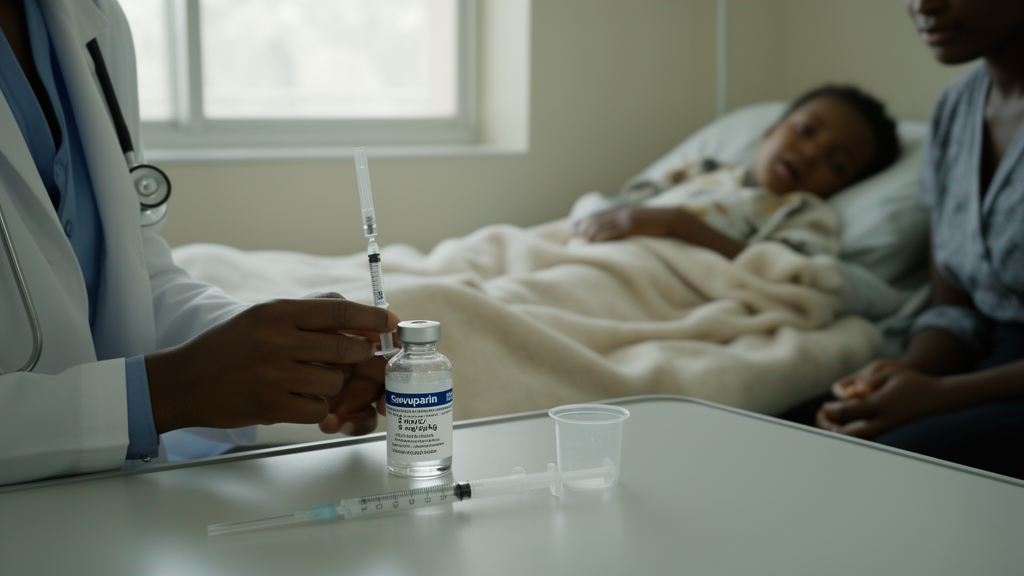
A small phase I trial in Zambia and Kenya has identified 3 mg/kg per infusion as the maximum tolerated dose of sevuparin for further investigation in children hospitalised with severe malaria. Investigators administered the heparin-like compound as an adjunct to standard treatment, including intravenous artesunate, and used a continual reassessment method to adjust doses as coagulation results accumulated. Twenty-three children were enrolled between September 2022 and March 2025, although three Kenyan participants were excluded from the primary dose-finding analysis because activated partial thromboplastin time measurements were unavailable. Among the 20 children analysed, six experienced dose-limiting coagulation abnormalities at doses of 4, 5 or 6 mg/kg, while no such event occurred at 3 mg/kg. The study was designed to establish safety and a tolerable dose, not to determine whether sevuparin improves survival or other clinical outcomes.
Severe malaria remains a major cause of paediatric hospital admission and death in sub-Saharan Africa. The trial introduction reports that approximately 94% of Plasmodium falciparum cases and 95% of global malaria deaths in 2023 occurred in the World Health Organization African Region. Even with fast-acting artemisinin-based combination therapy, inpatient mortality is estimated at about 7% to 8%, rising to roughly 20% to 25% among children with the most severe form, deep unarousable coma. Treatment options aimed at the microvascular pathology of severe malaria have had a limited evidence base. The authors note that only 33 clinical trials of supportive therapies had been conducted globally over four decades, generally small phase I or II studies that showed no benefit, and several of which were stopped early because of harm.
The biological target for sevuparin is the sequestration of parasite-infected red blood cells in small vessels. Infected erythrocytes can adhere to vascular endothelium and uninfected red cells through PfEMP1, an important parasite adhesion protein. The resulting blockage of the microcirculation is central to severe malaria, while the rapid removal of these cells by the spleen can help explain why mature parasites were rarely detected in the trial. Standard heparin has also been investigated as an adjunct because it binds PfEMP1 and can reduce adhesion in experimental systems. Its clinical record in malaria has been inconsistent, however, and it can produce dangerous changes in coagulation. Sevuparin is chemically modified to remove the pentasaccharide domain responsible for high-affinity binding to antithrombin, greatly reducing anticoagulant activity while retaining the ability to interfere with PfEMP1-mediated adhesion and rosetting.
The open-label, single-arm study enrolled children aged three months to 12 years who were slide-positive for P. falciparum and had clinical severe malaria plus a lactate concentration above 2 mmol/L. Recruitment took place at Kilifi County Hospital in Kenya and, after a protocol amendment, Saint Pauls Hospital in Nchelenge, Zambia. Children with bleeding or coagulation disorders, severe thrombocytopenia and major comorbidities that clinicians considered likely to worsen outcomes were excluded. Sevuparin was given intravenously over five minutes at enrolment and again eight and 16 hours later. The primary toxicity endpoint was an activated partial thromboplastin time, or APTT, above 95 seconds one hour after a dose, corresponding to 2.5 times the upper limit of the normal range used by the trial and grade 3 toxicity under Common Toxicity Criteria version 5.0.3.
Participants were assigned sequentially to dose cohorts, with four children initially receiving 1.5 mg/kg and subsequent cohorts of two receiving progressively adjusted doses. A statistical model and an independent data monitoring committee reviewed toxicity, serious adverse events and other data after each cohort, while laboratory personnel measuring APTT were blinded to dose level. The trial tested 1.5, 3, 4, 4.5, 5 and 6 mg/kg, using an a priori dose-toxicity model informed by earlier adult studies. The model initially selected escalating doses as intended. At 6 mg/kg, both children in the cohort developed dose-limiting toxicity, prompting a reduction to 5 mg/kg; both children at 5 mg/kg also met the stopping criterion. A further reduction to 4 mg/kg again produced two cases, and the final cohort received 3 mg/kg without a dose-limiting event. There was 100% adherence among the 20 children in the primary analysis, and the stopping rules were followed in every case.
Most of the coagulation abnormalities that triggered dose reductions were clinically silent. Six of the 20 analysed children, or 30%, had APTT values above 95 seconds, with two cases at each of 4, 5 and 6 mg/kg. Five had values between 95 and 110 seconds, while one child receiving 5 mg/kg exceeded 110 seconds. The events occurred one hour after the first infusion in two children and one hour after the second infusion in four others; none were recorded 24 hours after enrolment, eight hours after the third dose. The mean APTT at 24 hours was 36 seconds, with a standard deviation of 13.2 seconds. No child experienced bleeding or another adverse clinical event associated with the coagulation threshold. Children meeting the stopping criterion did not receive additional sevuparin doses but remained in follow-up.
The safety analysis found seven grade 3 adverse events among the 20 children in the primary analysis. Six were the laboratory-defined dose-limiting toxicities without clinical complications; the remaining event was high fever with cough. One child was readmitted with anaemia, and one died from complications of malaria. The clinical team and an independent reviewer judged the death unlikely to be related to sevuparin. No neurological sequelae were reported at the day 28 visit. An additional analysis that included all 23 enrolled children produced similar results and added one readmission for convulsions. Sevuparin remains an investigational drug, and these observations establish the selected dose for further study rather than provide evidence of clinical benefit or broad safety in a larger population.
Lactate clearance was examined as a possible endpoint for a later phase II trial. Among 18 children with measurements in the five-to-12-hour window, lactate fell by an average of 1.9 mmol/L, with a standard deviation of 3.1 mmol/L; the mean reduction was also 1.9 mmol/L at 24 hours in 19 children. Five of 18 children, or 28%, reached a lactate of 2 mmol/L or lower around eight hours, and seven of 19, or 37%, did so at 24 hours. Parasite-clearance half-life could be calculated for only five children because three positive blood-film measurements were required. Their geometric mean half-life was six hours, with a 95% confidence interval of 3.5 to 10.4 hours. No mature infected erythrocytes were visible at nine or 24 hours, leaving the trial unable to assess directly whether sevuparin accelerated de-sequestration.
Observed mortality was lower than might have been expected from the children’s initial severity, but the uncontrolled design prevents an efficacy interpretation. One of the 23 enrolled children died, giving mortality of 4.3%, with a 95% confidence interval of 0.1% to 21%. Half of the primary-analysis population had unrousable coma, and 19 of 20 children had a PET score of at least 5, corresponding to an estimated mortality risk of 10% or more. In an observational cohort with coma and metabolic acidosis, mortality was 34% in Nchelenge and 21% in Kilifi. The trial team noted that additional clinical monitoring may have contributed to the low observed mortality, but the study included no control group and was not powered to test whether sevuparin altered mortality. The findings therefore support controlled investigation rather than demonstrate a survival advantage.
Several limitations constrained the study’s mechanistic and clinical assessment. Baseline measurements of renal function and parasite biomass were limited, blood films were collected less frequently than the four-hour interval recommended for estimating parasite clearance, and no blood samples were timed specifically during sevuparin infusions to look for circulating mature parasites. A device intended to measure changes in sublingual microcirculation was not available when the study began. The authors propose a multisite randomised phase II trial with nested pharmacokinetic and pathophysiological studies, more frequent parasitaemia monitoring and parasite staging, and measurements during infusions. Such a trial could compare sevuparin with control treatment while testing whether reduced sequestration or blocked invasion is associated with changes in lactate, parasite kinetics and clinical outcomes. For the present phase I study, the central conclusion is narrower: 3 mg/kg per infusion was the maximum tolerated dose and warrants further controlled investigation in children with severe malaria.
Subject of Research: Phase I safety and dose-finding trial of sevuparin in children hospitalised with severe malaria
Article Title: Sevuparin in children with severe malaria: a phase I safety and dose-finding trial
Article References: Chaponda, M., Gwasupika, J., Connon, R., Tshilab Kabwit, P., Miti, S., Obonyo, N., Gibb, D. M., Williams, T. N., Day, N. P. J., Dondorp, A. M., Walker, A. S., George, E. C., & Maitland, K. (2026). Sevuparin in children with severe malaria: a phase I safety and dose-finding trial. Nature Communications, 17(1), Article 10693. https://doi.org/10.1038/s41467-026-78536-3
Image Credits: AI Generated
DOI: 10.1038/s41467-026-78536-3
Keywords: sevuparin, severe malaria, paediatric trial, dose finding, coagulation, Plasmodium falciparum, microvascular sequestration, lactate clearance, artesunate, children, severe, malaria
Cite Scienmag News
Harold Sullivan. (October 21, 2026). Sevuparin 3 mg/kg dose selected in children with severe malaria. Scienmag. https://scienmag.com/sevuparin-3-mg-kg-dose-selected-in-children-with-severe-malaria/
Harold Sullivan. "Sevuparin 3 mg/kg dose selected in children with severe malaria." Scienmag, 21 October 2026, https://scienmag.com/sevuparin-3-mg-kg-dose-selected-in-children-with-severe-malaria/. Accessed 21 October 2026.
Harold Sullivan. "Sevuparin 3 mg/kg dose selected in children with severe malaria." Scienmag. October 21, 2026. https://scienmag.com/sevuparin-3-mg-kg-dose-selected-in-children-with-severe-malaria/


