


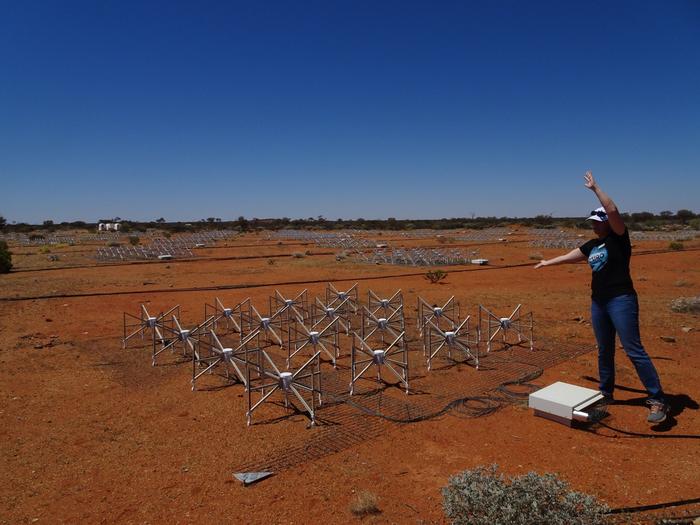
August 26, 2024, Mountain View, CA — The SETI Institute, the Berkeley SETI Research Center and the International Centre for Radio Astronomy Research announced a groundbreaking study using the Murchison Widefield Array (MWA) in Western Australia. Led by Dr. Chenoa Tremblay of the SETI Institute and Prof. Steven Tingay of Curtin University, this research is the first to search for signs of alien technology in galaxies beyond our own, focusing on low radio frequencies (100 MHz). This innovative study used the MWA’s large field of view (FOV), allowing the team to cover about 2,800 galaxies in one observation, of which 1300 we know the distance to. Usually, the search for extraterrestrial intelligence (SETI) has focused on signals within our galaxy. This new approach goes further, looking at distant galaxies. This new approach looks at distant galaxies, making it one of the most detailed searches for super civilizations—those more advanced than ours. To send a signal from another galaxy, a civilization would need technology powerful enough to use the energy of their sun or several stars in their galaxy.

Credit: SETI Institute
August 26, 2024, Mountain View, CA — The SETI Institute, the Berkeley SETI Research Center and the International Centre for Radio Astronomy Research announced a groundbreaking study using the Murchison Widefield Array (MWA) in Western Australia. Led by Dr. Chenoa Tremblay of the SETI Institute and Prof. Steven Tingay of Curtin University, this research is the first to search for signs of alien technology in galaxies beyond our own, focusing on low radio frequencies (100 MHz). This innovative study used the MWA’s large field of view (FOV), allowing the team to cover about 2,800 galaxies in one observation, of which 1300 we know the distance to. Usually, the search for extraterrestrial intelligence (SETI) has focused on signals within our galaxy. This new approach goes further, looking at distant galaxies. This new approach looks at distant galaxies, making it one of the most detailed searches for super civilizations—those more advanced than ours. To send a signal from another galaxy, a civilization would need technology powerful enough to use the energy of their sun or several stars in their galaxy.
“This work represents a significant step forward in our efforts to detect signals from advanced extraterrestrial civilizations,” said Tremblay. “The large field of view and low-frequency range of the MWA makes it an ideal tool for this kind of re- search, and the limits we set will guide future studies.”
While this first study did not find any technosignatures (signs of alien technology), it provides insights that will help focus future searches. It shows how important it is to keep exploring different radio frequencies and using the unique capabilities of telescopes like the MWA.
“The MWA continues to open up new ways of exploring the Universe for intelligent civilizations and technosig- natures, while using the same data to study the astrophysics of stars and galaxies. This work is new and novel, but also paves the way for future observations with even more powerful telescopes,” said Tingay, who is also the Director of the MWA.
This research highlights the importance of working together internationally and using advanced technology to expand our understanding of the Universe. The SETI Institute explores the cosmos for signs of intelligent life and works to increase our knowledge of the universe.
For more information about SETI Institute projects, please visit www.seti.org.
About the SETI Institute
Founded in 1984, the SETI Institute is a non-profit, multi-disciplinary research and education organization whose mission is to lead humanity’s quest to understand the origins and prevalence of life and intelligence in the universe and to share that knowledge with the world. Our research encompasses the physical and biolog- ical sciences and leverages expertise in data analytics, machine learning and advanced signal detection tech- nologies. The SETI Institute is a distinguished research partner for industry, academia and government agen- cies, including NASA and NSF.
Journal
The Astrophysical Journal
Article Title
An Extragalactic Widefield Search for Technosignatures with the Murchison Widefield Array
Cite Scienmag News
Denise Maddox. (August 26, 2024). SETI Institute starts first low frequency search for alien technology in distant galaxies. Scienmag. https://scienmag.com/seti-institute-starts-first-low-frequency-search-for-alien-technology-in-distant-galaxies/
Denise Maddox. "SETI Institute starts first low frequency search for alien technology in distant galaxies." Scienmag, 26 August 2024, https://scienmag.com/seti-institute-starts-first-low-frequency-search-for-alien-technology-in-distant-galaxies/. Accessed 3 September 2026.
Denise Maddox. "SETI Institute starts first low frequency search for alien technology in distant galaxies." Scienmag. August 26, 2024. https://scienmag.com/seti-institute-starts-first-low-frequency-search-for-alien-technology-in-distant-galaxies/

