


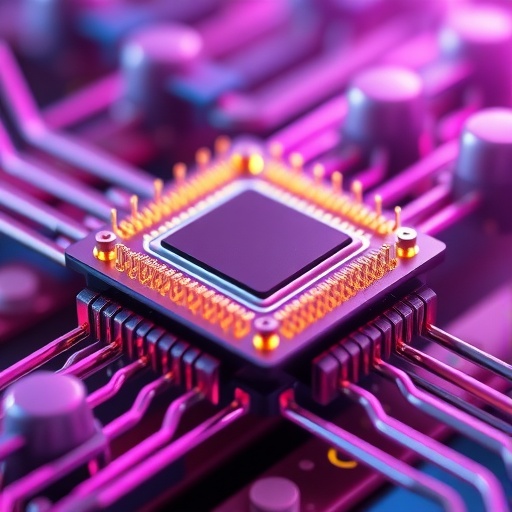
In a remarkable advancement poised to redefine the fields of synthetic biology, diagnostics, and data storage, researchers have unveiled a novel approach to enzymatic DNA synthesis leveraging semiconductor technology. This breakthrough showcases the power of integrating cutting-edge chip design with biochemistry to achieve high-throughput, parallel DNA synthesis—fundamentally transforming how synthetic DNA sequences are produced and potentially democratizing access to this essential technology.
Historically, DNA synthesis has been dominated by phosphoramidite chemistry, a method that, while allowing significant parallelization, necessitates the use of hazardous organic solvents and centralized manufacturing facilities. These constraints have limited the scalability and accessibility of synthetic DNA, impeding rapid innovation outside specialized laboratories. Enzymatic DNA synthesis, on the other hand, employs enzymes in mild aqueous solutions, offering significant improvements in safety and environmental compatibility. Despite its promise, enzymatic approaches have so far struggled to achieve the levels of parallel synthesis required for large-scale applications, often being limited to modest throughput.
The team behind this latest study has successfully harnessed a complementary metal–oxide–semiconductor (CMOS) chip to orchestrate the parallel enzymatic synthesis of up to 64 unique DNA sequences simultaneously. Each generated sequence consists of 38–39 nucleotides, with feature sequences of 10–11 nucleotides, showcasing precise, site-specific nucleotide assembly. This unprecedented integration of semiconductor technology with biochemical synthesis marks a landmark in DNA manufacturing approaches, bringing the promise of scalable enzymatic synthesis closer to reality.
Central to this innovation is a CMOS chip outfitted with 256 ring-electrode pairs, each functioning as an independent synthesis site capable of programmable control. These electrodes enable the creation of localized acidic environments on the chip surface, crucial for the selective deprotection of DNA strands. Deprotection is a pivotal step in DNA synthesis, allowing the stepwise incorporation of nucleotides by enzymatic machinery. Thanks to the chip’s fine-tuned electrochemical capabilities, this process occurs precisely where commanded, enabling distinct DNA sequences to be built in parallel across the array.
The method employed achieves localized acidification indirectly by applying electrical potentials to electrode pairs, which in turn triggers chemical reactions generating acidic conditions limited to specific microenvironments. This controlled acidity facilitates enzymatic nucleotide incorporation with reduced cross-talk between synthesis sites, a major hurdle in creating complex DNA arrays. By carefully choreographing this acidic microenvironment patterned by the chip, the researchers demonstrate that multiple discrete DNA sequences can be synthesized side-by-side without interference.
Beyond the impressive technical achievement, the study also illustrates a compelling practical application: encoding digital information within DNA sequences. As a proof-of-concept, the researchers successfully synthesized DNA strands encoding a 169-byte text message, confirming the synthesis fidelity and viability of their approach for DNA-based data storage. With DNA’s extraordinary density as a storage medium, this capability signals a future in which high-density, error-controlled digital archiving may be driven by accessible enzymatic synthesis platforms.
A key insight from the team’s mechanistic studies highlights the potential benefits of transitioning from indirect to direct local-acid chemistry pathways. While the current indirect approach uses electrical inputs to generate acid indirectly, direct acid generation methods promise higher throughput and more efficient, scalable control over synthesis chemistry. Such improvements could rapidly accelerate synthesis rates and extend the complexity of DNA libraries accessible via compact semiconductor devices.
This integration of semiconductor chip technology with enzymatic synthesis represents a vital step forward in decentralizing DNA production. Conventional phosphoramidite methods require specialized facilities equipped for handling toxic solvents, limiting access predominantly to industrial-scale producers. In contrast, the mild aqueous-based synthesis enabled by CMOS chip patterning may empower labs worldwide—across biomedicine, synthetic biology, and materials science—with portable, safer, and cost-effective DNA manufacturing tools.
The significance of this advance extends into diagnostics as well, where rapid, multiplexed synthesis of DNA probes can enhance the sensitivity and specificity of nucleic acid tests. By programming chips to produce arrays of distinct oligonucleotides rapidly, diagnostics companies could accelerate assay development pipelines while reducing reliance on supply chain bottlenecks inherent in traditional synthesis methods.
Moreover, the demonstrated capability of synthesizing arrays with high spatial precision points to possibilities beyond static DNA synthesis. Future iterations might include dynamic, real-time synthesis guided by external signals or feedback, further expanding the versatility of semiconductor-driven enzymatic synthesis. This flexibility opens doors to on-demand synthesis of functional nucleic acid constructs tailored for precise experimental or therapeutic needs.
While technical challenges remain—such as improving synthesis yield, minimizing error rates, and expanding sequence lengths—the current demonstration firmly establishes a new paradigm where electrical engineering meets enzymology. The power to program chemical synthesis at microscopic scales using chips built on decades of semiconductor innovation could spur a renaissance in synthetic nucleic acids, analogous to the revolution seen with microelectronics.
In sum, by leveraging a CMOS chip’s ability to locally modulate chemical environments for enzymatic reactions, this pioneering study reveals a scalable route to parallel DNA synthesis that overcomes many intrinsic limitations of prior methods. The potential impact spans diverse domains from personalized medicine and synthetic genomics to sustainable manufacturing and ultra-dense data archiving, all enabled by safer, faster, and more accessible DNA synthesis technology.
As this field progresses, the fusion of electronics and biochemistry exemplified here is likely to catalyze new tools and applications for synthetic biology and beyond. This breakthrough not only overcomes longstanding barriers to commercial-scale enzymatic DNA synthesis but also signals the dawn of a new era, wherein digital control systems might directly write biology’s most fundamental molecule with unprecedented agility and precision.
The implications ripple outward: affordable, on-demand DNA manufacturing could democratize synthetic biology globally, providing critical infrastructure for rapid vaccine development, environmental monitoring, and cutting-edge research. By reducing dependence on hazardous chemistries and centralized facilities, this technology lays the groundwork for sustainable, distributed biofabrication networks.
Looking ahead, refinement of chemical protocols, chip architectures, and enzyme engineering will further unlock the promise of electrically driven, massively parallel enzymatic DNA synthesis. This exemplary study charts a clear course toward next-generation DNA synthesis—where biology and silicon converge to rewrite the fabric of life and information, rendering the inaccessible attainable and igniting new horizons across science and technology.
Cite Scienmag News
Denise Maddox. (June 17, 2026). Semiconductor Chip Enables Parallel Enzymatic DNA Synthesis. Scienmag. https://scienmag.com/semiconductor-chip-enables-parallel-enzymatic-dna-synthesis/
Denise Maddox. "Semiconductor Chip Enables Parallel Enzymatic DNA Synthesis." Scienmag, 17 June 2026, https://scienmag.com/semiconductor-chip-enables-parallel-enzymatic-dna-synthesis/. Accessed 4 September 2026.
Denise Maddox. "Semiconductor Chip Enables Parallel Enzymatic DNA Synthesis." Scienmag. June 17, 2026. https://scienmag.com/semiconductor-chip-enables-parallel-enzymatic-dna-synthesis/


