


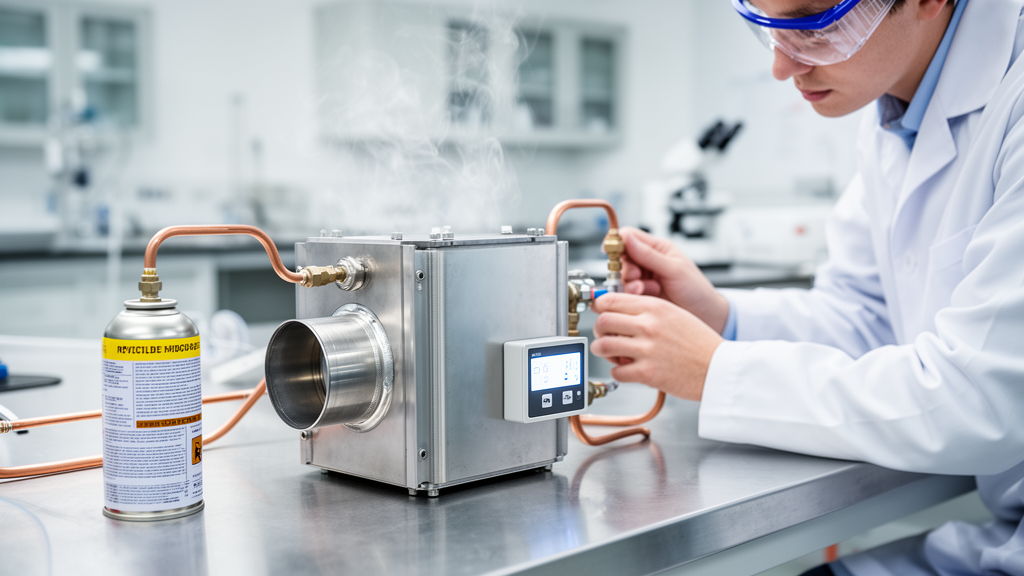
A fuel cell system that keeps itself hot enough to run—without any external heater—has been demonstrated by engineers at Arizona State University, in a study that pairs a thermodynamic model of a micro-scale flame-assisted fuel cell with a working prototype fueled by n-butane. The research, published in Frontiers in Energy Research, tackles one of the stubborn obstacles facing compact solid oxide fuel cells: at very small scales, heat leaks away so quickly that the chemical reactions needed to convert ordinary hydrocarbon fuels into usable fuel simply cannot sustain themselves. By recycling heat from the fuel cell and its exhaust back into the incoming fuel and air, the team showed that a miniature reactor and fuel cell can generate electricity continuously for more than an hour on nothing but butane, air, and their own waste heat.
Solid oxide fuel cells, or SOFCs, are among the most efficient devices for turning chemical energy directly into electricity, outperforming conventional combustion-based heat engines. Their high operating temperatures allow them to consume carbon monoxide and even methane directly, making them attractive for combined heat and power applications. But conventional SOFC systems running on larger hydrocarbons usually need external reformers to break the fuel down into hydrogen and carbon monoxide, along with careful thermal management—both of which add complexity, cost, and bulk. For a technology pitched at portable power and distributed energy, that overhead is a serious liability.
Flame-assisted fuel cells emerged as one way around this problem. In the earliest architecture, the direct flame fuel cell, the cell was placed directly in or immediately above a flame, proving that electrochemical power generation could happen right inside a combustion environment. Later designs moved the reforming step upstream into a separate reaction chamber, giving engineers tighter control over the fuel-to-air ratio and the composition of the reformate gas. The latest iteration couples a micro-scale thermal partial oxidation reactor—a tiny fuel-rich combustor—with micro-tubular SOFCs just a few millimeters across, improving thermal integration and power density while suiting the systems to micro-combined heat and power roles.
The central challenge at these scales is heat. When the reactor is smaller than about two millimeters, heat losses make it difficult to hold the temperature needed for stable, fuel-rich partial oxidation. Heat recirculation offers a fix: hot exhaust gases are routed through a heat exchanger to preheat the incoming reactants, extending the practical operating range of the microscale system. Previous experimental setups, however, generally relied on external heat supplies to keep conditions stable, leaving open the question of whether a fully integrated system could sustain itself. The new study set out to answer that question with both a model and a machine.
The modeling framework is a zero-dimensional thermodynamic description that couples partial oxidation reforming, electrochemical conversion in the fuel cell, tail-gas combustion, and heat recovery. Fuel and air enter at ambient conditions and are preheated in a heat exchanger to 1,073 kelvin before entering the micro-flow reactor, where fuel-rich combustion generates syngas—a mixture of hydrogen and carbon monoxide—alongside water and carbon dioxide. Product compositions in the reactor and the tail-gas combustor are calculated assuming chemical equilibrium, the system is treated as adiabatic, and no pressure drop is assumed. The researchers swept equivalence ratios from 1 to 5, total fuel and air flow rates from 200 to 400 milliliters per minute, and fuel utilizations from 0.3 to 1.0, for methane, propane, and n-butane.
The model’s predictions trace a clear pattern. As the equivalence ratio rises, the equilibrium composition shifts away from fully oxidized products like water and carbon dioxide and toward the electrochemically active species hydrogen and carbon monoxide, with the fastest changes occurring between equivalence ratios of roughly 2 and 3. The reversible cell potential climbs steeply over the same range and then levels off near 0.965 volts beyond an equivalence ratio of about 2.5 to 3, because further enrichment barely changes the partial pressures that govern the Nernst losses. At high equivalence ratios the curves for all three fuels nearly overlap, meaning the reversible potential depends more on the resulting gas composition than on which hydrocarbon went in. Low water fractions at these conditions are also good news for the nickel-based anode, since high water concentrations are known to promote nickel agglomeration and raise polarization resistance.
Electrical efficiency tells a more nuanced story. Efficiency increases with fuel utilization, as a greater share of the available chemical energy is converted electrochemically rather than escaping as unreacted fuel, and it peaks at intermediate-to-high equivalence ratios of roughly 3 to 4 before declining slightly under very fuel-rich conditions—a rollover the authors attribute to falling carbon monoxide concentrations as graphite and other hydrocarbons form in the exhaust. Methane delivers the best performance, with a peak modeled efficiency of approximately 43 percent at full fuel utilization and the highest flow rate, compared with roughly 38 percent for propane and 37 percent for n-butane. Power output rises with both equivalence ratio and flow rate, since higher throughput delivers more reactants, but the gains flatten beyond an equivalence ratio of about 3.5 to 4, indicating that pushing the reactor ever richer buys little.
Perhaps the most practically important result is an operating regime map linking the reactor’s fuel-rich equivalence ratio to the total equivalence ratio of the whole system, which includes the air fed to the fuel cell cathode and the tail-gas combustor. The analysis shows that running the partial oxidation reactor at equivalence ratios above 3 is only thermally viable if the total equivalence ratio stays near stoichiometric conditions, above roughly 0.8. Leaner total conditions demand more enthalpy to preheat the extra cathode air than the fuel-rich reactor can supply. The 400 milliliter-per-minute case offers the widest window of feasible fuel and air ratios, giving the team a concrete boundary for the prototype’s operating limits.
The experimental prototype put those predictions to the test with n-butane. The team fabricated micro-tubular SOFCs with nickel oxide and yttria-stabilized zirconia anode tubes about 4 millimeters in outer diameter, an 18-micrometer YSZ electrolyte, a samaria-doped ceria buffer layer, and an LSCF-based cathode, finishing with cells 3.35 millimeters across. Conditions the model flagged as thermally insufficient proved unstable in practice, with the reactor temperature falling until the tail-gas combustor extinguished—direct validation of the modeled boundary. Sustained operation was ultimately achieved at a total flow rate of 4,505 milliliters per minute and an equivalence ratio of 2.65, corresponding to an estimated total equivalence ratio near 0.9, with the reaction chamber reaching 700 degrees Celsius.
A polarization curve from a single cell showed a power density of 63.8 milliwatts per square centimeter at 0.6 volts, with a measured electrical efficiency of 0.18 percent and fuel utilization of 0.32 percent—low values the authors attribute to the small active area used for preliminary testing and non-optimized flow rates, noting that larger cells should improve performance. No macroscopic soot was found when the cell was inspected after testing, and no voltage degradation appeared during sustained operation. Over a 1.4-hour constant-current test, the system maintained power generation, with slight fluctuations in power density likely caused by an unstable temperature distribution in the reforming tubes. Because heat from the fuel cell and tail-gas combustor was recirculated to preheat the reactor without any external heat source, the demonstration marks a step beyond prior studies—and a foundation for optimizing self-sustained, fuel-flexible micro-combined heat and power systems, with longer-duration testing, more fuels, and closer study of carbon deposition on the anode named as the next priorities.
Subject of Research: Flame-assisted fuel cell system with thermal partial oxidation reformer
Article Title: Performance modeling and experimental validation of a thermally integrated micro-scale thermal partial oxidation reactor and flame-assisted fuel cell system
Article References: Pruthy, A., Demers, G., Jenkins, C., Tian, J., & Milcarek, R. J. (2026). Performance modeling and experimental validation of a thermally integrated micro-scale thermal partial oxidation reactor and flame-assisted fuel cell system. Frontiers in Energy Research, 14, Article 1958573. https://doi.org/10.3389/fenrg.2026.1958573
Image Credits: AI Generated
DOI: 10.3389/fenrg.2026.1958573
Keywords: solid oxide fuel cells, flame-assisted fuel cell, partial oxidation, heat recirculation, micro-combustion, n-butane, methane, propane, combined heat and power, Arizona State University, Performance, modeling
Cite Scienmag News
Faith Mcneil. (October 23, 2026). Self-Sustaining Fuel Cell Runs on Butane With Recycled Heat in Breakthrough Demo. Scienmag. https://scienmag.com/self-sustaining-fuel-cell-runs-on-butane-with-recycled-heat-in-breakthrough-demo/
Faith Mcneil. "Self-Sustaining Fuel Cell Runs on Butane With Recycled Heat in Breakthrough Demo." Scienmag, 23 October 2026, https://scienmag.com/self-sustaining-fuel-cell-runs-on-butane-with-recycled-heat-in-breakthrough-demo/. Accessed 23 October 2026.
Faith Mcneil. "Self-Sustaining Fuel Cell Runs on Butane With Recycled Heat in Breakthrough Demo." Scienmag. October 23, 2026. https://scienmag.com/self-sustaining-fuel-cell-runs-on-butane-with-recycled-heat-in-breakthrough-demo/


