Thursday, October 29, 2026
Science
No Result
View All Result
  • Login
  • HOME
  • SCIENCE NEWS
  • CONTACT US
  • HOME
  • SCIENCE NEWS
  • CONTACT US
No Result
View All Result
Scienmag
No Result
View All Result
Home Science News Technology and Engineering

Self-supervised deep learning spots cotton leaf diseases with explainable heatmaps

October 29, 2026
in Technology and Engineering
Blake Davidson
By Blake Davidson Scienmag Editorial Profile - Data Science
Reading Time: 3 mins read
0
Self-supervised deep learning spots cotton leaf diseases with explainable heatmaps

Self-supervised deep learning spots cotton leaf diseases with explainable heatmaps

65
SHARES
587
VIEWS
Share on FacebookShare on Twitter
ADVERTISEMENT

Cotton, often called “white gold,” loses quality and yield to a range of leaf diseases, including Alternaria leaf spot, bacterial blight, curl virus and other stress-related conditions. Diagnosing these problems traditionally depends on expert knowledge and manual inspection, a process the authors describe as labor-intensive, subjective and error-prone. A new study in Neural Computing and Applications presents a deep learning framework that aims to automate this diagnosis while requiring fewer labeled images and explaining its own decisions.

The work, published on 20 October 2026 as Volume 38, article number 827, was carried out by Anjali Singh, Padma Nilesh Mishra and Garima Singh. Their approach combines three ingredients: self-supervised learning (SSL) for pretraining, a supervised convolutional neural network (CNN) for classification, and an explainable AI technique called Gradient-weighted Class Activation Mapping, or Grad-CAM.

The central problem the researchers set out to address is the heavy dependence of most current plant-disease models on large labeled datasets.

To reduce that dependence, the framework first applies self-supervised contrastive pretraining to a set of unlabelled cotton leaf images. In this stage the network learns general and distinctive feature representations without any disease labels, essentially teaching itself what visually distinguishes one leaf from another. These pretrained representations are then fine-tuned with labeled data to classify multiple types of cotton leaf diseases.

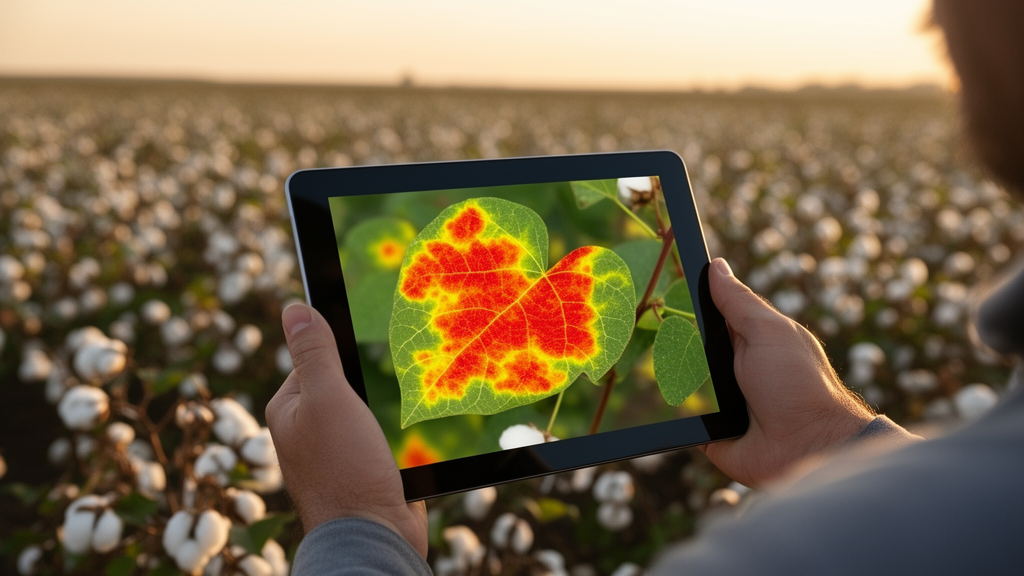
Transparency is handled by Grad-CAM, which generates visual heatmaps overlaid on the leaf images. These heatmaps highlight the areas affected by disease, allowing domain experts to check whether the model is attending to biologically meaningful regions rather than background artifacts. According to the authors, the visualizations confirm that the model targets biologically relevant areas, which they argue boosts understanding and user trust.

The framework was evaluated on the SAR-CLD-2024 cotton leaf dataset, which contains 2,137 labeled images spanning seven classes, plus a separate unlabeled subset of 565 images reserved for self-supervised pretraining. The dataset deliberately reflects the messiness of real-world agriculture, showing class imbalance, natural variability and real-field imaging conditions rather than clean laboratory photographs.

The reported results are strong. The framework reaches a validation accuracy of up to 94.38 percent and achieves strong precision, recall and F1-scores across all disease classes. The authors state that this performance exceeds that of several leading supervised and transfer learning models they compared against.

Beyond raw accuracy, the study’s broader claim is practical: by pairing self-supervised pretraining with explainable outputs, the framework lowers the need for large labeled datasets, increases robustness and generalization, and offers what the authors call a practical solution for accurate and understandable cotton leaf disease detection in real-world farming situations.

As with any single-dataset evaluation, however, performance on other cotton varieties, regions and imaging setups remains to be demonstrated, and the reported accuracy reflects validation on this particular benchmark rather than an independent field deployment.

Subject of Research: Self-supervised deep learning with Grad-CAM explainability for detecting cotton leaf diseases

Article Title: Deep learning-based detection of cotton leaf diseases using self-supervised feature learning and Grad-CAM visualization

Article References: Singh, A., Mishra, P. N., & Singh, G. (2026). Deep learning-based detection of cotton leaf diseases using self-supervised feature learning and Grad-CAM visualization. Neural Computing and Applications, 38(20), Article 827. https://doi.org/10.1007/s00521-026-12586-y

Image Credits: AI Generated

DOI: 10.1007/s00521-026-12586-y

Keywords: deep learning, cotton leaf diseases, self-supervised learning, Grad-CAM, explainable AI, convolutional neural networks, plant disease detection, SAR-CLD-2024, agriculture, contrastive pretraining, Deep, learning-based

Cite Scienmag News

Blake Davidson. (October 29, 2026). Self-supervised deep learning spots cotton leaf diseases with explainable heatmaps. Scienmag. https://scienmag.com/self-supervised-deep-learning-spots-cotton-leaf-diseases-with-explainable-heatmaps/

Blake Davidson. "Self-supervised deep learning spots cotton leaf diseases with explainable heatmaps." Scienmag, 29 October 2026, https://scienmag.com/self-supervised-deep-learning-spots-cotton-leaf-diseases-with-explainable-heatmaps/. Accessed 29 October 2026.

Blake Davidson. "Self-supervised deep learning spots cotton leaf diseases with explainable heatmaps." Scienmag. October 29, 2026. https://scienmag.com/self-supervised-deep-learning-spots-cotton-leaf-diseases-with-explainable-heatmaps/
Tags: agricultureAI-based cotton leaf stress detectionautomatic plant disease diagnosis with explainabilityautonomous plant disease classificationcontrastive pretrainingcontrastive pretraining for unlabelled crop imagesconvolutional neural networksconvolutional neural networks for agriculturecotton leaf disease detectioncotton leaf diseasesDeepdeep learningdeep learning for cotton disease identificationexplainable AIexplainable AI for plant disease diagnosisGrad-CAMGrad-CAM heatmaps for cotton disease visualizationlearning-basedplant disease detectionreducing labeled data reliance in plant health monitoringSAR-CLD-2024self-supervised deep learning in agricultureself-supervised learningtextile crop disease recognition using deep learning
Share26Tweet16
Previous Post

Point-of-care urine Gram staining linked to narrower antibiotic prescribing in febrile urinary tract infections

Next Post

TCTP and Mcl-1 Proteins Rise in Chronic Lymphocytic Leukemia, Study Finds

Related Posts

Lead-based optoelectronics move toward monolithic integration with silicon chips
Technology and Engineering

Lead-based optoelectronics move toward monolithic integration with silicon chips

October 29, 2026
Simple, Repairable Yb-Doped Fiber Amplifier Delivers Over 10 Watts for Harsh Radiation Environments
Technology and Engineering

Simple, Repairable Yb-Doped Fiber Amplifier Delivers Over 10 Watts for Harsh Radiation Environments

October 29, 2026
Phase-Separating Amine Solvents Could Slash the Energy Cost of CO2 Capture
Climate

Phase-Separating Amine Solvents Could Slash the Energy Cost of CO2 Capture

October 29, 2026
AI Learns to Fly a Twin-Rotor Helicopter in Simulation Using Twin Delayed DDPG
Technology and Engineering

AI Learns to Fly a Twin-Rotor Helicopter in Simulation Using Twin Delayed DDPG

October 29, 2026
Architecture’s New Philosophy: Matter That Thinks, Feels and Resonates
Technology and Engineering

Architecture’s New Philosophy: Matter That Thinks, Feels and Resonates

October 29, 2026
Chrome-free leather biodegrades faster in soil, reshaping microbial communities
Technology and Engineering

Chrome-free leather biodegrades faster in soil, reshaping microbial communities

October 29, 2026
Next Post
TCTP and Mcl-1 Proteins Rise in Chronic Lymphocytic Leukemia, Study Finds

TCTP and Mcl-1 Proteins Rise in Chronic Lymphocytic Leukemia, Study Finds

  • Mothers who receive childcare support from maternal grandparents show more optimized

    Mothers who receive childcare support from maternal grandparents show more parental warmth, finds NTU Singapore study

    27656 shares
    Share 11059 Tweet 6912
  • University of Seville Breaks 120-Year-Old Mystery, Revises a Key Einstein Concept

    1061 shares
    Share 424 Tweet 265
  • Bee body mass, pathogens and local climate influence heat tolerance

    682 shares
    Share 273 Tweet 171
  • Researchers record first-ever images and data of a shark experiencing a boat strike

    546 shares
    Share 218 Tweet 137
  • Groundbreaking Clinical Trial Reveals Lubiprostone Enhances Kidney Function

    531 shares
    Share 212 Tweet 133
Science

Embark on a thrilling journey of discovery with Scienmag.com—your ultimate source for cutting-edge breakthroughs. Immerse yourself in a world where curiosity knows no limits and tomorrow’s possibilities become today’s reality!

RECENT NEWS

  • Lead-based optoelectronics move toward monolithic integration with silicon chips
  • Review maps deep learning tools to real clinical tasks in pathology
  • AI Learns Grid Physics From Millions of Solver-Generated Perturbation Responses
  • Simplified Police Bail Notice Boosts Court Attendance in New Zealand Trial

Categories

  • Agriculture
  • Anthropology
  • Archaeology
  • Athmospheric
  • Biology
  • Biotechnology
  • Blog
  • Bussines
  • Cancer
  • Chemistry
  • Climate
  • Earth Science
  • Editorial Policy
  • Marine
  • Mathematics
  • Medicine
  • Pediatry
  • Policy
  • Psychology & Psychiatry
  • Science Education
  • Science News
  • Social Science
  • Space
  • Technology and Engineering

Subscribe to Blog via Email

Enter your email address to subscribe to this blog and receive notifications of new posts by email.

Join 5,150 other subscribers

© 2025 Scienmag - Science Magazine

Welcome Back!

Login to your account below

Forgotten Password?

Retrieve your password

Please enter your username or email address to reset your password.

Log In
No Result
View All Result
  • HOME
  • SCIENCE NEWS
  • CONTACT US

© 2025 Scienmag - Science Magazine

Discover more from Science

Subscribe now to keep reading and get access to the full archive.

Continue reading