


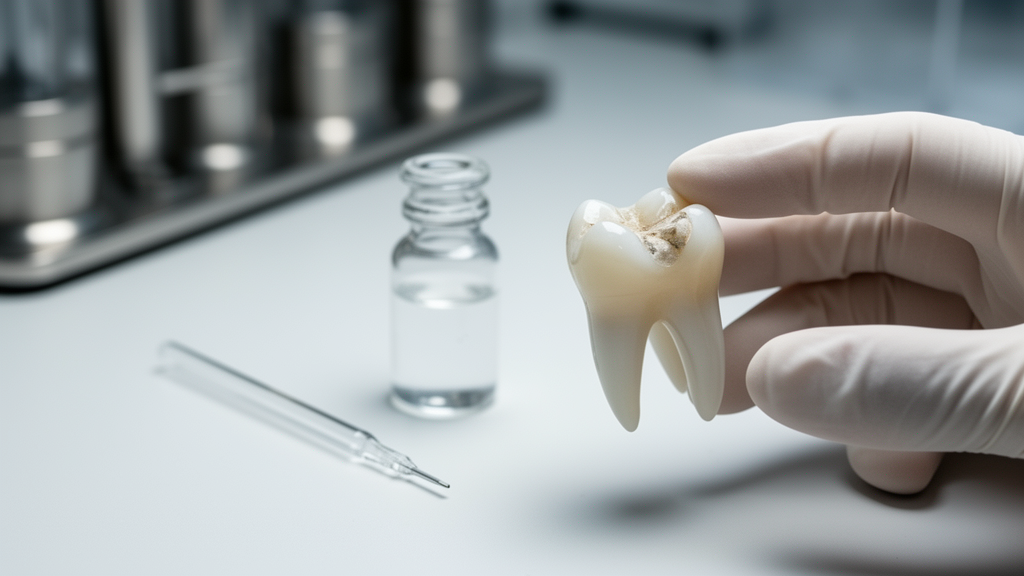
A chalky white blemish on a teenager’s front tooth may look like a cosmetic nuisance, but to a dentist it is a warning sign. White spot lesions are the earliest visible stage of tooth decay, where acid-producing bacteria have stripped minerals from beneath the enamel surface without yet breaking it. Caught early, these lesions can theoretically heal; left alone, they can collapse into cavities that require drilling and filling. Now researchers at the Medical University of Warsaw have designed a rigorous clinical trial to test whether a remarkable biomimetic material—a self-assembling peptide known as P11-4—can genuinely regenerate enamel, and, crucially, whether one application is enough or whether patients need a top-up dose.
The trial, described in a study protocol published in Frontiers in Oral Health, is registered as NCT07664046 and approved by the Bioethics Committee of the Medical University of Warsaw. It will enroll 75 adolescents aged over 10 and under 18, each carrying at least two active white spot lesions on the smooth, visible surfaces of permanent teeth. Participants will be randomly divided into three equal groups of 25. Group A will receive a single application of the peptide gel together with a standard fluoride varnish. Group B will receive the peptide twice—once at the start of the study and again three months later—plus the same varnish. Group C, the control, will receive fluoride varnish alone. Everyone will be followed for a full year.
The science behind the peptide is what makes this trial worth watching. P11-4 is a short chain of amino acids that exists as free-floating monomers in a liquid formulation. When applied to a demineralized tooth surface, the molecules respond to the local environment and spontaneously assemble into a three-dimensional fibrous matrix—a kind of biological scaffold. This matrix has a high affinity for hydroxyapatite, the mineral that makes up enamel, and it acts as a nucleation point: it draws calcium and phosphate ions out of saliva and organizes them into new hydroxyapatite crystals within the lesion itself. In effect, the material hijacks the tooth’s own natural remineralization chemistry and gives it a template to rebuild on, potentially reaching deep into the subsurface body of the lesion where conventional fluoride treatments often fall short.
That depth matters. Topical fluoride, casein phosphopeptide products, and resin infiltration have all been proposed for white spot lesions, but many of these approaches mainly harden the outermost surface. A remineralized crust can seal mineral inside the lesion while the deeper demineralized zone persists, sometimes even blocking the pathway for further repair. Prior laboratory and clinical studies suggest P11-4 can inhibit the progression of early carious lesions and even shrink them, and that its effect is enhanced when combined with fluoride varnish. Yet the evidence base has gaps: follow-up periods have been short, and no randomized trial has ever directly compared a single application against repeated applications in the same study. One influential study by Güven and colleagues found that the benefit of a single peptide application was clear at three months but had faded relative to a fluoride comparator by six months—a hint that a booster dose might be needed.
Measuring whether enamel is actually healing is a technical challenge in its own right. The Warsaw team will rely on quantitative light-induced fluorescence, or QLF, a light-based imaging technique that has transformed early caries detection. Healthy enamel fluoresces when illuminated at specific wavelengths; demineralized enamel scatters light and loses fluorescence in proportion to its mineral loss. The researchers will track two key parameters: ΔF, the percentage fluorescence loss relative to sound enamel, which reflects lesion depth, and ΔQ, a lesion-volume measure expressed in percent times square millimeters that combines lesion area with severity. More negative values indicate worse lesions, so a shift toward zero over time signals genuine remineralization. Because these measurements are quantitative and non-invasive, they can be repeated at every visit without harming the tooth.
The primary endpoint is the change in ΔQ from baseline to six months, comparing the repeated-application group against the single-application group. Secondary endpoints include fluorescence loss, lesion area, and clinical lesion activity scores at 3, 6, 9, and 12 months, assessed with the International Caries Detection and Assessment System II and two lesion-activity classification schemes. The team will also monitor plaque and gingival indices, saliva pH, and unstimulated salivary flow rate—variables that could confound remineralization, since saliva supplies the calcium and phosphate ions the peptide scaffold is meant to organize. Patient-reported tolerability will be captured with a visual analogue scale, and any adverse events will be recorded throughout the year.
The application procedure itself is deliberately simple. The tooth surface is first cleaned of pellicle with a 2% sodium hypochlorite solution, then etched with 35% phosphoric acid for twenty seconds to open the porous lesion to the outside. The peptide gel is applied with a saturated sponge applicator and left in contact with the lesion for about five minutes, during which the patient must not rinse. Five minutes later, fluoride varnish is painted over all the teeth. The entire visit takes roughly half an hour. Strict blinding is built into the design: two unblinded investigators deliver the treatments and record adverse events, while a third investigator, kept ignorant of group assignments for the entire study, performs all QLF assessments. Statistical analysis will use linear mixed-effects models to handle the fact that each patient contributes multiple lesions and repeated measurements over time.
The trial is not without limitations, which the authors acknowledge candidly. Diet and oral hygiene habits cannot be fully controlled over twelve months, although all participants receive standardized brushing instructions and dietary counselling. No universally accepted minimal clinically important difference exists for QLF parameters in white spot lesions, so statistical changes in ΔQ will be interpreted alongside clinical lesion assessments rather than in isolation. The sample-size calculation also had to lean on effect estimates from a comparison of peptide versus fluoride, since no prior data exist for the single-versus-repeated question at the heart of this trial. Still, the design addresses a genuine and consequential gap in the evidence.
The stakes are higher than they might appear. Adolescents with fixed braces, sugary diets, or imperfect brushing are prime candidates for white spot lesions, and once cavitation occurs the only options are invasive restorations that weaken teeth for life. If repeated peptide applications prove superior, dentists would gain a cheap, quick, drill-free protocol for reversing decay at its earliest stage—and the trial’s results, expected after study completion in July 2027, could reshape preventive dentistry for young patients. If a single application suffices, treatment becomes even simpler. Either answer will be valuable, and the study’s combination of a biomimetic regenerative material with quantitative fluorescence imaging offers a template for how early caries research should be done: measure the mineral, not just the appearance, and let the data decide how often the scaffold needs to be rebuilt.
Subject of Research: A randomized controlled trial of single versus repeated self-assembling peptide P11-4 application for remineralizing enamel white spot lesions in adolescents
Article Title: Three-arm randomized controlled trial evaluating the effectiveness of the self-assembling peptide P11-4 in the remineralization of enamel carious white spot lesions: a study protocol
Article References: Turska-Szybka, A., Sazonowa, J., Olczak-Kowalczyk, D., Wójcik-Gront, E., & La Rosa, G. R. M. (2026). Three-arm randomized controlled trial evaluating the effectiveness of the self-assembling peptide P11-4 in the remineralization of enamel carious white spot lesions: a study protocol. Frontiers in Oral Health, 7, Article 1932140. https://doi.org/10.3389/froh.2026.1932140
Image Credits: AI Generated
DOI: 10.3389/froh.2026.1932140
Keywords: self-assembling peptide P11-4, enamel remineralization, white spot lesions, quantitative light-induced fluorescence, randomized controlled trial, fluoride varnish, preventive dentistry, hydroxyapatite, adolescent dental health, caries management, biomimetic materials, Curodont Repair
Cite Scienmag News
Ophelia Keating. (October 16, 2026). Self-Assembling Peptide P11-4 Goes on Trial: Can One Dose Rebuild Tooth Enamel? Scienmag. https://scienmag.com/self-assembling-peptide-p11-4-goes-on-trial-can-one-dose-rebuild-tooth-enamel/
Ophelia Keating. "Self-Assembling Peptide P11-4 Goes on Trial: Can One Dose Rebuild Tooth Enamel?" Scienmag, 16 October 2026, https://scienmag.com/self-assembling-peptide-p11-4-goes-on-trial-can-one-dose-rebuild-tooth-enamel/. Accessed 16 October 2026.
Ophelia Keating. "Self-Assembling Peptide P11-4 Goes on Trial: Can One Dose Rebuild Tooth Enamel?" Scienmag. October 16, 2026. https://scienmag.com/self-assembling-peptide-p11-4-goes-on-trial-can-one-dose-rebuild-tooth-enamel/


