


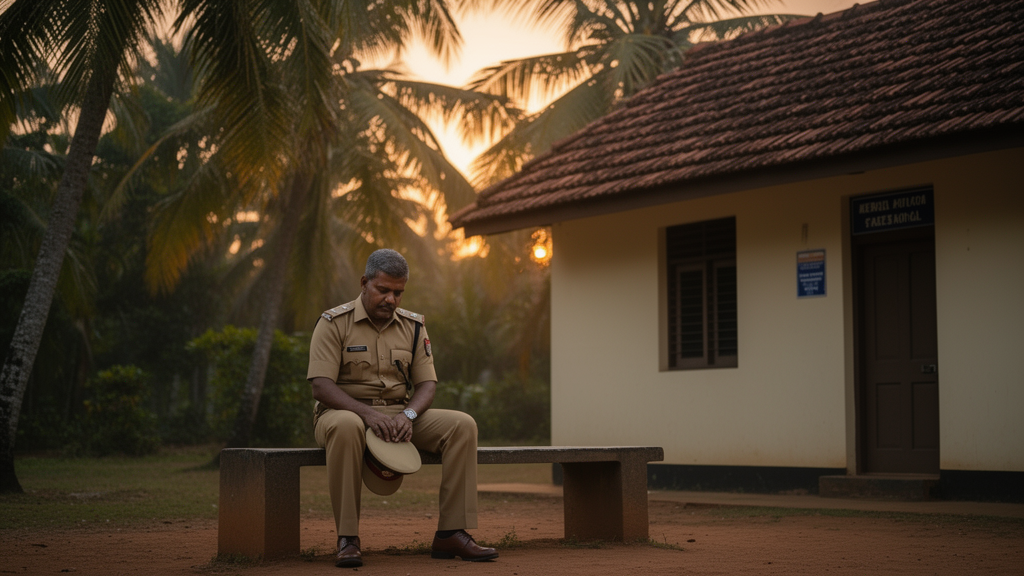
Nearly one in ten police personnel in the southern Indian state of Kerala reported suicidal thoughts during the past year, and roughly one in twenty-five reported some form of suicidal behavior, according to a new cross-sectional study published in Frontiers in Public Health. The research, conducted among 400 officers serving in fifteen police stations across two districts, offers one of the most detailed portraits yet of suicide risk within a police force in a state that already carries one of the heaviest suicide burdens in India. The findings arrive at a moment when occupational mental health is moving from the margins of public health research to its center, and they suggest that the people entrusted with responding to society’s crises may be quietly carrying crises of their own.
The study was led by researchers at the Department of Public Health, Amrita School of Medicine, Amrita Vishwa Vidyapeetham in Kochi, who set out to fill a conspicuous gap in the evidence. Although police work is widely recognized as psychologically demanding, and although Kerala has long recorded suicide rates far above the Indian national average, no rigorous estimates of suicidal ideation and suicidal behavior among the state’s police had been available. The team recruited participants from fifteen police stations in Ernakulam and Malappuram districts, drawing on a multistage cluster sampling design that selected stations at random within two administrative strata: Malappuram District Police in northern Kerala and the Kochi City Police Commissionerate in central Kerala. The final sample of 400 personnel ranged in rank from Civil Police Officers to Inspectors, had a mean age of 37.94 years, and was 81 percent male.
Methodologically, the study leaned on the Columbia-Suicide Severity Rating Scale, or C-SSRS, a widely used clinical instrument that probes suicidal thinking across five escalating levels, from a passive wish to be dead up to active ideation with a specific plan and intent. The researchers adapted the scale’s reference period to the past twelve months and translated it into Malayalam with back-translation to check consistency. Suicidal behavior was captured across four categories: actual attempts, interrupted attempts, aborted or self-interrupted attempts, and preparatory acts. Participants completed the questionnaire privately within their stations, a design choice intended to reduce the influence of stigma and social desirability, though the authors acknowledge it cannot eliminate them.
The headline numbers are sobering. The survey-weighted prevalence of suicidal ideation over the previous year was 9.39 percent, with a 95 percent confidence interval of 6.18 to 14.01 percent. Suicidal behavior was reported by 4.11 percent of participants, and actual suicide attempts by 1.47 percent. Among the 36 personnel who reported suicidal ideation, 13.56 percent described the most severe form: active ideation with a specific plan and intent. A wish to be dead was the most common manifestation of ideation, reported by 32 participants. Interrupted attempts, aborted attempts, and preparatory behaviors were each more common than completed attempts, a pattern that underscores how many moments of crisis hover just short of a lethal outcome, and how much preventive opportunity may exist in those margins.
To identify who was most at risk, the researchers used survey-weighted generalized linear models with a Poisson distribution and log link, estimating adjusted prevalence ratios that account for the clustered sampling design. The results paint a consistent picture of cumulative occupational strain. Personnel older than 36 years had nearly three times the prevalence of suicidal ideation compared with younger colleagues, with an adjusted prevalence ratio of 2.90. Civil Police Officers, the frontline rank that handles the bulk of public interaction and emergency response, showed 2.31 times the prevalence of ideation and a striking 12.32 times the prevalence of suicidal behavior compared with higher ranks. Working more than twelve hours per day raised the prevalence of ideation by 67 percent, and a self-reported history of psychiatric illness was associated with elevated risk for both outcomes.
The most dramatic estimates clustered around two exposures. Personnel with more than fifteen years of service had an adjusted prevalence ratio of 13.82 for suicidal behavior, and those reporting workplace violence or harassment had a ratio of 13.81. The authors are careful to flag that these figures come from sparse data, only 14 participants reported any suicidal behavior, and the deliberately restricted four-variable model cannot rule out instability or overestimation. Still, the direction of the associations aligns with a substantial international literature. Studies among police in Canada, and large multicohort analyses in Europe, have linked chronic occupational stress, sleep disturbance, bullying, and workplace violence to elevated suicide risk, suggesting the Kerala findings reflect mechanisms rather than statistical artifacts.
Why might frontline rank and long service carry such weight? The researchers point to the structure of policing in Kerala, where Civil Police Officers face continuous public contact, law-and-order disturbances, and unpredictable emergencies requiring rapid decisions under pressure, often with limited opportunity for recovery between incidents. Nearly all participants, 97.70 percent, reported exposure to traumatic events during their service, including violence, deaths, and disasters. Age and years of service were so strongly correlated, with a Pearson coefficient of 0.95, that the team could not include both in the same model, but they interpret the two measures as complementary signals of the same underlying phenomenon: prolonged, cumulative exposure to occupational stress that may gradually erode psychological resilience.
The context of Kerala sharpens the significance of these numbers. According to the National Crime Records Bureau, the state recorded 10,972 suicides in 2023, a rate of 30.6 per 100,000 population, more than double the national average of 12.3. Kerala has achieved some of India’s best health and literacy indicators, yet its suicide burden remains persistently high, a paradox that has puzzled researchers for decades. Within that landscape, police personnel face a distinctive combination of stressors: long hours, weekly night duty reported by 96 percent of the sample, demanding public interactions, and high societal expectations. Compounding the problem, 88.60 percent of participants said no psychological support was available at their workplace, and stigma around mental health in uniformed services is well documented as a barrier to help-seeking.
The authors are transparent about the study’s limits. The cross-sectional design cannot establish whether the identified factors preceded the suicidal outcomes, and reverse causation cannot be excluded. Individual-level recruitment depended on personnel being available during data-collection visits rather than random selection, so an exact response rate could not be calculated and selection bias cannot be ruled out. All measures were self-reported, and the sensitive nature of the questions may have driven under-reporting despite privacy safeguards. The 15 stations came from only two administrative settings, and the small number of primary sampling units limited the precision of variance estimates. The authors also note that depression, anxiety, post-traumatic stress, burnout, and hopelessness were not measured with dedicated validated instruments, leaving residual confounding possible.
Even with those caveats, the public health implications are concrete. The researchers call for routine confidential mental health screening within the police force, timely treatment and follow-up for personnel with psychiatric histories, measures to reduce excessive working hours, and active prevention of workplace violence and harassment. They also recommend strengthening peer-support programs, training supervisors in mental health literacy, and integrating occupation-specific services into existing Kerala Police welfare structures, building on state initiatives such as the District Mental Health Program, Tele-MANAS, and the Aswasam depression program. Kerala’s police force numbers roughly 57,000 personnel; if the study’s prevalence estimates hold across that workforce, tens of thousands of officers’ colleagues, families, and communities are touched by this silent burden. The study’s central message is that suicide prevention in policing cannot rest on individual courage alone. It requires organizational change, workloads that permit rest, workplaces free of violence, and support systems an officer can use without fear that asking for help will end a career.
Subject of Research: Suicidal ideation and behavior among police personnel in Kerala, India
Article Title: Prevalence and factors associated with suicidal ideation and suicidal behavior among police personnel in Kerala, India: a cross-sectional study
Article References: Sasi, A., Ravi, R., Olickal, J. J., & Thankappan, K. R. (2026). Prevalence and factors associated with suicidal ideation and suicidal behavior among police personnel in Kerala, India: a cross-sectional study. Frontiers in Public Health, 14, Article 1949658. https://doi.org/10.3389/fpubh.2026.1949658
Image Credits: AI Generated
DOI: 10.3389/fpubh.2026.1949658
Keywords: suicidal ideation, suicidal behavior, police personnel, Kerala, India, occupational stress, C-SSRS, cross-sectional study, workplace violence, mental health, public health, prevalence
Cite Scienmag News
Ophelia Keating. (October 16, 2026). Nearly One in Ten Police Officers in Kerala Reports Suicidal Thoughts, Study Finds. Scienmag. https://scienmag.com/nearly-one-in-ten-police-officers-in-kerala-reports-suicidal-thoughts-study-finds/
Ophelia Keating. "Nearly One in Ten Police Officers in Kerala Reports Suicidal Thoughts, Study Finds." Scienmag, 16 October 2026, https://scienmag.com/nearly-one-in-ten-police-officers-in-kerala-reports-suicidal-thoughts-study-finds/. Accessed 16 October 2026.
Ophelia Keating. "Nearly One in Ten Police Officers in Kerala Reports Suicidal Thoughts, Study Finds." Scienmag. October 16, 2026. https://scienmag.com/nearly-one-in-ten-police-officers-in-kerala-reports-suicidal-thoughts-study-finds/


